Exhaust parts in the UAE: catalytic converters, pipes, silencers and sensors, and how to order the right one
The quick answer
An exhaust system is a chain of separately bought parts: the manifold, front pipe, catalytic converter with an oxygen sensor on each side, connecting pipe, silencer and tailpipe, plus flex joints, gaskets, clamps and mounting parts, and on diesels and some newer petrol cars a particulate filter. Every part is matched to the car by chassis number and engine code, and the converter and the particulate filter need extra care. BM Catalysts, a converter maker, says the housings for cars built to different Euro levels can be identical while the internals differ, so the approval has to cover your car and its emission level. A code such as P0420 does not prove the converter has failed, because it is set from oxygen sensor readings. We publish no prices because we hold no dated quotes. Send the chassis number, the engine code and a photo of the part's markings on WhatsApp and matched suppliers quote against them.
Ask a human · free · no account
Not sure which part fits your car?
Tell us the make, model and year — we check fitment and come back with prices from UAE sellers who have it on the shelf.
Free · usually a reply in minutes · no obligation
Key facts
- Gas leaves the engine through the exhaust manifold, passes down a front pipe to the catalytic converter, then through a connecting pipe to the silencer, also called the back box, and out of the tailpipe. BM Catalysts catalogues the front pipe as the part joining the manifold to the converter and the connecting pipe as the one joining the converter to the back box.
- A three-way catalytic converter reduces three pollutants, hydrocarbons, carbon monoxide and nitrogen oxides, and works only while the engine holds the air and fuel mixture at about lambda 1. HJS Emission Technology says the engine control unit does that using the oxygen content measured by a lambda sensor, so the sensors before and after the converter are part of how it is controlled and checked.
- A replacement converter has to be approved for the vehicle and its Euro level. BM Catalysts says it is not uncommon for the external housing and pipework of parts approved to different Euro levels to be the same while the internal specification and the approval are not, so a part that physically fits can still be the wrong one.
- The UAE's Ministry of Industry and Advanced Technology requires new models imported from 1 January 2026 to meet at least Euro 6B, and all imported light and heavy vehicles to meet at least Euro 6B or equivalent from 1 July 2027. That guideline covers new vehicles, and we found no UAE rule on replacement converters, so this page states none.
- A P0420 or P0430 code reports the converter below its efficiency threshold on bank 1 or bank 2. BM Catalysts says the code is set from oxygen sensor readings rather than measured emissions, and lists exhaust leaks, manifold damage, a misfire, a leaking injector and faulty sensors or wiring among the causes to rule out first.
- Oxygen sensor types are not interchangeable: NTK says zirconia and titania sensors cannot be swapped, and nor can air-fuel ratio and wide band sensors. Bosch's 2018 aftermarket brochure recommends checking lambda sensors every 30,000 km.
- A diesel particulate filter is a soot trap rather than a flow-through part. BM Catalysts says a blocked filter is rarely the filter's own fault, and that a new filter fitted without finding why regeneration failed can fail again in under 300 miles, about 480 km.
- We hold no dated exhaust quotes, so the page publishes no prices, and we have not recorded exhaust stock shop by shop.
Rather fill in a form? Send the same request here and matched UAE suppliers reply on WhatsApp either way.
Open the request formExhaust — types and specifications
- Three-way catalytic converter
- Ceramic honeycomb coated with platinum-group metals; approved for the car's emission level
- Diesel oxidation catalyst
- Works alongside the particulate filter on diesels
- Diesel particulate filter (DPF)
- A soot trap in cordierite or silicon carbide, cleared by regeneration
- Petrol particulate filter (GPF)
- A soot filter for direct-injection petrol engines; coated ones act as four-way catalysts
- Front pipe
- Joins the manifold to the catalytic converter
- Connecting pipe
- Joins the converter to the back box
- Flex joint
- Standard, inner braided or strengthened; sold by diameter and length
- Silencer (back box)
- Aluminised or stainless steel; a small weep hole is normal
- Upstream oxygen sensor
- The control sensor before the converter, sensor 1 on its bank
- Downstream oxygen sensor
- The diagnostic sensor after the converter, sensor 2 on its bank
- DPF pressure pipe
- Thin tubes to the differential pressure sensor; replace with the filter
- Exhaust gasket
- Seals the manifold and other joints in the line
- Fitting kit
- Gaskets, clamps, washers, springs, nuts and bolts
The exhaust system from engine to tailpipe, and what each part is called at the counter
An exhaust system is a line of parts that are bought one at a time. Gas leaves the cylinders through the exhaust manifold, which a general engineering reference describes as collecting the exhaust gas from several cylinders into one pipe, and which is generally cast iron or stainless steel. A front pipe, also called a downpipe, carries it to the catalytic converter. A connecting pipe takes it from the converter to the silencer, which the trade also calls the back box, and the gas leaves through the tailpipe. BM Catalysts catalogues the front pipe and the connecting pipe in those terms, as the pipes that join the manifold to the converter and the converter to the back box.
Beside that line sit the parts that decide whether it works. Oxygen sensors read the gas before and after the converter. Gaskets seal each joint. A flexible joint takes up engine movement, and clamps, brackets and mounting parts hold the line under the car. Diesel cars add a particulate filter to the line, and so do some newer direct-injection petrol cars.
Exhaust makers divide their catalogues in similar ways, and their names for the parts are the ones to use in a message. Bosal lists silencers and pipes, catalytic converters, diesel particulate filters and related products, and mounting and repair parts. Walker's light-vehicle range covers mufflers and muffler assemblies, catalytic converters, exhaust pipes, accessories and hardware, and direct-fit exhaust kits. BM Catalysts, which concentrates on what it calls the hot end of the system, adds SCR units, gasoline particulate filters, pressure pipes, fitting kits, flexes and universal catalysts.
| Part | What it does | What matters when ordering |
|---|---|---|
| Exhaust manifold | Collects the gas from several cylinders into one pipe; cast iron and stainless steel are the usual materials | Engine code, and which bank on a V engine |
| Front pipe (downpipe) | Carries the gas from the manifold to the first catalytic converter | Chassis number and engine code |
| Upstream oxygen sensor | The control sensor in front of the converter, in the exhaust manifold or the Y pipe according to NTK | Bank and sensor number, number of wires, connector |
| Catalytic converter | Reduces hydrocarbons, carbon monoxide and nitrogen oxides | Approval and part number on the unit, and the car's emission level |
| Particulate filter | A DPF traps soot on diesels; a GPF does the same job on some direct-injection petrol cars | Whether the car has one at all, which the chassis number settles |
| Downstream oxygen sensor | The diagnostic sensor after the converter, which the engine computer compares with the upstream one | Bank and sensor number, number of wires, connector |
| Connecting pipe | Joins the converter to the back box | Chassis number and engine code |
| Flex joint | A flexible section; BM Catalysts supplies standard, inner braided and strengthened types | Diameter and length |
| Silencer and tailpipe | Reduce the noise and carry the gas out of the car | Chassis number and engine code |
| Gaskets, clamps, nuts, bolts and springs | Seal and hold each joint; BM Catalysts sells them as fitting kits | Ask for them to be listed on the quote |
What is inside a catalytic converter and what it does to the exhaust gas
BM Catalysts, a UK converter maker, describes a converter as three things in a steel shell. A ceramic monolith with a honeycomb structure gives the gas free flow and a large surface, and it is coated with precious metals that make the conversion happen. Matting around the monolith holds it in place and expands when heated to supply the pressure that keeps it secure. The can, which BM Catalysts describes as grade 409 stainless steel, protects the monolith and lets the unit be built into the exhaust line. Gas carrying carbon monoxide, hydrocarbons and nitrogen oxides goes in, and carbon dioxide, nitrogen and water come out.
HJS Emission Technology, a German emission-control specialist, explains why one converter can handle all three pollutants. A three-way converter reduces hydrocarbons, carbon monoxide and nitrogen oxides together, but only when the oxygen content of the exhaust is very low, which HJS calls running the engine at lambda 1. The engine control unit holds the mixture at lambda 1 on average, using the oxygen content measured by a lambda sensor, and an oxygen store in the converter, built around cerium oxide, smooths the swings. HJS says good three-way converters contain at least two of the three precious metals platinum, palladium and rhodium.
Two things follow for a buyer. First, the converter works only on the gas that reaches it. BM Catalysts says it can only convert what passes through it, so an engine that runs badly loads it with unburned fuel and it stops converting efficiently. Second, it is not a silencer. BM Catalysts says a converter has some silencing quality but should not be treated as a silencer, and that excess fuel in the converter can make it noisy.
On diesel engines the converter is usually an oxidation catalyst. The general engineering reference says diesel oxidation catalysts contain palladium or platinum on an alumina support and convert particulate matter, hydrocarbons and carbon monoxide to carbon dioxide and water, and BM Catalysts says modern diesels commonly use one or more oxidation catalysts to work alongside the particulate filter.
Why a replacement converter is ordered by approval and part number, not by the model name
BM Catalysts puts the rule plainly in its guide to Euro levels. The vehicle carries the Euro level it was designed and tested to, and a replacement converter or particulate filter has to be designed so that the vehicle keeps meeting that level when it is tested independently. If the car was designed to Euro 4, the aftermarket converter should be designed to Euro 4. The certification for an aftermarket part ties it to the vehicles listed on the certificate and to the emission standard achieved in testing.
The catch for a buyer is that a part can fit and still be wrong. BM Catalysts notes that it is not uncommon for the external housing and pipework of parts for different vehicles, approved to different Euro levels, to be the same, while the internal specification, the detail of the approval and the performance are not. Its advice is to check that the approval covers the vehicle and its Euro level, not only that the part bolts on. BM Catalysts is a UK maker and the legal duty it quotes is a UK one. We have found no equivalent UAE rule on replacement converters, so we state none; the engineering point stands without it.
Makers describe approval in similar terms. Bosal says all its emission control systems are individually type-approved, that the top end of its converter range is fully compliant with the EU type-approval regulation R103, which it says ensures a durability of 80,000 km, and that each of those converters is engraved with its approval. BM Catalysts says it carries type approval on a wide range of converters and filters, and it marks the homologated ones with an H at the end of the part number.
Under the European replacement-part rules, which Bosal and BM Catalysts build to, a device approved as a replacement carries an approval mark: a rectangle around a lower-case e followed by the code of the country that approved it. The mark has to be legible and indelible and, wherever possible, visible once the device is fitted. A unit sold as an original replacement must also carry the vehicle maker's name or trade mark and its identifying part number. A photo of those markings lets a supplier check what a unit is.
None of these is a UAE marking. Where a part carries none of them, say so in your message and send the best photo you can. A supplier can then work from the chassis number and engine code and tell you the quote is for a catalogue match rather than for the unit on your car.
| What you may find | Who uses it | What it tells the supplier |
|---|---|---|
| An approval mark: a rectangle around a lower-case e and a country code | Replacement devices approved under the European rules | That the unit was approved as a replacement, and by which country's authority |
| The vehicle maker's name or trade mark and a part number | Original replacement units under the same rules | The vehicle maker's own number, which a dealer catalogue can match to a chassis number |
| A serial number of six letters beginning with C or D, pin-stamped on the body | BM Catalysts converters and filters | The individual unit, which is what any warranty query is raised against; BM Catalysts advises noting it before fitting because labels can be hidden afterwards |
| A part number with a prefix and a suffix, for example BM9 for a petrol catalyst, BM8 for a diesel catalyst and BM11 for a DPF | BM Catalysts | The product family; the suffix H means homologated and P means premium |
| A Blauer Engel type-approval engraving | Bosal, on the top end of its converter range | That the unit belongs to the range Bosal describes as compliant with R103 |
Emission levels and the UAE: which standard your car was built to
Euro standards are dated limits on what comes out of the tailpipe. BM Catalysts' table of the European passenger-car standards gives implementation dates of January 2005 for Euro 4, September 2009 for Euro 5 and September 2014 for Euro 6, and it notes that Euro 6 cut the permitted nitrogen oxides on diesels and introduced a particulate number limit for petrol cars. BM Catalysts says the replacement has to be designed to the car's own level, which is why the Euro level is part of the order.
The UAE sets its own timetable. The Ministry of Industry and Advanced Technology, MoIAT, publishes an implementation guideline for new vehicle emission limits. It says new models, meaning models recently introduced by a manufacturer and not registered anywhere in the world before, imported from 1 January 2026 must meet new requirements at minimum equal to Euro 6B, and that from 1 July 2027 all light and heavy vehicles imported to the UAE must meet at least Euro 6B or equivalent. It accepts vehicles that meet limits based on United States standards as an alternative for passenger cars and light-duty vehicles, and it names Euro 6D for passenger cars and light trucks from the 2030 model year.
Three things about that guideline matter here. It is about vehicles imported new, so it does not tell you what is required of a replacement converter, and we have found no UAE rule that does. It is written as a reference for manufacturers, and we found nothing in it about used cars already registered. And it treats petrol and diesel differently: its particulate mass and number limits for petrol engines apply only to those with direct injection.
For the buyer the practical result is a spread. A car on UAE roads today may have been built to an older standard than the guideline now asks of new imports, or approved by the United States route, and its converter was specified for that. The chassis number and engine code identify the car; the model name does not.
| Date or class | Applies to | What the guideline names |
|---|---|---|
| From 1 January 2026 | New models (first registration) of light and heavy vehicles imported to the UAE | New emission requirements at minimum equal to Euro 6B |
| From 1 July 2027 | All light and heavy vehicles imported to the UAE | At least Euro 6B or equivalent |
| Passenger cars and light-duty vehicles | Reference mass up to 2,610 kg, or up to 2,840 kg at the manufacturer's request | Euro-based limits, with limits based on United States standards accepted as an alternative |
| Heavy vehicles | Reference mass above 2,610 kg, petrol, diesel and dual fuel | Euro VI/B limits |
| Petrol particulates | Petrol engines | Particulate mass and number limits apply only to direct-injection engines |
| 2030 model year | Passenger cars and light trucks | Euro 6D |
| Fuel | Petrol and diesel | Standards UAE.S 5018:2021 for unleaded petrol and UAE.S 477:2021 for diesel, with sulphur at 10 ppm or below |
Front and rear converters, manifold position and the bank and sensor codes that locate them
Converters sit close to the engine because they work only when hot. The general engineering reference says converters are placed as close to the engine as possible, with small pre-converters immediately after the exhaust manifold, so that they warm up quickly after a cold start. BM Catalysts says coated petrol particulate filters, which it calls four-way catalysts, have commonly sat much closer to the engine since about 2018, where the earlier uncoated ones sat downstream of the main converter.
The words front and rear do not identify a converter on their own. They can describe where a unit sits on the car or where it sits in the gas flow, and a V engine has two exhaust banks that can each carry sensors and a converter. The unambiguous references are the bank and the sensor number, which the engine computer itself uses.
NTK's technical brochure defines them. Bank 1 is always the side of the engine that has cylinder number 1. Sensor 1 is always upstream of the converter and sensor 2 is downstream. BM Catalysts uses the same bank numbering in the codes P0420 and P0430, which report the converter's efficiency below threshold on bank 1 and bank 2.
When you describe a part to a supplier, give the bank and sensor reference if you have it. If you do not, say whether it is before or after the converter and which side of the engine, and send a photo.
| Reference | Meaning | Where it is and what it does |
|---|---|---|
| Bank 1, sensor 1 (B1 S1) | The upstream sensor on the side of the engine that has cylinder 1 | In front of the converter, in the exhaust manifold or the Y pipe; Bosch calls this the control sensor |
| Bank 1, sensor 2 (B1 S2) | The downstream sensor on the same bank | After the converter; the engine computer compares it with the upstream sensor to judge the converter |
| Bank 2, sensors 1 and 2 (B2 S1, B2 S2) | The same pair on the second bank of a V engine | Only on engines with two exhaust banks |
| P0420 | Catalyst system efficiency below threshold, bank 1 | Set from oxygen sensor readings, not from measured emissions |
| P0430 | Catalyst system efficiency below threshold, bank 2 | The same code for the second bank |
Oxygen and lambda sensors: types, what upstream and downstream mean, and what spoils them
Oxygen sensors and lambda sensors are the same part under two names: a sensor in the exhaust that measures the oxygen left in the gas so the engine computer can correct the mixture. Bosch, which says it invented the lambda sensor in 1976, states that modern exhaust systems carry at least two. The control sensor upstream of the converter lets the computer optimise the mixture, and a diagnostic sensor downstream monitors the result. NTK adds that a sensor becomes operational at about 350 degrees Celsius, and that until it does the engine runs in what it calls open loop, with the mixture not yet corrected by the sensors.
Sensors differ in how they measure, and the types are not interchangeable. NTK describes zirconia sensors as the most common type, with one to four wires and heated and unheated versions, and titania sensors as always heated, with three or four wires. A zirconia sensor produces a voltage and a titania sensor needs one supplied, so they cannot be swapped. An air-fuel ratio sensor has four wires and measures the mixture across a range, and a wide band sensor has five wires and needs a controller. NTK says those two cannot be swapped either. Bosch separates step-change sensors, which detect the point where the mixture crosses lambda 1, from broad-band sensors, which measure lean and rich mixtures with high accuracy, and it describes finger-type and planar designs, the planar one being a plate-shaped element with the heater built in that is ready to work sooner.
Direct-fit and universal sensors are a real choice, and the makers disagree about it. A universal sensor has no factory connector and is spliced onto the old plug. NTK says universal sensors are not recommended, because compatibility and installation issues often stop them performing as well as an original-matched unit. Bosch sells a universal range alongside its original range, says ten universal sensors substitute for some 1,000 original lambda sensors, and includes a connector. Tell the supplier which you are being offered, and ask for the connector to be named.
A sensor that looks wrong usually points at something upstream. NTK says the common causes of sensor failure are poisoning by engine coolant, silicone gasket materials or soot, and thermal shock from raw fuel or moisture in the exhaust, and that the root cause should be fixed along with the replacement. Bosch's brochure describes the deposits a technician finds on a used sensor, set out below. NTK says a check engine light does not necessarily mean the oxygen sensor is faulty, and BM Catalysts says a fault in the air and fuel mixture does not always mean the lambda sensor needs replacing.
Sensors are wearing parts. Bosch's 2018 aftermarket brochure says they should be checked regularly and replaced if required, and recommends checking them every 30,000 km. We found no UAE-specific interval and give none.
| Type | Wires and heater | What to know before ordering |
|---|---|---|
| Zirconia, switching | One to four wires, heated or unheated | The most common type, according to NTK; it produces its own voltage |
| Titania | Three or four wires, always heated | Not interchangeable with zirconia, because it needs a supplied voltage |
| Air-fuel ratio (AFR) sensor | Four wires | Measures the mixture across a range; not interchangeable with a wide band sensor |
| Wide band | Five wires | Needs a controller; not interchangeable with an AFR sensor |
| Universal or direct fit | A universal sensor has no factory connector; a direct-fit sensor has the right connector, hardware and wire length | NTK advises against universal sensors; Bosch supplies a universal range with a connector included |
What the tip of a used oxygen sensor shows about the engine behind it
Bosch and NTK both publish what a deposit on a removed sensor points to, and the pattern is that the sensor is usually the victim rather than the cause. In Bosch's descriptions, green grainy, black oily and dark brown soiling point to engine faults: coolant reaching the combustion chamber, oil being burned and a rich mixture. Red or white soiling, white silicone deposits and shiny lead deposits point to what has gone into the fuel or onto the engine: fuel additives, silicone-based products and leaded fuel. Thick soot points to a rich mixture or a damaged heater.
In every case the makers pair the new sensor with a check on the engine. Bosch names what to check beside most deposits, and NTK says the root cause should be addressed along with the replacement. The table sets the two lists side by side, with the maker named in each row.
| Condition of the sensor | Possible cause | What the maker says to do |
|---|---|---|
| Green, grainy soiling | Antifreeze leaking into the combustion chamber (Bosch) | Replace the sensor and check the engine block, cylinder head, intake manifold and head gasket |
| Black with oily soiling | Excessive oil consumption (Bosch) | Check the valve guides and seals, which may be worn, and replace the sensor |
| Dark brown soiling | A fuel and air mixture that was too rich (Bosch) | Check the fuel pressure and replace the sensor |
| Red or white soiling | Fuel additives (Bosch) | Do not use fuel additives, and replace the sensor |
| White deposits | Silicone contamination from silicone-based adhesives or products (NTK) | Replace the sensor and use only oxygen-sensor-friendly products |
| Shiny deposits | Lead in the fuel, which attacks the sensor element and the converter (NTK) | Replace the sensor and use lead-free fuel only |
| Thick soot deposits | A mixture that is too rich, or damage to the sensor heater (NTK) | Replace the sensor |
Silencers, pipes, flex joints and mounting parts
A silencer quietens the exhaust by obstruction and by cancellation. The general engineering reference describes passages and chambers, some lined with insulation, that slow the gas, and resonating chambers tuned so that opposite sound waves cancel each other. It also names the cost of the design: restricting the flow creates back pressure, which can reduce engine efficiency. Bosal says its silencers are made from aluminised or stainless steel, with no welds inside the silencer, and BM Catalysts says a small weep hole at one end of a muffler is normal because it lets water out to help prevent rust.
Between the converter and the silencer the pipes are the simple part, but the flex joint is not. BM Catalysts lists three types: a standard flex that suits nearly all applications, an inner braided flex that it says can counteract whistling, and a strengthened flex for applications with a lot of movement through the joint. Each is sold by diameter and length. The reference entry notes that the flexible section exists so that engine vibration is not transferred into the exhaust.
Brackets and mounting parts are not an afterthought. BM Catalysts says that when a pipe has snapped, a flange has broken or a flex has blown, worn engine mountings that let the engine move too much can contribute, and that if exhaust brackets are not replaced when they corrode, extra pressure falls on the converter, which can snap at its weakest point. Bosal lists mounting and repair parts as one of its four aftermarket product groups, described as a wide range of mounting parts to support correct fitment of the exhaust system.
A leak anywhere in the line matters beyond noise. BM Catalysts lists the signs below, and says damaged pipes can leak fumes into the cabin, which it treats as a health threat to the driver and passengers. A leak near the sensors also upsets the engine computer. Bosch says air entering the exhaust gives incorrect lambda signals, and BM Catalysts lists exhaust leaks among the causes to rule out before blaming a converter code or a diesel filter pressure code.
| Sign | What BM Catalysts says |
|---|---|
| Engine noise | A loud rumble, especially under acceleration, or intermittent hissing or popping while the engine runs |
| Loss of power | A noticeable loss of power when accelerating, which continues if the leak is not dealt with |
| Poor fuel economy | Depending on its position a leak can disturb the air to fuel ratio, so the engine runs less efficiently, for example by over-fuelling |
| Smell of exhaust fumes | Fumes entering the cabin are a health threat to the driver and passengers |
| Soot at a joint or hole | Soot only forms where gas is escaping, so soot marks the spot |
| A rusty pipe that gives when squeezed | If a rusty pipe compresses or flexes when gently squeezed, BM Catalysts says replacement should be considered |
Gaskets, fitting kits and hardware: the small parts that belong on the quote
The parts that spoil a replacement are often the ones nobody quoted. BM Catalysts sells fitting kits for its converters, particulate filters and pipes. A kit includes gaskets, clamps, washers and springs as well as nuts and bolts, and for many parts a choice of Kit A, B or C is offered. A kit is identified by FK followed by the five digits of the part it fits and the kit letter. Its fitting advice is to use a new kit wherever possible, because rusty nuts and bolts sometimes lose threads and may then be too short for the replacement unit. Bosal says mounting kits are included in all its catalytic converters, so the question to ask is whether a kit is in the box or has to be added.
BM Catalysts also names poor fitting among the causes of converter damage. Over-tightening can crack flanges, leaving out spring bolts can cause vibration that breaks up the monolith, and so can worn gaskets. It says exhaust paste in front of a converter voids its warranty, because dried paste is brittle and can break off and fracture the monolith.
Manifold and exhaust gaskets are sold as parts of their own. CRP Automotive, which distributes Ajusa in the United States, lists intake and exhaust gaskets in the Spanish maker's range as the parts that seal components in the intake and exhaust systems, and BM Catalysts lists damage to or a leak from the exhaust manifold among the causes of a P0420 code. Our Ajusa brand page covers that range.
A particulate filter order has one more item. BM Catalysts recommends new pressure pipes with any replacement unit that includes a diesel filter, because they are thin metal tubes, usually around 8 mm across, that run to the differential pressure sensor and are exposed under the car.
| Main part | Also ask about | Why |
|---|---|---|
| Catalytic converter | A fitting kit, new gaskets, and whether the oxygen sensors are being reused | BM Catalysts advises a new kit because rusty bolts can be too short; Bosal says a mounting kit is in the box with its converters |
| Diesel particulate filter | Pressure pipes, a fitting kit, and the additive system if the car has one | BM Catalysts recommends new pressure pipes with the unit and notes that some vehicles use an additive tank that must be kept filled |
| Front or connecting pipe | A fitting kit and a flex joint | BM Catalysts sells kits for its front and connecting pipes and sells flex joints separately |
| Silencer | Clamps, brackets and mounting parts | Bosal lists mounting and repair parts as a range of their own to support correct fitment |
| Oxygen sensor | Connector type, thread and number of wires | NTK says direct-fit sensors have the correct connector, hardware and wire length |
Diesel particulate filters and the parts around them
A diesel particulate filter is a soot trap, not a flow-through part like a converter. BM Catalysts explains that exhaust gas enters channels that are closed at alternate ends, the porous channel walls let the gas through and hold the soot back, and the engine computer burns the soot off in a process called regeneration. It describes three kinds. Passive regeneration happens on a sustained run, for example 15 minutes at 60 mph, about 97 km/h, when the filter gets hot enough, between about 350 and 500 degrees Celsius, to burn some soot naturally. Active regeneration is started by the engine computer when that is not enough, raising the exhaust gas temperature to 500 to 800 degrees Celsius for around ten minutes. Forced regeneration is carried out by a garage with diagnostic equipment.
Two filter materials dominate. BM Catalysts says cordierite filters look like converters, are thermally stable and are often used in aftermarket products, while silicon carbide filters, built from small sections cemented together, tend to be used in original-equipment applications and are classed as premium. Bosal says its filters are car-specific and based on the latest original technology, recommends cordierite for long-distance driving and silicon carbide for urban driving including regular start-stop use, and says all its filters are type-approved and come with mounting kits.
When a filter blocks, the filter is rarely the root cause. BM Catalysts says the usual reason is regeneration that did not happen, often because of the driving: short journeys do not give the filter time to regenerate, and a lot of town driving, or motorway driving at very low revs, may never reach the temperature needed. It says that once a filter is about 45 per cent full the engine computer changes the injection timing to raise the temperature, that at about 75 per cent regeneration may have to be done by a dealer or specialist, and that at about 95 per cent the engine is put into limp mode to protect it, at which point the filter has to be replaced. Those are BM Catalysts' figures and they vary by manufacturer. A new filter fitted without finding the cause can block as well, and BM Catalysts says it is likely to fail in under 300 miles, about 480 km, when no diagnostic work has been done.
Other parts sit behind a blocked filter, and a supplier may be asked about them. BM Catalysts says most vehicles with a diesel filter need a low-ash oil and that the wrong oil can cause problems in regeneration. Some use a fuel additive system with a tank that must be kept filled. The filter's pressure pipes and differential pressure sensor tell the engine computer when to regenerate. BM Catalysts lists the air mass meter, lambda sensor, EGR valve, exhaust gas sensor, glow plugs, filter pressure sensor, swirl flaps, oxidation catalyst, injectors and turbo among the components to check before assuming a replacement filter is needed.
Diesel aftertreatment often goes beyond the filter. HJS describes SCR converters, which reduce nitrogen oxides using a reducing agent such as AdBlue, also called diesel exhaust fluid, and BM Catalysts lists SCR units as a separate product. We hold no data on which diesel cars sold in the UAE carry a particulate filter or an SCR system, so the first step is always to confirm what your car has from the chassis number.
| Code | What it reports | What BM Catalysts says to check first |
|---|---|---|
| P242F | Ash accumulation restricting the filter | A defective or clogged pressure sensor or hoses, an open or shorted sensor circuit, inefficient regeneration, and overuse of engine or fuel additives |
| P244A | Differential pressure too low on bank 1; the computer concludes no filter is present and active regeneration is disabled | Exhaust leaks before or near the pressure sensor, and leaks in the sensor hose |
| P244B | Differential pressure too high on bank 1 | The same checks as for P244A |
| P2452 and P2453 | A fault in the circuit or range of the pressure sensor designated A | Clogged sensors or hoses, a faulty sensor, inappropriate or empty diesel exhaust fluid, an open or shorted circuit, and inefficient regeneration |
| P2463 | Restriction from soot accumulation | Insufficient regeneration, a faulty pressure or exhaust sensor, insufficient or incorrect diesel exhaust fluid, and shorted or open wiring |
Petrol particulate filters on direct-injection petrol cars
A petrol particulate filter, or GPF, is the petrol counterpart. BM Catalysts describes it as an emissions control device that cuts soot from gasoline direct-injection engines, built like a diesel filter with a wall-flow honeycomb of the same cordierite material. It says direct injection gives fuel and air less time to mix, which can create local rich combustion and so particulates, that petrol cars have faced a particulate mass limit since Euro 5, and that Euro 6 added a particulate number limit, which GPFs allow engines to meet under nearly all driving conditions.
Position has changed. BM Catalysts says early GPFs were uncoated and sat downstream of the three-way converter, and that since about 2018 coated GPFs, sometimes called four-way catalysts, have commonly been placed much closer to the engine. A GPF needs heat to work well, and BM Catalysts adds that the engine computer may alter the timing to raise the temperature and burn off the soot.
The UAE link is the MoIAT guideline, whose particulate mass and number limits for petrol engines apply only to direct-injection engines. That does not tell us which cars here carry a GPF, and we have found no UAE data on it. If your petrol car is a recent direct-injection model, ask the supplier to check from the chassis number whether it has one before ordering a converter, because a coated filter can do part of the converter's job.
Why exhaust parts fail, and what to check before you buy a replacement
BM Catalysts makes one point repeatedly in its warranty and replacement guidance. Converters fail for many reasons, and in many cases the failure has little to do with the converter and is the result of another fault in the vehicle. Fit a new one without fixing that and the new one is likely to be damaged and its warranty invalidated. The first job when a converter is suspected is therefore to find out what ruined the old one.
The signs BM Catalysts lists are physical, and some can be seen from outside: dents or scratches on the can from an impact, a blue or purple colour on the can, and a rattle from inside. It says to check first that a rattle is not a loose heat shield or baffle. Others are felt while driving. For a P0420 code BM Catalysts lists a check engine light, lack of power and poor acceleration, decreased fuel economy and a rotten-egg or sulphur smell from the exhaust. BM Catalysts adds that if a converter becomes totally blocked the engine will fail from the increased back pressure, and that poor engine performance could be an indicator.
The most common cause of overheating, BM Catalysts says, is unburned fuel entering the converter. That can come from faulty spark plugs or leads that make the engine misfire, ignition timing that is out, or a faulty lambda sensor, fuel injection system or MAP sensor. Our spark plugs page covers misfire parts and our electrics page covers sensors.
P0420 and P0430 deserve the same care. BM Catalysts says they are set from oxygen sensor readings rather than from measuring emissions: the upstream sensor reading fluctuates and the downstream sensor should read steadily, and if the two read alike the computer concludes the converter is not working. It lists a damaged pipe or leak in the exhaust, damage to or a leak from the manifold, an engine misfire, a leaking injector, high fuel pressure, defective oxygen sensors or wiring, a faulty coolant sensor and incorrect fuel among the other causes, and says a newly replaced converter should never be the cause of a fault code.
Water and impacts do damage too. BM Catalysts warns that in extreme circumstances, such as a deep puddle or a ford, the steel can crush the monolith because the can cools faster than the ceramic inside, and that hitting a solid object such as a speed bump can fracture it.
| What you see | Usual cause upstream | Settle this first |
|---|---|---|
| Dents or scratches on the can, and a rattle | An impact such as a speed bump, or a sudden change in temperature | That the rattle is not a loose heat shield or baffle, and that worn engine mountings or corroded brackets are not letting the line move |
| A blue or purple can, or a melted or warped monolith | Overheating from unburned fuel: a misfire, faulty plugs or leads, ignition timing, a lambda sensor, the fuel injection system or a MAP sensor | A full diagnostic and emissions check |
| Oil on the converter and no conversion | Oil getting into the exhaust | Where the oil is entering the exhaust |
| A plugged or contaminated converter, or a noisy one | The wrong fuel, unsuitable fuel additives, an engine running poorly, or excess fuel | The fuel, the additives used and the engine's condition |
| A cracked flange, or a monolith broken up after fitting | Over-tightening, no spring bolts, or worn gaskets | A new fitting kit and the correct bolts |
| A blocked converter and an engine that loses power | A totally blocked converter creates back pressure that can make the engine fail | Why it blocked; BM Catalysts names the wrong fuel, unsuitable additives and engine problems |
Not sure what you're looking at? Send a photo and the car — we'll tell you what you're seeing and what the parts cost. Free, no form.
New, aftermarket, universal and used: the routes to a replacement
Four routes lead to a replacement part, and the quote should say which one it is. The first is the vehicle maker's own part, which under the European rules carries the maker's name or trade mark and its part number. The second is a type-approved aftermarket unit built to the original design. Bosal says all its products are based on the original design for a guaranteed fit, and Walker describes its direct-fit converters as bolt-on units with OE-style hangers, brackets, routings and heat shields that need no fabrication or welding.
The third is a universal part, one made to suit several applications. Walker sells universal converters as well as direct-fit ones, BM Catalysts lists universal catalysts under the prefix BMU, and Bosal publishes a universal parts catalogue. Because BM Catalysts says approval ties a part to the vehicles listed on its certificate, the question for a universal converter is whether the approval covers your car and its Euro level, and for a universal sensor, which connector it will use.
The fourth is a used part, taken from another vehicle with nothing done to it. The UAE's used-parts trade supplies these from dismantled cars, and our used car parts guide explains how that market works. BM Catalysts says converters often fail because of something else in the vehicle, so a used converter's history matters: ask why the donor car was dismantled and whether it ran well. The signs in the failure section above, dents, a blue or purple can and a rattle, are the checklist to put to the seller.
Warranty terms vary, and the makers' are written for their home markets. For its EPA-compliant converters Walker states an emissions warranty of 25,000 miles, about 40,000 km, and a structural warranty of five years or 50,000 miles, about 80,000 km. BM Catalysts says its warranty covers manufacturing defects only and excludes impact damage, exhaust paste in front of the converter, oil fouling, plugging or contamination, overheating, a melted or broken monolith, and noise caused by excess fuel. We found no UAE-specific warranty terms. Get the term, the exclusions and the claim process in writing, and note the unit's serial number before fitting.
| Route | What it is | What to get in writing |
|---|---|---|
| Vehicle maker's part | An original replacement unit, which under the European rules carries the vehicle maker's name or trade mark and its part number | The maker's part number, and that it was matched to your chassis number |
| Type-approved aftermarket, direct fit | A unit built to the original design that bolts on, with OE-style hangers, brackets, routings and heat shields in Walker's description | The approval, the brand and part number, and whether the kit, sensors and pressure pipes are included |
| Universal | A unit or sensor made to suit several applications; Walker, BM Catalysts and Bosal all list universal ranges | That the approval covers your car and its Euro level, how it connects, and for a sensor, which connector comes with it |
| Used | A part taken from another vehicle with nothing done to it | The donor vehicle's chassis number, photos of the outer can and the inlet, and the warranty or return term |
Brands that make exhaust parts, and what each says it makes
These are the makers whose own published material we read, and what that material says. It is not a ranking, and we hold no record that any particular UAE shop stocks them. None of Bosal, BM Catalysts, HJS or Walker appears in the brand lists of the supplier records we checked in July 2026, so ask rather than assume. Those records do list Bosch, NTK and Denso among the brands some shops carry, without saying for which parts.
Several of these are covered on brand pages of their own. Our NGK page explains the split between NGK ignition parts and NTK sensors, and our Ajusa page covers its gasket range.
| Brand | What it says it makes | Source read |
|---|---|---|
| Bosal | Silencers and pipes, catalytic converters (more than 1,000 for petrol and diesel engines, up to Euro 6), diesel particulate filters and related products, and mounting and repair parts | bosal.com aftermarket pages |
| BM Catalysts | Catalytic converters, diesel and gasoline particulate filters, SCR units, front and connecting pipes, pressure pipes, flexes, fitting kits and universal catalysts; it calls itself Europe's leading manufacturer of aftermarket hot end emissions products | bmcats.com and its technical documents |
| HJS Emission Technology | Three-way converters, particulate filters including a sintered metal design, and SCR systems | hjs.com |
| Walker | Mufflers, catalytic converters in direct-fit and universal forms, exhaust pipes, accessories and hardware | walkerexhaust.com |
| NTK (Niterra) | Oxygen sensors; NGK's own brochure says NTK manufactures and supplies over half of original-equipment oxygen sensors | ngksparkplugs.com |
| Bosch | Lambda sensors, which it says it invented in 1976, in step-change and broad-band types | bosch-mobility.com and Bosch's aftermarket brochure |
| Ajusa | Gaskets, including intake and exhaust gaskets, according to its United States distributor | crpautomotive.com |
| Purem by Eberspächer | Diesel and petrol particulate filters, SCR-DPF filters and silencers for passenger cars, according to its own media captions; we did not read an aftermarket range page | eberspaecher.com |
What our supplier list does and does not tell you about exhaust stock
The shops listed below this guide are matched from the information each business gives about itself. The directory has no exhaust category, and the match used here is the broad one: a shop is shown because its own information says it sells engine parts, not because we have recorded that it stocks exhaust parts. That is a weaker claim than the one other parts pages can make, and it is the honest one.
Treat the listings as a place to start. Shops that sell new parts and shops that sell used parts can both appear, and the question to put to any of them is the same: can they match the part number and the approval to your chassis number, and will they put the brand, the warranty and what is in the box in writing. Our guide on genuine, OEM and aftermarket parts explains the terms they will use, and our used car parts guide covers the used trade.
What we do not list is exhaust fitting, welding or modification work. This page is about parts only.
What to send on WhatsApp to get the right exhaust part quoted
One message is enough for a supplier to start. Send the chassis number, which identifies the car and its build, and the engine code, and say whether the car is petrol or diesel. Send a clear photo of the part and of any label, stamping or engraving on it, because the approval marks and serial numbers described above sit on the metal. If you have fault codes, send them as written, such as P0420 or P2463, with a line on what the car is doing, and say that you want the cause checked before a converter or filter is quoted, as BM Catalysts advises.
Say which route you want: a vehicle maker's part, a type-approved aftermarket unit, a universal part or a used one. Then ask the supplier to name the brand, the approval, the warranty and what is included, meaning the kit, gaskets, sensors and pressure pipes. Two quotes written that way can be compared like for like.
| Part | Send | Why |
|---|---|---|
| Catalytic converter | Chassis number, engine code, a photo of the unit's markings, its position or bank, and any fault code | The approval has to cover the vehicle and its Euro level, and the markings are how a supplier confirms the unit |
| Oxygen sensor | The bank and sensor number, or before or after the converter; a photo of the connector; the number of wires if you can count them | Sensor types are not interchangeable, and a direct-fit sensor comes with the right connector |
| Diesel particulate filter | Chassis number, engine code, the warning light or code, and whether the filter has been replaced before | A blocked filter often has a cause upstream, and pressure pipes and additive systems vary by car |
| Pipe, flex joint or silencer | A photo of the old part and of any break, the chassis number, and the diameter if you have measured it | BM Catalysts sells flex joints by diameter and length |
Exhaust in the UAE — what is different
- The Ministry of Industry and Advanced Technology's implementation guideline says new models imported from 1 January 2026 must meet at least Euro 6B and that all light and heavy vehicles imported from 1 July 2027 must meet at least Euro 6B or equivalent. For passenger cars and light-duty vehicles it accepts limits based on United States standards as an alternative, so two cars of the same model can reach the UAE by different approval routes.
- That guideline concerns vehicles imported new. We found no UAE rule, statistic or price for replacement catalytic converters or particulate filters, so this page states none. The approval marks, warranty terms and failure causes described here come from makers in Europe and the United States and from European regulations.
- The guideline applies its particulate mass and number limits to petrol engines only where they use direct injection, and BM Catalysts says particulate filters on petrol cars exist to let such limits be met. We hold no data on which cars sold in the UAE carry a petrol or diesel particulate filter.
- The shops listed on this page are matched on engine parts, because the directory has no exhaust category, and we have not recorded exhaust stock shop by shop. Ask each shop to match the part number and approval to your chassis number.
Exhaust suppliers across the UAE
 Top-Rated
Samdo Auto Spare Parts Trading LLC
Dubai · AL Asmawi Commercial Building 1 El - Shop 17 - Al Manama St - Ras Al Khor Industrial Area 2 - Dubai
 Top-Rated
Oscar Auto Spare Parts Co LLC SP
Sharjah · Building 20 - First Industrial St - beside Em-post Office - Industrial Area 2 - Industrial Area - Sharjah
 Top-Rated
BRIGHT STAR AUTO SPARE PARTS TRADING LLC
Shop # 4, Silver Island Building, 38 C Street, Near Fish Roundabout
 Top-Rated
Al Amani TVR Group
Dubai · Business Bay - Dubai
 Top-Rated
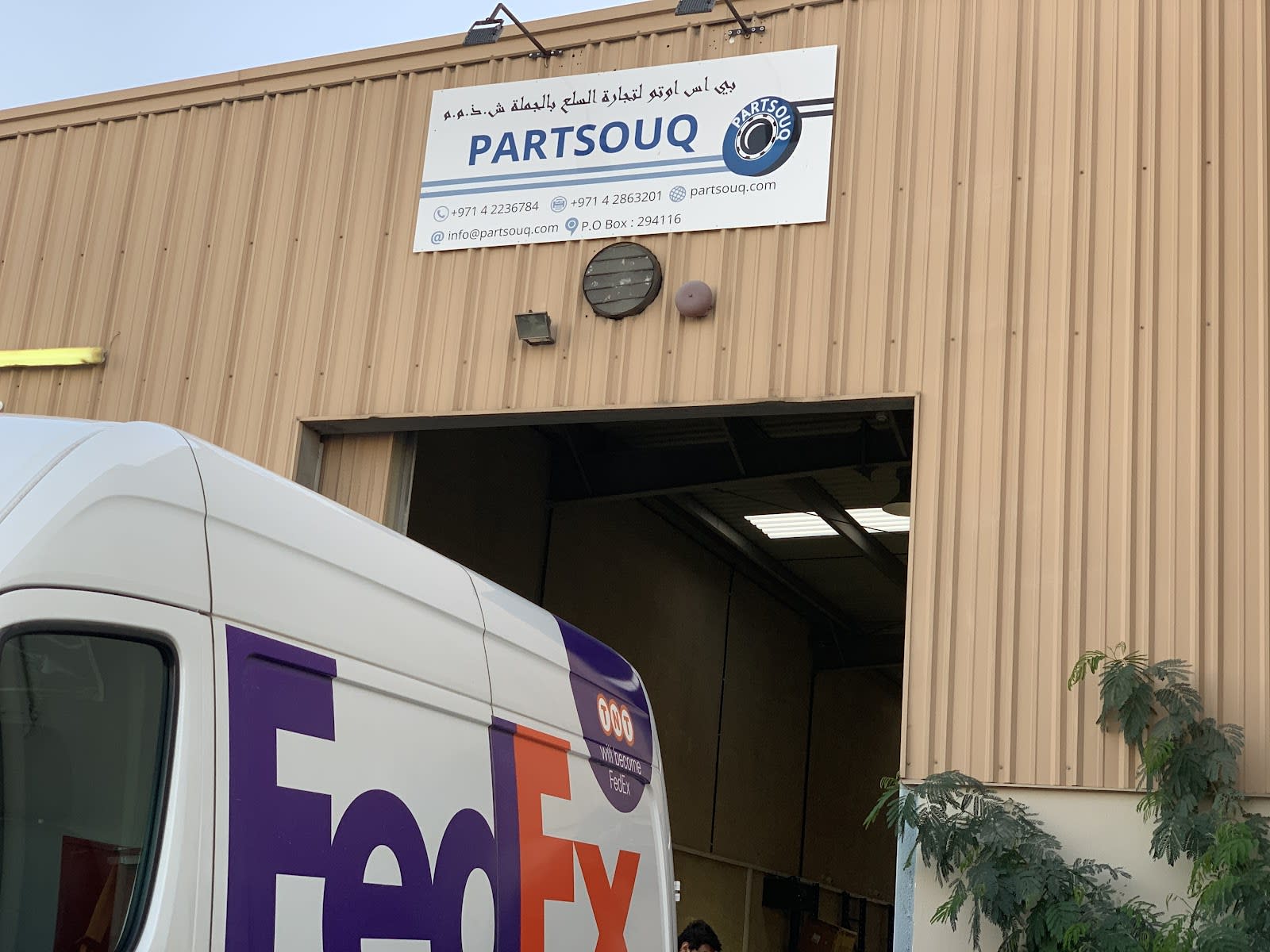
PARTSOUQ - PS AUTO GOODS WHOLESALERS L.L.C
Dubai · RAS AL KHOR 2, ST 7, Building 7, WH-11 - Dubai
 Top-Rated
Noor Din Ditta Auto Spare Parts Trading Branch-3
Sharjah · 8C56+QVF - Shop 1, 56th Street, Industrial Area 3 - Industrial Area 3 - Industrial Area - Sharjah
Where to actually buy this
Shops whose stock we have recorded ourselves. Last checked July 2026. Not paid placement.
Listed for engine parts — aftermarket, new parts. It carries Depo, TYG, Double Horse and Viewmark and 4 more and delivers to Dubai, Sharjah and Abu Dhabi.
4.4 on Google from 85 reviews
Listed for engine parts — genuine and aftermarket, new parts. It carries Textar, Hella and Delphi, matches parts to your VIN and delivers across all seven emirates.
4.6 on Google from 33 reviews
Listed for engine parts — aftermarket, new parts. It carries Just1, SMK and Oneal and delivers across all seven emirates.
4.7 on Google from 12 reviews
Listed for engine parts — genuine and aftermarket, new parts. It carries Mopar, ACDelco, Motorcraft and Renault and 8 more and delivers across all seven emirates.
3.8 on Google from 120 reviews
- Divya Auto Spare PartsAl Ain · Abu Dhabi
Listed for engine parts — genuine OEM, new parts. It carries Toyota, Lexus, Nissan and Mitsubishi and 2 more and delivers to Sharjah, Dubai and Ajman.
4.4 on Google from 8 reviews
Listed for engine parts — genuine OEM, new parts. It carries Energizer, matches parts to your VIN and delivers across all seven emirates.
4.1 on Google from 8 reviews
Listings are compiled from each business’s own public information. If you run one of these shops and want the entry corrected or removed, email easycarpartsteam@gmail.com.
Ask a human · free · no account
Rather not ring around?
Tell us the car and the part once — we'll send you the shops that actually stock it.
Free · usually a reply in minutes · no obligation
Still easier on a form? The request goes to the same matched UAE suppliers, free, with only the number of shops you choose able to contact you.
Open the request formKeep reading
Exhaust — FAQs
- What are the main parts of a car exhaust system?
- From the engine back: the exhaust manifold, the front pipe, the catalytic converter with an oxygen sensor before and after it, the connecting pipe, the silencer or back box and the tailpipe, with flex joints, gaskets, clamps and mounting parts holding and sealing the line. Diesel cars add a particulate filter, and so do some newer direct-injection petrol cars.
- What does a catalytic converter do?
- It reduces three pollutants in the exhaust, hydrocarbons, carbon monoxide and nitrogen oxides, using a ceramic honeycomb coated with precious metals. HJS Emission Technology says this works only when the engine holds the mixture at about lambda 1, which the engine computer manages using an oxygen sensor reading. A converter is not a silencer.
- Can I order a catalytic converter by my car's model, and how do I find the right one?
- No. BM Catalysts says the vehicle carries the Euro level it was designed to, a replacement must be designed to meet the same level, and housings for different levels can look the same while the internals differ. Give the supplier the chassis number, the engine code and a photo of the unit's markings, then ask for the approval and part number in writing and for what is included, such as the kit and sensors.
- What do bank 1 and sensor 1 mean?
- NTK defines bank 1 as the side of the engine that has cylinder number 1, and sensor 1 as the oxygen sensor upstream of the converter, with sensor 2 downstream. So B1 S1 is the upstream sensor on the cylinder 1 side. On a V engine bank 2 is the other side. Use those references when you describe a sensor or converter to a supplier.
- What does the code P0420 mean?
- P0420 reports catalyst system efficiency below threshold on bank 1, and P0430 reports the same on bank 2. BM Catalysts says the code is set from oxygen sensor readings, not from measured emissions, and does not by itself mean the converter is faulty. It lists exhaust leaks, manifold damage, a misfire, a leaking injector, high fuel pressure, faulty sensors or wiring and incorrect fuel as causes to check first.
- What are the signs of a failing catalytic converter?
- BM Catalysts lists dents or scratches on the can, a blue or purple colour on the can and a rattle from inside as the physical signs, and a check engine light, lack of power, poor acceleration, worse fuel economy and a rotten-egg or sulphur smell as the ones felt while driving. A totally blocked converter can make the engine fail from back pressure. Check that a rattle is not a loose heat shield or baffle first.
- What makes a catalytic converter fail?
- BM Catalysts says the cause is often another fault in the vehicle. Its list is impact damage, overheating from unburned fuel after a misfire, oil entering the exhaust, the wrong fuel or unsuitable additives, over-tightening or worn gaskets at fitting, and sudden cooling, as when the can meets a deep puddle. Fixing that cause matters as much as the new part, or the new part is likely to be damaged too.
- What does an oxygen sensor do, and where are the sensors?
- It measures the oxygen left in the exhaust so the engine computer can correct the mixture. Bosch says modern systems have at least two: a control sensor upstream of the catalytic converter and a diagnostic sensor downstream of it. NTK says the upstream sensor sits in the exhaust manifold or the Y pipe, and the downstream sensor sits after the converter to monitor its output.
- Can I fit a universal oxygen sensor?
- Makers differ. A universal sensor has no factory connector and is spliced on. NTK advises against universal sensors because compatibility and installation issues often stop them performing as well as a matched original, while Bosch sells a universal range with a connector included. Ask the supplier which you are being offered, and check that the type, zirconia, titania, air-fuel ratio or wide band, matches the sensor you are replacing.
- How often should oxygen sensors be replaced?
- Bosch calls lambda sensors wearing parts, says they should be checked regularly and replaced if required, and in its 2018 aftermarket brochure recommends checking them every 30,000 km. We found no UAE-specific interval. NTK says a check engine light does not necessarily mean the sensor is faulty, so the cause should be confirmed before one is bought.
- What is a diesel particulate filter?
- A soot trap in the exhaust of a diesel. BM Catalysts explains that exhaust gas enters channels closed at alternate ends and leaves through porous walls that hold the soot, and that the engine computer burns the soot off by regeneration. Unlike a catalytic converter it is not a flow-through part. Bosal says its filters are car-specific, so the chassis number and engine code decide which one fits.
- Why does my diesel particulate filter keep blocking, and will a new one fix it?
- Not by itself. BM Catalysts says a blocked filter is very unlikely to be the filter's own fault and usually reflects regeneration that failed, for example after many short journeys. It lists the air mass meter, lambda sensor, EGR valve, pressure sensor, injectors and turbo among the parts to check, and says a new filter fitted without diagnosis can fail in under 300 miles, about 480 km.
- What is a petrol particulate filter?
- A GPF is a soot filter for gasoline direct-injection engines, built like a diesel filter with a wall-flow honeycomb. BM Catalysts says Euro 6 added a particulate number limit for petrol cars and GPFs let engines meet it, and that coated GPFs, sometimes called four-way catalysts, now commonly sit close to the engine. We hold no data on which cars sold in the UAE have one, so confirm from the chassis number.
- What emission standard applies to cars in the UAE?
- The Ministry of Industry and Advanced Technology's guideline requires new models imported from 1 January 2026 to meet at least Euro 6B, and all light and heavy vehicles imported from 1 July 2027 to meet at least Euro 6B or equivalent, with United States limits accepted as an alternative for passenger cars. It covers vehicles imported new. We found no UAE rule on replacement converters, so we state none.
- What is the difference between a direct-fit and a universal exhaust part?
- A direct-fit part is built for a specific application. Walker describes its direct-fit converters as bolt-on units with OE-style hangers, brackets, routings and heat shields that need no fabrication or welding. A universal part is made to suit several applications. BM Catalysts says approval ties a converter to the vehicles on its certificate, so check that a universal unit's approval covers your car and its Euro level.
- Is a small hole in a silencer normal, and is an exhaust leak dangerous?
- BM Catalysts says a small weep hole at one end of a muffler is normal because it lets water out to help prevent rust. A leak is different: it gives rumbling, hissing or popping, lost power and worse economy, and BM Catalysts says damaged pipes can leak fumes into the cabin, which it treats as a health threat to the driver and passengers. Soot around a joint or hole marks where gas escapes.
- What should I get with a replacement converter or filter?
- Ask whether a fitting kit, new gaskets and the oxygen sensors are included. BM Catalysts advises a new kit because rusty nuts and bolts can be too short, and recommends new pressure pipes with a diesel filter. Bosal says mounting kits are included with its converters. Note the unit's serial number before fitting, since BM Catalysts says labels can be hidden afterwards and the number is needed for any warranty query.
- How much does a catalytic converter cost in the UAE?
- We do not publish a price, because we hold no dated supplier quotes and will not guess. Ask each supplier for the approval, brand, part number, warranty and what is included, so that two quotes can be compared like for like. A new, aftermarket, universal or used unit, direct fit or not, is a different thing to price, so say which you want.
- Where can I buy exhaust parts in the UAE?
- Start with the shops listed on this page, which are matched from what each business says about itself. We have not recorded exhaust stock shop by shop, so ask each one to match the part number and approval to your chassis number before you travel. Our guides on used car parts and on genuine, OEM and aftermarket parts explain the trade and its terms.
- What should I send on WhatsApp for an exhaust part quote?
- The chassis number, the engine code, whether the car is petrol or diesel, and clear photos of the part and any label or stamping on it. For a sensor, send the bank and sensor reference or its position and a photo of the connector. If a fault code is showing, send it as written, say what the car is doing, and ask for the cause to be checked before a converter or filter is quoted.
Ask a human · free · no account
Still not the question you had?
Ask it directly — a person reads every message.
Free · usually a reply in minutes · no obligation