Car batteries in the UAE: sizes, prices, and why they last half as long here
The quick answer
Your car will not start, or it started this morning and you do not trust it to start again tonight. That is why most people read a page like this. The short answer: in the UAE a starter battery is a consumable with a working life of roughly 24 to 36 months, not the 4 to 5 years it was designed for, and the reason is heat rather than anything you did wrong. UAE workshops and battery retailers converge on the same figure — two to three years is normal here, against three to five in a temperate climate, and a car that lives outdoors in the sun can be closer to two.
Ask a human · free · no account
Not sure which part fits your car?
Tell us the make, model and year — we check fitment and come back with prices from UAE sellers who have it on the shelf.
Free · usually a reply in minutes · no obligation
Key facts
- Battery service life in the UAE is typically 24-36 months against a 48-60 month design life, consistent with UAE workshops and retailers reporting two to three years here against three to five in cooler climates.
- Ageing follows the industry rule of thumb that life halves for every 10C of sustained temperature above 25C — an Arrhenius approximation normally quoted as valid to about 40C. The observed 24-36 month outcome implies a sustained average battery temperature around 32-38C, which is an inference from the service life rather than a measured figure.
- Under-bonnet peaks of 50-70C are transient hours-long conditions that drive water loss and grid corrosion; they are not the sustained average that sets service life, and any page claiming otherwise fails its own arithmetic.
- Self-discharge runs roughly 5-8 per cent per month at 25C and roughly 15-20 per cent per month at 45C. A flat battery after a long summer absence is self-discharge plus parasitic draw (alarm, telematics, sleeping modules at typically 20-50 mA), not self-discharge alone.
- Modern sealed flooded maintenance-free batteries cannot be topped up any more than AGM can, so top-up ability is not a differentiator here. AGM's real UAE trade-offs are price (2-2.5x flooded) and the need for correct charging and BMS registration — the literature generally reports AGM resisting heat-induced degradation better than flooded, not worse.
- Three battery standards are sold side by side here (JIS on Japanese cars, DIN/EN on European, BCI on US-spec imports), and JIS and DIN terminal posts are physically different diameters, so a near-miss battery cannot clamp properly.
Rather fill in a form? Send the same request here and matched UAE suppliers reply on WhatsApp either way.
Open the request formBatteries — types and specifications
- NS40 / 46B19
- 35-45 Ah, small hatchbacks
- 46B24L / NS60
- 40-50 Ah, Corolla, Yaris, Sunny
- 55D23 / N50
- 55-60 Ah, mid-size Japanese saloons
- 80D26L
- 65-75 Ah, positive on left
- 80D26R
- 65-75 Ah, positive on right
- NS70
- Trade nickname for the D26 case, 65-70 Ah
- N50Z
- Legacy nickname, wide D26-class case, around 60 Ah
- 105D31R
- 90-100 Ah, Prado, Land Cruiser, pickups
- 105D31L
- 90-100 Ah, positive on left
- DIN L2 (56219)
- 55-62 Ah, 242 mm European box
- DIN L3 / LN3
- 70-80 Ah, 278 mm European box
- DIN L4 / LN4
- 80-95 Ah, 315 mm European box
- AGM H6 / LN3
- 70-80 Ah, stop-start with regen braking
- AGM H7 / LN4
- 80-95 Ah, larger European saloons and SUVs
- AGM H8 / LN5
- 95-105 Ah, Range Rover, Mercedes S, BMW 7
- EFB 70Ah
- Entry-level stop-start without regen braking
- BCI Group 48
- US-spec imports, same box as H6
- BCI Group 34/78
- Dual top and side terminals, GM vehicles
- 60 Ah
- Most common capacity for mid-size cars
- 70 Ah
- Large saloons, mid-size SUVs
- 100 Ah
- Large SUVs, diesel pickups, twin-battery setups
What a car battery actually does, and why starting is only a third of it
A 12 V lead-acid starter battery has three jobs.
Cranking. For 0.5 to 3 seconds it delivers a very large current into the starter motor. Published engineering figures put a healthy petrol four-cylinder at roughly 125-200 A. A large V8 diesel such as a Land Cruiser is a different order of demand: sustained cranking of roughly 400-600 A, with an instantaneous inrush peak in the first fraction of a second that can approach 1,000 A. Those are typical design ranges, not measurements taken from UAE-market cars, and a tired starter motor pushes all of them upwards.
Cranking demand is what sets the physical size class the manufacturer specified — the plate area, the case, the tray. It is not a useful way to choose between two batteries that already fit that class. That distinction matters, and the CCA section below comes back to it, because getting the two confused is how people end up paying for a number that does nothing for them.
Buffering the electrical system. The alternator is the actual power source once the engine runs, but its output at idle is limited. On a car sitting in Sheikh Zayed Road traffic with the AC compressor engaged, both radiator fans running, headlights on and the blower at maximum, demand can approach or exceed what the alternator produces at 700-800 rpm, depending on the vehicle. Where it does, the battery covers the shortfall and is recharged later at road speed. Sustained high-load idling keeps the charging system near its ceiling and leaves less headroom to put charge back, which is a harder duty cycle than typical European use. We should be straight that this is a mechanism, not a measurement: we have found no comparative UAE-versus-Europe cycling data, and anyone telling you UAE batteries do a specific multiple more cycling is guessing.
Holding memory and keeping modules alive when parked. Engine ECU adaptations, radio codes, seat and mirror positions, steering angle calibration, TPMS pairing, alarm and telematics all draw a small standing current. A healthy modern car draws 20-50 mA parked. Anything above about 80 mA will flatten a 60 Ah battery in two to three weeks. Those are standard workshop guidance figures rather than a specification, and cars with always-on connectivity legitimately sit higher.
A fully charged battery reads 12.6-12.8 V at rest after four hours off charge. 12.4 V is about 75 per cent charged, 12.2 V about 50 per cent, and 12.0 V about 25 per cent. Below 12.4 V resting, sulfation begins.
How a lead-acid battery actually fails
Batteries do not simply "run out". Five distinct mechanisms end their lives, and they call for different responses.
Sulfation. Discharging forms lead sulfate on the plates. This is normal and reverses on charge, but if the battery sits below roughly 12.4 V for weeks the crystals grow hard and stop dissolving. Capacity is permanently lost. This is what kills batteries in cars parked at DXB long-stay while the owner is away for the summer.
Positive grid corrosion. The lead-alloy grid holding the positive active material slowly converts to lead oxide. It is unavoidable and it is the mechanism that sets the design life. Its rate roughly doubles for every 10C rise, and it is generally reported as the dominant ageing route in flooded starter batteries.
Water loss and dry-out. Charging above the gassing voltage splits water into hydrogen and oxygen. This is not an AGM-only problem: the overwhelming majority of flooded batteries sold today are sealed lead-calcium maintenance-free units with no filler caps, so in practice neither type can be topped up. When the electrolyte drops below the plate tops, that exposed area is dead permanently.
Shedding and shorting. Vibration and repeated deep cycling knock active material off the plates. It collects in the base and eventually bridges a cell, giving the classic "reads 10.5 V and will not charge" battery.
Mechanical and terminal failure. A missing hold-down clamp, a cracked case, a lead post loosened by over-torqued clamps, or corrosion at the terminal. Cheap to prevent, common in this market, and frequently misdiagnosed as a dead battery.
| Failure mode | How it shows up | Usual cause | Recoverable? |
|---|---|---|---|
| Sulfation | Slow crank, low capacity, will not hold charge | Left below 12.4 V for weeks; short trips only | Rarely, and only if caught early |
| Positive grid corrosion | Gradual loss of cranking power over months | Age and heat; accelerated by over-voltage | No |
| Water loss / dry-out | Sudden failure after a hot month; low electrolyte | Charging voltage too high for the temperature | No |
| Shedding, internal short | One cell reads low; 10.5 V total; will not charge | Vibration, loose hold-down, deep cycling | No |
| Terminal or clamp fault | Intermittent no-start, clicking, dash resets | Corrosion, loose or over-torqued clamp | Yes, clean and re-torque |
Not sure what you're looking at? Send a photo and the car — we'll tell you what you're seeing and what the parts cost. Free, no form.
Why a battery lasts about half as long in the UAE
This is the section that explains almost everything else on this page, and it is also the section where most writing on the subject quietly gets the arithmetic wrong. It is worth doing properly.
Every chemical reaction inside a lead-acid battery, including the unwanted ones, speeds up with temperature. The industry rule of thumb is that battery life halves for every 10C of sustained operating temperature above 25C. Two caveats come with that rule and they are usually dropped: it is an Arrhenius approximation, and it is normally quoted as valid between roughly 15C and 40C, steepening rather than staying linear above about 35C. Push it far outside that band and it stops predicting anything useful.
The temperature that matters is the sustained average, not the peak. This is where the popular version of this argument falls apart. You will read that a UAE engine bay runs at 55-70C and that this is why batteries last two years. Those two statements cannot both be true. If a battery genuinely sat at 55-70C year-round, the halving rule would turn a 60-month design life into single-digit months, and batteries here plainly do better than that.
What actually happens: the battery case gets very hot for a few hours a day in summer, then cools overnight, and the UAE has a mild half of the year. Peaks in a hot-climate engine bay are commonly cited in the 50-70C range — we have not found a UAE-specific measured study, so treat that as a general figure rather than a local one. Those peaks are what drive water loss and accelerate grid corrosion during the hours they last. But the service life figure follows from the annual average, which the observed 24-36 month outcome implies sits somewhere around 32-38C for a typical UAE car. That is our inference working backwards from the observed life, not a measured number, and we would rather say so than present it as data.
Three specific consequences follow.
Water loss accelerates. Gassing roughly doubles per 10C. Many charging systems apply a fixed 14.2-14.7 V regardless of temperature; the correct voltage at high battery temperature is meaningfully lower. In a sealed battery, whether flooded MF or AGM, the water that goes is gone.
Self-discharge accelerates. A parked lead-acid battery loses roughly 5-8 per cent of charge per month at 25C (published figures range from about 4 per cent for AGM to 10-12 per cent for older flooded designs, with calcium maintenance-free units in between). Self-discharge roughly doubles per 10C, which puts a 45C battery at around 15-20 per cent per month. That alone will not flatten a car over a two-week trip — it is self-discharge plus the parasitic draw of alarm, telematics and sleeping modules over a multi-week absence that does it.
Grid corrosion accelerates. The irreversible ageing clock simply runs faster.
Cold is the opposite problem and it barely registers here. A UAE battery almost never fails from cold cranking demand. It fails from heat ageing and then finally cannot deliver a perfectly ordinary 300 A crank.
| Sustained average battery temperature | Where this corresponds to | Approx. relative ageing rate | Realistic service life |
|---|---|---|---|
| 25C | Northern Europe average | 1x (baseline) | 48-60 months |
| 30C | Mediterranean / mild subtropical | ~1.4x | 34-43 months |
| 35C | UAE car parked in shade or a basement | ~2x | 24-30 months |
| 38C | UAE car parked outdoors year-round | ~2.4x | 20-25 months |
| 40C | Upper bound of the rule's stated validity | ~2.8x | 17-21 months |
Flooded, EFB, AGM or lithium: which one your car actually needs
The technology is not a luxury tier. It is a fitment requirement on some cars and a waste of money on others.
Conventional flooded (SLI / maintenance-free). Liquid electrolyte, calcium or calcium-silver grids, almost always sealed with no filler caps. Correct for the overwhelming majority of GCC-spec Japanese and Korean cars without stop-start. Cheapest, widely stocked, easiest to warranty. Manufacturer literature commonly quotes a conventional starter battery at around 30,000 engine starts, which is plenty for a car that starts twice a day — though these are marketing figures repeated across the industry rather than independently tested data.
EFB (Enhanced Flooded Battery). A flooded battery with a polyester scrim on the positive plates and denser active material. Manufacturers quote roughly double the cycle life of standard flooded, with figures around 85,000 starts against 30,000. Fitted as original equipment to entry-level stop-start cars without regenerative braking. An EFB may be replaced with an AGM, but a car specified for EFB should not be downgraded to standard flooded, because stop-start will cycle it to death in months.
AGM (Absorbent Glass Mat). Electrolyte held in glass fibre mats, sealed, valve-regulated. Manufacturers quote three to four times the cycle life of flooded, plus far better vibration tolerance, much higher charge acceptance, and the ability to be mounted in a boot or under a seat. Required on stop-start cars with regenerative braking and on most modern German cars.
A correction we owe you on AGM. An earlier version of this page argued that AGM has a specific UAE disadvantage because it cannot be topped up and therefore fails abruptly in heat. That was wrong on both halves and we have removed it. Modern sealed flooded batteries cannot be topped up either, so it is not a differentiator; and the mainstream literature runs the other way, reporting that AGM resists heat-induced degradation better than flooded, precisely because a vented flooded cell is the one exposed to evaporation. The real UAE trade-offs with AGM are the ones you can see on the invoice: price at roughly 2 to 2.5 times flooded, and the need for correct charging and BMS registration. If a heat caveat is worth making at all, it is the narrow one that standard lead-calcium AGM is more heat-sensitive than thin-plate pure-lead (TPPL) AGM — not that AGM is worse than flooded.
Lithium (LiFePO4) starter batteries. 3-5 kg instead of 17-22 kg, excellent cranking. Do not buy one for a daily driver in this climate unless the manufacturer fitted it. Cell life falls sharply above about 45C, the internal BMS can disconnect to protect itself and leave you stranded with no warning, most stock alternator profiles are not designed for it, and prices are far above lead-acid. It is a motorsport and track-day part here, not a commuting part.
Who should not buy the expensive option: a 2014 Corolla, Sunny, Yaris or Pajero with no stop-start gains nothing measurable from AGM. Buy a good flooded battery from a brand with a real local warranty and spend the difference on a charging-system check.
| Type | Cost vs flooded | Cycle life (manufacturer figures) | Best for | Disadvantage here |
|---|---|---|---|---|
| Flooded MF | 1x | Baseline, ~30,000 starts | Non stop-start Japanese, Korean, most GCC-spec cars | Sealed, so water loss is unrecoverable; most exposed to heat-driven evaporation |
| EFB | 1.3-1.5x | ~2x flooded | Entry-level stop-start without regen braking | Pointless on a car with no stop-start |
| AGM | 2-2.5x | 3-4x flooded | Stop-start with regen braking, German cars, boot-mounted | Price, and it must be correctly charged and registered to the car |
| Lithium LiFePO4 | 5-10x | Very high in ideal temps | Track and motorsport use | Degrades fast above ~45C; BMS cutoff strands you; charging system mismatch |
How to read a battery label
Three separate standards are sold side by side in the UAE, and the confusion is the single most common cause of buying the wrong battery.
JIS (Japanese, e.g. 80D26L, 46B24R, 105D31R). Dominant here because most of the car park is Japanese. Reading 80D26L: 80 is a performance index that rises with capacity and cranking, D is the case width and height class, 26 is the case length in centimetres, and L means the positive terminal is on the left when the terminals face you.
Legacy trade names, and why not to trust them alone. You will also hear NS40, NS60, NS70 and N50Z at the counter. Broadly, NS40 corresponds to the B19/B20 case, NS60 to the B24 case, N50 to D23 and NS70 to the D26 case, with N50Z a wide D26-class variant. We are stating those loosely on purpose: these are old Australian and Gulf trade names, different suppliers apply them inconsistently, and a mismatch of one class is exactly what leaves a battery unclamped in the tray. The JIS or DIN code printed on the battery is authoritative; the trade name is a nickname.
DIN / EN (European, e.g. L2, L3, H6, LN3, 56219). Sized by a standard box length: L1 207 mm, L2 242 mm, L3 278 mm, L4 315 mm, L5 353 mm, all 175 mm wide. H5, H6, H7 and H8 are the taller AGM-friendly variants of L2 through L5.
BCI (North American, e.g. Group 24F, 34/78, 35, 48, 49, 65). Found on US-spec imports. Group 48 is the same box as H6, Group 49 the same as H8. Group 34/78 has both top and side posts.
Terminals differ physically and this catches people out. JIS posts are smaller than DIN posts (JIS positive about 14.7 mm tapering, DIN positive about 19.5 mm). A JIS battery in a DIN clamp will not tighten properly no matter how hard the clamp is squeezed, which produces a high-resistance joint, heat, and an intermittent no-start.
Polarity matters more than anything else on the label. An L battery fitted where an R is required means the cables may not reach, or reach only under tension. Never solve this by stretching a cable across the terminals.
Also check the date code, usually a punched or printed month and year on the case or a sticker. Buy stock less than six months old. The chemistry behind this is not in dispute — a lead-acid battery sitting at high ambient temperature self-discharges at several times its 25C rate and can sulfate on the shelf. What we cannot document is the specific claim, often repeated locally, that UAE warehouses run at 45C without air conditioning. Check the date code because it is free to check, not because we can prove the warehouse was hot.
| Standard | Example | What the parts mean | Typical case size |
|---|---|---|---|
| JIS | 80D26L | 80 = performance index; D = width/height class; 26 = 26 cm long; L = positive on left | ~260 x 173 x 225 mm, 65-75 Ah |
| JIS | 46B24R | 46 = index; B class; 24 cm; positive on right | ~238 x 129 x 203 mm, 40-50 Ah |
| JIS | 105D31R | 105 = index; D class; 31 cm; positive on right | ~306 x 173 x 225 mm, 90-100 Ah |
| DIN/EN | L2 (e.g. 56219) | 242 mm standard box, low height | 242 x 175 x 190 mm, 55-62 Ah |
| DIN/EN | L3 / H6 / LN3 | 278 mm box; H6 is the taller AGM version | 278 x 175 x 190 mm, 70-80 Ah |
| DIN/EN | L4 / H7 / LN4 | 315 mm box | 315 x 175 x 190 mm, 80-95 Ah |
| BCI | Group 48 | North American code, same box as H6 | 278 x 175 x 190 mm, 70 Ah |
| BCI | Group 34/78 | Dual top and side terminals, GM vehicles | 260 x 173 x 200 mm, 60-70 Ah |
GCC spec, US spec and JDM imports: why the same model takes different batteries
This is a UAE-specific problem and it is the reason a parts counter asks for a chassis number instead of just "2018 Camry".
The same nameplate is built in different plants for different markets, and the build market determines which battery standard the car left the factory with. That alone changes the case size and the terminal type, which is enough to make a battery ordered by model name unfittable.
A GCC-spec car sold through the local agent is built to a hot-climate specification and usually carries a JIS or DIN battery depending on where it was built. The trade also holds that GCC cars get larger batteries and higher-output alternators than European equivalents. That is plausible and widely repeated, but we have no manufacturer documentation for it, so take it as trade lore rather than a spec you can rely on.
A US-spec import of the same model carries a BCI group size, sometimes with side terminals. Ordering by model name alone gets you a battery that physically will not clamp down.
A JDM import — a Japan-domestic auction car, common in the used market — is identified by a 9-15 character chassis or frame number rather than a 17-digit VIN, because JDM vehicles do not follow the ISO 3779 VIN standard. It carries a JIS size, frequently a lower capacity class than the GCC equivalent. The reason is not that Japan has a mild climate: Japanese summers reach the mid-30s C and its winters are genuinely cold, which pushes OE cranking specs up rather than down. The real reason is that a JDM car is specified without the hot-climate and high-electrical-load provisions built into a GCC-spec car.
One honest limit on the above: we can document that build markets use different battery standards and different terminals. We have not found a source confirming that the tray and hold-down hardware themselves differ between GCC and US builds of the same model. It may well be true — it is what fitters describe — but we are not going to state it as established.
The practical rule: read the battery that is currently in the car, and check the hold-down and cable reach before buying. If the car has had a previous replacement, treat what is fitted as a suggestion rather than gospel, because the last shop may already have fitted a near-miss.
The table below is a starting point only. It reflects general market knowledge rather than a verified fitment database, and trims, engines and build markets vary, so verify against the label on the battery in your car or against the owner's manual before you buy.
| Vehicle group | Typical size | Approx. capacity | Approx. cranking |
|---|---|---|---|
| Corolla, Yaris, Sunny, Rio (GCC petrol) | JIS 46B24 / NS60 | 40-55 Ah | 330-450 A |
| Camry, Accord, Altima, Sonata | JIS 80D26 / NS70 or DIN L2 | 60-72 Ah | 550-650 A |
| Hilux, Fortuner, Pajero (petrol) | JIS 80D26 | 65-70 Ah | 600-680 A |
| Prado, Land Cruiser, Patrol | JIS 105D31 (diesel often twin) | 90-100 Ah each | 750-850 A |
| BMW 3/5, Mercedes C/E with stop-start | DIN H6 / H7 AGM | 70-95 Ah | 720-850 A |
| Range Rover, Discovery | AGM H8 plus a separate auxiliary battery | 95-105 Ah | 850-950 A |
| Tahoe, Explorer, Charger (US spec) | BCI 48, 65 or 34/78 | 65-80 Ah | 650-750 A |
CCA, Ah and reserve capacity: which number matters here
Three numbers appear on every label and the marketing pushes you at the wrong one.
First, resolve an apparent contradiction. Earlier we said cranking demand is what sets the size of the battery. Here we are going to say the headline cranking number is a poor way to choose one. Both are true, and the difference is the point: cranking demand sets the size class and plate area the manufacturer specified for your car. The CCA figure printed on the label is a way of comparing two batteries at -18C, and at that job it is nearly useless to you, because both of the batteries you are comparing already fit.
CCA (Cold Cranking Amps) is defined at -18C: the current the battery can supply for 30 seconds while holding at least 7.2 V, that is 1.2 V per cell. That definition is exact and correct. It is also a cold-climate metric. Coastal UAE winter mornings sit around 10-15C, which is nowhere near the test point. The UAE is not uniformly warm — the National Center of Meteorology recorded -1.7C at Raknah in the Al Ain interior during a 2021 cold spell, an all-time national low of -5.7C on Jebel Jais in February 2017, and 0.2C during the 2026 winter — so an inland or mountain start can be genuinely cold. But for the driving almost everyone on this page actually does, the coldest start of the year is far above -18C, and headline CCA is a poor primary selection criterion. Do not pay a premium for 800 CCA on a Corolla.
Beware also that CCA is quoted under several standards and they are not interchangeable. SAE and EN figures are broadly comparable — the commonly used conversion is EN ≈ SAE CCA × 0.92. DIN figures are substantially lower for the same battery, with a conversion factor usually given as CCA ≈ DIN × 1.7 (some manufacturers use 1.6 or 1.8). A battery advertised as "600 CCA" and one advertised as "600 DIN" are not the same product. Ask which standard is quoted.
Ah (amp-hours, at the 20-hour rate) is the energy store, and it is the more useful comparison here, because UAE duty is dominated by electrical load, idling with the AC on, and parked standing drain rather than by cold cranking. A larger Ah rating also means more plate area and more electrolyte, which means more thermal mass. If you must choose between more CCA and more Ah for the same money and the same box, take the Ah.
RC (Reserve Capacity) is the minutes the battery can supply 25 A while holding above 10.5 V. It is the most honest single figure for "how long can I run with a dead alternator", and it is the one to compare if you drive long distances between towns.
Do not fit a larger battery than the tray allows simply to get more capacity. It will not clamp down, and an unrestrained battery in a hot bay sheds plate material and cracks its case. Going up one size within the same case family is usually fine; going up a case size is not.
| Rating | Measured at | What it tells you | UAE relevance |
|---|---|---|---|
| CCA (SAE) | -18C, 30 s, above 7.2 V | Cold cranking ability | Low as a comparison tool. Rarely the limiting factor here |
| CCA (EN) | -18C, EN 50342 profile | Broadly comparable to SAE; EN ≈ SAE x 0.92 | Low, same reason |
| CCA (DIN) | -18C, more severe profile | Same property, substantially lower number; SAE ≈ DIN x 1.7 | Low, but always check which standard is quoted |
| Ah (C20) | 25C, 20-hour discharge | Total energy storage and plate area | High. The number to compare |
| RC (minutes) | 25C, 25 A to 10.5 V | How long you can run without an alternator | High for long-distance and inter-emirate driving |
| Weight | - | Rough proxy for lead content | A crude sanity check only, not a rating |
The symptoms, ranked by how much time you have left
Batteries usually warn you. The warnings are just easy to rationalise away in a car that starts anyway.
Weeks to months of warning. Slow crank on the first start of the day, especially after the car has been parked outdoors overnight. Headlights visibly dimming at idle and brightening when you rev. The clock or radio presets resetting occasionally. Stop-start no longer engaging at traffic lights, which on many cars is the battery management system quietly telling you the battery is below its threshold.
Days of warning. Needing two attempts to start. Electric windows moving noticeably slower. A dashboard battery or charging warning that appears and clears. Corrosion, a white or blue-green crust, building at a terminal.
Hours of warning. A rapid clicking from the starter solenoid rather than a crank. The dash lighting up but nothing turning. Everything working on the key but the engine barely turning over then stopping.
No warning. An internal short. The car was normal yesterday and is completely dead today, and the battery reads around 10.5 V. Nothing you could have observed would have predicted it. Shops here describe this clustering in the late-summer months, which is what the heat mechanism would predict — but we have no UAE callout dataset to size that, so treat it as the trade's impression rather than a statistic.
A useful distinction: if the car is dead but jump-starts and then runs perfectly, that points at the battery or a drain. If it jump-starts and dies again once the leads come off, that points at the alternator, not the battery.
| Symptom | Most likely cause | Time remaining | Action |
|---|---|---|---|
| Slow crank on the first start of the day | Ageing battery losing capacity | Weeks to months | Test now, plan replacement |
| Stop-start stops engaging | BMS has downgraded the battery's state of health | Weeks to months | Test; on some cars this is the only warning |
| Lights dim at idle, bright when revved | Battery weak or alternator output low | Days to weeks | Test both battery and charging voltage |
| Rapid clicking, no crank | Battery below cranking threshold | Hours | Jump start, then test the same day |
| Dead overnight, recovers on jump, dies again in days | Parasitic drain, not the battery | Ongoing | Measure standing current before buying anything |
| Runs fine on jump leads, dies when leads removed | Alternator or regulator failure | Immediate | Do not replace the battery first |
| Battery reads ~10.5 V and will not charge | Internal short, dead cell | None | Replace |
| Swollen or bulging case | Heat damage or over-charging | None | Replace and check charging voltage before fitting the new one |
What a free battery test actually does, and the three things it misses
Almost every battery shop and mobile van in the UAE offers a free test. It is genuinely useful and it is genuinely incomplete, so it is worth knowing what the machine does.
The handheld unit clipped to your terminals is a conductance tester. It injects a small AC signal and measures how easily the battery conducts it, in millisiemens. It compares that against the CCA rating you type in and returns a state of health as a percentage, plus a pass, marginal or replace verdict. It takes about ten seconds and does not discharge the battery.
What it does well: it detects sulfation, plate shedding and a shorted cell reliably, and it is far better than the old carbon-pile load test at not damaging a weak battery.
Three things it does not tell you.
1. It confounds a discharged battery with a bad one. A perfectly good battery at 50 per cent charge often reads "replace". If your car has been sitting, insist the battery is charged before it is condemned. This is the most common way a working battery gets replaced.
2. It does not find a parasitic drain. That needs a clamp meter or a multimeter in series after the car has gone to sleep, which can take 20-45 minutes on a modern vehicle. Normal is 20-50 mA as workshop guidance, though cars with telematics sit higher.
3. It does not properly test the alternator. A quick voltage reading at idle is not the same as testing output under load and checking for AC ripple from a failed diode. Charging voltage on a conventional system should sit around 13.8-14.6 V with the engine running, and sustained readings above about 15 V will cook a battery. One caveat that matters on newer cars: regenerative-charging and temperature-compensated systems deliberately vary charging voltage over a wide range and can read outside those bands perfectly normally. Judge the reading against what the manufacturer specifies for that car, not against a generic band.
One further note on state of health. Testers commonly flag "replace" at around 50 per cent SoH, and different testers compute the figure differently, so it is a decision aid rather than a measurement you can hold. If you are replacing a battery that is less than two years old, do not accept a free test as the whole diagnosis. Ask for the standing current and the charging voltage in writing.
| Reading | Meaning | Correct response |
|---|---|---|
| Resting 12.6-12.8 V, SOH above 80% | Healthy | Nothing |
| Resting 12.6 V, SOH 60-79% | Ageing but serviceable | Retest in 3 months; consider replacing before summer |
| Resting 12.6 V, SOH around 50% or below | At or past the usual replace threshold | Replace |
| Resting 12.2 V, SOH low | Ambiguous, likely just discharged | Charge fully, then retest before deciding |
| Cranking voltage drops below 9.6 V | Cannot support cranking load | Replace |
| Charging voltage above 15 V on a conventional system | Regulator or alternator fault | Fix before fitting a new battery |
| Standing current above 80 mA | Likely parasitic drain | Trace the circuit; a new battery will not fix it |
Mobile fitting, dial-a-battery, and the coding question
Roadside and doorstep battery replacement is a normal, mature part of the UAE market rather than an emergency oddity. The category dates back at least to December 2011, when DriveArabia reported the launch of a 24/7 dial-a-battery service in Dubai; that operator states it has since worked across Dubai, Abu Dhabi and Sharjah. It exists because standing beside a dead car in 45C is a very strong motivator and because towing a car to a workshop for a 15-minute job makes no sense.
How it works. You call or message with your location, car and often a photo of the old battery. A stocked van arrives, tests, fits, takes the old battery away and issues a warranty card. Fitted prices are the norm rather than the exception: CarBatterySquad, for example, states that every quoted price includes "the battery, free delivery, professional fitting, BMS coding where required, free old battery disposal, VAT, and a manufacturer warranty up to 18 months" (site as at August 2026). Not every operator words it that way, so confirm what your quote covers.
Where it is genuinely better: speed, no towing, no waiting room, and the old battery leaves with someone who has the disposal arrangement in place.
Where it falls short, stated plainly:
Stock on the van is a real constraint, but a smaller one than it sounds. You get what is on board. Operators advertise on the order of 18 size codes carried, from DIN44/NS40 up through DIN100 plus AGM H5 to H9 and EFB, which covers most of the UAE car park. Still, if your car needs an AGM H8 and the van is carrying flooded JIS sizes, the pressure to accept a near-fit is real, and a wrong-size battery jammed into a tray without a proper hold-down will fail early. We have no data on how often this actually happens — it is a question to ask, not a documented failure mode.
No diagnosis of the real fault. A van technician can test the battery. Tracing a 120 mA parasitic drain or diagnosing a regulator over-volting to 15.4 V is workshop work.
Memory loss. Without a memory saver on the OBD port, disconnecting the battery loses radio codes, one-touch window calibration, steering angle calibration, throttle adaptation, seat memory and sometimes TPMS pairing. Ask before they disconnect.
Battery registration — and a correction. An earlier version of this page said mobile vans usually cannot register a battery to a modern European car. That is not true of the Dubai market and we have removed it. Established mobile operators here carry OBD-II diagnostic tools and perform BMS registration as a standard part of the job, frequently at no extra charge — VCDS coding advertised for Audi, STAR coding for Mercedes, OEM-level tools in the van for BMW, and coverage extending to Porsche, Range Rover and Volvo. The useful caveat is not that they cannot do it; it is to confirm coding is included before you book, because a fitter without the tool will fit the battery anyway and say nothing.
The underlying reason it matters is unchanged. Most modern European cars, and a growing number of Japanese and Korean ones, monitor the battery through an intelligent sensor on the negative terminal and adapt the charging strategy to its age and type. Fit a new battery without telling the car and it keeps charging on the old battery's profile, leaving the new battery chronically under- or over-charged. BMW and Mini call it BEM coding; Mercedes registers through its own diagnostic system; Audi, VW, Porsche, Volvo and Land Rover have equivalents. Model-year cut-offs vary considerably by marque and we are deliberately not stating any — ask about your specific car.
Mechanically, the job is simple and the rules do not change: disconnect negative first, connect negative last, clean both posts, re-fit the hold-down clamp properly, and do not over-tighten the terminal clamps. Terminal clamps are typically in the region of 5-8 Nm and hold-down brackets 8-12 Nm; those are typical trade values, manufacturer figures vary, and yours is the one that counts.
| Factor | Mobile / dial-a-battery | Workshop |
|---|---|---|
| Time to fix | Typically same day, often under an hour | Depends on booking, plus getting the car there |
| Range of stock | Around 18 size codes on the van; wide but finite | Full range, can order the exact size |
| Diagnosis depth | Battery test only | Drain test, alternator load test, ripple test |
| Battery registration / coding | Standard at established operators, often included; confirm when booking | Available at a specialist |
| Memory retention | Ask for a memory saver | Standard practice at a good shop |
| Old battery removal | Almost always included | Almost always included |
| Best for | A dead car, and most routine fitments including coded European cars | Repeat failures, suspected drain or charging fault, anything under 2 years old |
What a car battery costs in the UAE
Price intent on this subject is unusually strong, so here is the honest structure of it rather than a single headline number.
UAE retail spans roughly AED 150 at the very bottom of the market to around AED 1,300 for a large premium AGM, based on retailer and workshop listings observed in August 2026. Where you land inside that is determined by three things in this order: case size, then technology, then brand.
Size dominates. A 105D31 has roughly twice the lead of a 46B24. Lead is the cost. No brand or marketing can move that.
Technology is the second step. AGM is typically 2 to 2.5 times the price of the equivalent flooded battery, EFB roughly 1.3 to 1.5 times.
Brand is the smallest of the three factors and, in this market, the one most likely to be inflated at the point of sale. Real listings make the spread visible: an 80D26L was listed at AED 388 for one budget brand and AED 555 for a well-known one; a 105D31L ranged from AED 270 for an entry brand to AED 955 for a premium name (UAE retailer listings, August 2026). That is the same box and roughly the same lead content.
The bands in the table below are interpolated from those listings. They are estimates, not quotes, and battery pricing moves with lead. Get a live quote before you commit.
What should be included in the quoted price, and should be confirmed before you agree:
VAT at 5 per cent stated, not added at the end.
Fitting. For a standard engine-bay battery this is normally included, at a shop or by a van. A boot-mounted or under-seat battery may legitimately carry a labour charge; BMS coding on a European car is usually included by mobile operators, but confirm it.
Removal of the old battery, and any trade-in credit for it, stated as a number rather than vaguely "adjusted".
The warranty period in months and what it covers, on a card with a punched or printed date.
A quote of "550 dirhams fitted, VAT included, 18 months warranty, old battery taken" is a complete quote. "550 dirhams" on its own is not.
Budget batteries are not automatically a bad decision. On a car that is being sold in a year, or a second car that does short trips, a AED 250 flooded battery with a 12-month warranty may be the rational purchase. The expensive battery is worth it when the car specifies AGM, when the vehicle is parked outdoors year-round, or when a failure has a real cost, such as a car used for work.
| Size / type | Approx. capacity | Typical AED band | Typical vehicles |
|---|---|---|---|
| JIS NS40 / B19-B24, flooded | 35-50 Ah | 180-330 | Yaris, Sunny, small hatchbacks |
| JIS 55D23 / N50, flooded | 55-65 Ah | 250-450 | Corolla, Civic, Elantra |
| JIS 80D26 / NS70, flooded | 65-75 Ah | 300-560 | Camry, Accord, Hilux, Pajero |
| JIS 105D31, flooded | 90-100 Ah | 400-960 | Prado, Land Cruiser, Patrol, pickups |
| DIN L2 (56219), flooded | 55-62 Ah | 280-520 | European saloons without stop-start |
| DIN L3 / L4, flooded | 70-90 Ah | 380-800 | Larger European saloons and SUVs |
| EFB, L2 to L4 | 60-80 Ah | 450-820 | Entry-level stop-start |
| AGM H6 / LN3 | 70-80 Ah | 650-1,050 | BMW 3, Mercedes C, VW Golf with stop-start |
| AGM H7 / H8 | 80-105 Ah | 800-1,300 | Mercedes E/S, BMW 5/7, Range Rover |
These are UAE market ranges. The price for your car depends on the model, the year and which brand you fit.
Get the exact priceBrands sold in the UAE, and the vocabulary at the counter
Ask for a battery in Sharjah or Deira and you may hear "genuine", "commercial" and "copy" used as though they were formal grades. They are not official categories, and we should be straight that we cannot document them as named grades anywhere. The documented UAE parts vocabulary is genuine / OEM / aftermarket. "Commercial" and "copy" are spoken trade shorthand we hear used at counters; if your seller does not use those words, do not force the frame on them. The distinctions underneath are what matter, whatever they are called.
Original-equipment or agent-supplied means a battery bought through the vehicle's agent or an authorised distributor, with a warranty card the seller will actually honour.
Legitimate aftermarket means a real brand, often Asian or regionally manufactured, sold at a lower price with a shorter warranty. Frequently a perfectly sensible purchase, particularly in the mid sizes.
The category to be careful with is the unbranded battery in a familiar-looking case, the one with an inflated capacity or CCA printed on it, or a refurbished unit sold as new.
On the weight test. It is often said that you can spot an over-rated battery by lifting it, because lead is both the cost and the capacity. There is something in that, but it does not work as a precise discriminator and we are not going to pretend it does: AGM, EFB and flooded of the same nominal Ah weigh different amounts, and construction varies between manufacturers. Use weight to flag something obviously wrong — a supposed 70 Ah battery that is dramatically lighter than every other 70 Ah battery on the shelf — not to verify a rating. If you want certainty, buy from a seller who will put the size, the brand, the date code and the warranty term on a document.
The Sharjah Industrial Area and Sajaa used-parts markets are a real and useful part of this ecosystem — the industrial area alone has well over a thousand parts shops. For batteries specifically, used is the weakest proposition in that market. You cannot see the state of health at the point of sale, the remaining life is unknown, and in this climate a second-hand battery has usually already spent its best years. That is reasoning from how batteries age here rather than a surveyed finding, but the conclusion is not close: once you price in the missing warranty, there is no meaningful saving against a new budget battery.
On brands: the international names widely available here include Varta, Bosch, AC Delco, Amaron, Exide, Century, Solite and Hankook, alongside regional and Chinese manufacturers. Genuine agent-branded batteries from Toyota, Nissan and the German marques are sold through dealer parts counters. In practice, the meaningful differences between reputable brands in this climate are smaller than the difference between a well-charged, correctly-sized, correctly-registered battery and a badly-fitted one.
| What is offered | What it usually means | Warranty reality | When it makes sense |
|---|---|---|---|
| Agent / OEM | Dealer or authorised-distributor stock | Honoured, card issued, date recorded | Cars under warranty, AGM and coded fitments |
| Branded aftermarket | Major international brand via distributor | Commonly 12-24 months free replacement | Most cars, most of the time |
| Lower-cost aftermarket | Legitimate budget or regional brand | Often 6-12 months, seller-dependent | Older cars, second cars, short-hold vehicles |
| Unbranded or relabelled | No traceable brand, or an over-rated label | Effectively none | Rarely. Ask for brand, date code and a written term |
| Used / Sharjah market | Second-hand, state of health invisible at sale | None | Not recommended for batteries specifically |
Warranty in this market, and what quietly voids it
Battery warranty in the UAE is normally a free-replacement period rather than the pro-rata credit common in the US. That much is documented: UAE operators openly quote one-time free replacement, typically over 12 to 24 months, and mobile sellers advertise manufacturer warranties of up to 18 months included in a fitted price (August 2026). Term is also the single most negotiable item at the counter.
The mechanism is the card. At the point of sale the seller records the date on a warranty card and often on a sticker on the battery itself. If you do not leave with a dated card, in practice you do not have a warranty, regardless of what was said. Photograph the card and the battery label the day it is fitted.
Here is where the evidence thins, and we would rather say so. The free-replacement basis is documented. The punched-date-card practice, and the exclusions list below, are what shops and fitters consistently describe and what standard industry practice looks like elsewhere — but they are not terms we have read off a set of actual UAE warranty documents. Treat the list as the questions to ask before you pay, not as rules you can hold a seller to afterwards:
Physical damage. A cracked case, a broken terminal, a damaged lid.
Deep discharge. A battery found below roughly 10.5 V is often treated as customer misuse rather than a defect.
Charging system faults. If the alternator was over-volting and cooked the battery, the fault is the car, not the battery. This is why a good shop checks charging voltage before it fits a warranty replacement.
Wrong application. A flooded battery fitted to a stop-start car, or a battery smaller than the specification.
Commercial use. Taxi, limousine, delivery and fleet vehicles are often excluded or given a shorter term.
Fitting by a third party, on some agent warranties.
The practical advice. Ask the specific question "is this free replacement or pro-rata, and for how many months?" and get it written on the card. Ask whether commercial use is excluded if you drive for a living. And keep the card in the glovebox rather than a drawer at home, because the claim happens where the car is.
| Battery class | Typical UAE term | Usual basis | Most commonly described refusal reason |
|---|---|---|---|
| Budget / lower-cost flooded | 6-12 months | Free replacement | No card, or no recorded date |
| Branded flooded | 12-24 months | Free replacement | Deep discharge below ~10.5 V |
| EFB | 18-24 months | Free replacement | Fitted to the wrong application |
| AGM | Commonly 18-24 months or more | Free replacement | Not registered to the vehicle, or a charging fault |
| Agent / OEM | Per vehicle warranty terms | Free replacement | Fitted outside the dealer network |
| Any, commercial vehicle | Often reduced or excluded | Varies | Taxi, delivery or fleet use |
Vehicle testing, disposal, and what your old battery is really worth
Vehicle testing. An annual technical inspection is required to renew vehicle registration in Dubai, and equivalents apply in the other emirates. Published inspection scopes from Dubai testing centres and garages list brakes, steering and suspension, tyres and wheels, lighting, chassis condition, emissions, horn, wipers and seat belts. We have not been able to read an official RTA line-item checklist, so treat that list as the trade's description of the test rather than a quoted regulation. What it does show consistently is that the battery is not an inspection item in its own right.
That does not make it irrelevant, though the argument that follows is reasoning from the checked items rather than a documented failure chain. A weak battery causes failures elsewhere in the test: low system voltage produces spurious dashboard warning lights, dim or flickering lamps, weak horn operation and sluggish window and wiper operation, and lighting, horn and wipers are all checked. Separately, an insecure, leaking or heavily corroded battery is a straightforward safety defect and it is reasonable to expect it to be flagged, though we cannot point to a rule that says so. If your car is due for testing and the battery is marginal, replace it first. It is cheaper than a retest.
Disposal is not optional and not a grey area. A spent lead-acid battery is hazardous waste. In Dubai, Law No. (18) of 2024 Regulating Waste Management makes Dubai Municipality the competent authority and requires a permit from it for waste-management activities, including the storage and treatment of hazardous waste. Dubai Municipality Circular No. (3) of 2018 on the Transport, Recycling and Disposal of Used Lead Acid Batteries sets the specific ULAB handling rules and directs disposal through permit-holding collectors such as dealerships and battery-change shops. Note that the 2018 circular refers to a municipal Environment Department; the 2024 law names Dubai Municipality itself, so older write-ups citing that department are describing the pre-2024 position.
On penalties: reporting on the 2018 circular (Gulf News) described unpermitted collection and disposal as exposing a business to legal action, penalty or licence cancellation, and the 2024 law provides for fines. We are not quoting a figure. Published amounts vary widely between secondary sources and we have not read the schedule ourselves.
The practical point for a consumer is that the permit obligation sits on the business, not on you. What it means for you is that handing the old battery to the shop or van fitting the new one is the compliant route and it is already built into their operation. Do not put a car battery in a household or building waste bin, and do not leave one in an apartment car park.
The old battery has value, but less than you may have read — including on an earlier version of this page. We previously quoted around AED 3,500 per tonne and AED 50-60 for a mid-size battery. Both were too high and we have corrected them. What a UAE scrap buyer actually pays for a used 12 V car battery is roughly AED 15-30 per battery (SellAnyScrap.ae, 2026). In bulk, used lead-acid batteries trade nearer AED 2,000-2,500 per tonne locally; a drained-battery offer ex-Jebel Ali was quoted around USD 560 per tonne, about AED 2,055. Refined lead sells for several times what scrap batteries fetch per kilo, because most of a battery's mass is casing, acid and material that is not recoverable lead — so do not use a lead price to estimate what your battery is worth.
That smaller number changes the advice slightly but not the principle. On a single battery the trade-in is worth tens of dirhams, not hundreds. It should still be acknowledged as a deduction from your price rather than quietly kept. Ask directly: what are you giving me for the old one? And do not throw it away yourself to save the hassle: it is hazardous, it has some value, and giving it to the person fitting the new one costs you nothing and closes the loop properly.
| Route | What you get | Effort | Notes |
|---|---|---|---|
| Trade in at point of sale | A deduction from the new battery price | None | Ask for the figure explicitly |
| Give to the mobile fitter | Usually taken as part of the service | None | Confirm it is included, not a separate charge |
| Sell to a scrap yard | Roughly AED 15-30 for a typical 12 V car battery | A trip and a heavy lift | Bulk ULAB trades nearer AED 2,000-2,500 per tonne |
| Leave with a workshop | Usually accepted | Low | They hold the permit and the disposal arrangement |
| General waste bin | Nothing | None | Not acceptable. It is hazardous waste |
How to get more than two years out of a battery here
None of the following defeats the chemistry, but together they are commonly the difference between 20 months and 36 months.
Park in shade or a basement whenever the choice exists. This is the single highest-impact habit, because it lowers the average temperature the battery lives at rather than just the peak. On the halving-per-10C rule, shifting a battery's sustained average from about 38C to about 33C is worth roughly a third more life.
Drive it far enough to recharge it. A 10-minute school run with the AC at maximum can consume more charge than it replaces. If the car only does short trips, take it for a 30-40 minute continuous run once a week, or use a maintainer.
Deal with the summer holiday properly. A car parked for six to eight weeks in July and August loses charge to self-discharge (roughly 15-20 per cent a month at 45C) and to the parasitic draw of alarm, telematics and sleeping modules. Together those can take it below the 12.4 V line, at which point sulfation starts. Either put a smart maintainer on it, or disconnect the negative terminal. If you disconnect, expect to lose radio codes and some adaptations, and check whether the alarm and any tracker need to stay live.
Keep the terminals clean and the hold-down tight. Corrosion adds resistance, resistance adds heat, and heat is the enemy. A loose battery in a hot bay sheds plate material.
Have the charging voltage checked once a year, before summer. On a conventional charging system, anything sustained above about 15 V is destroying the battery, and anything below about 13.6 V at 1,500 rpm means it is never being fully recharged. On a car with smart or regenerative charging, judge the reading against the manufacturer's specification instead, because those systems vary voltage deliberately.
Do not ignore stop-start switching itself off. On cars that have it, that is the battery management system reporting the battery is no longer good enough, and it is often the earliest warning you will get.
Replace before summer, not during it. A battery already down in the 50-60 per cent state-of-health band in April is unlikely to be comfortable in August. That is a judgement call rather than a threshold — testers differ in how they compute state of health, and around 50 per cent is where most flag "replace" — but the economics are one-sided. Replacing in the cooler months is planned spending. Replacing in August is roadside spending.
Batteries in the UAE — what is different
- Build market determines which battery standard a car left the factory with, which is the practical argument for identifying the car by chassis number rather than model name — GCC, US-spec and JDM versions of the same nameplate can take different sizes and terminal types.
- JDM auction imports are identified by a 9-15 character chassis or frame number rather than a 17-digit VIN because they do not follow ISO 3779, and their OE battery may be a lower capacity class than the GCC car — because JDM cars lack the hot-climate and high-electrical-load provisions, not because Japan has a mild climate.
- Legacy Gulf and Australian trade names (NS40, NS60, NS70, N50Z) are applied inconsistently by different suppliers; the JIS or DIN code printed on the battery is authoritative.
- For almost all UAE driving the coldest start of the year is far above the -18C CCA test point, so headline CCA is a poor way to compare two batteries that already fit. Inland and mountain areas do get cold: NCM recorded -1.7C at Raknah in 2021, an all-time low of -5.7C on Jebel Jais in February 2017, and 0.2C in winter 2026.
- CCA standards are not interchangeable: EN is broadly comparable to SAE (EN roughly SAE x 0.92), while DIN is substantially lower (SAE roughly DIN x 1.7).
- Mobile 'dial a battery' fitting is a mature UAE service — DriveArabia reported a 24/7 Dubai dial-a-battery launch in December 2011 — with fitted, disposal-inclusive pricing the norm rather than the exception.
- Contrary to a common claim, established Dubai mobile operators do carry OBD-II tools and perform BMS registration for European stop-start cars, often at no extra charge; one operator states its quoted price includes battery, delivery, fitting, BMS coding where required, old battery disposal and VAT (August 2026). Confirm coding is included when booking.
- Mobile vans advertise on the order of 18 size codes on board, covering most of the UAE car park, but stock is still finite and an unusual AGM size may not be there; whether near-fit acceptance is common is undocumented.
- UAE retail pricing spans roughly AED 150 to about AED 1,300 based on listings observed in August 2026, with size the dominant factor, technology second and brand third — an 80D26L appeared at AED 388 for a budget brand against AED 555 for a well-known one.
- Spent lead-acid batteries are hazardous waste. In Dubai, Law No. (18) of 2024 Regulating Waste Management makes Dubai Municipality the competent authority and requires a permit for waste-management activities including storing and treating hazardous waste; Circular No. (3) of 2018 sets the specific used lead-acid battery rules. Older write-ups citing a municipal 'Environment Department' describe the pre-2024 position.
- Scrap value is modest: UAE scrap buyers quote roughly AED 15-30 for a used 12 V car battery, with bulk used lead-acid batteries nearer AED 2,000-2,500 per tonne locally. Lead prices are not a usable proxy, because most of a battery's mass is not recoverable lead.
- The battery is not an item in its own right on any published Dubai testing-centre inspection scope we have seen; its effect on a test is indirect, through the lighting, horn and wiper items that low system voltage degrades.
- Warranty here is normally one-time free replacement over 12-24 months rather than pro-rata credit, which is documented by UAE sellers; the punched-date-card practice and the exclusions list are trade description rather than terms read off UAE warranty documents.
- Sustained high-load idling with the AC at maximum keeps the charging system near its ceiling and leaves less headroom to recharge the battery, which is a harder duty cycle than typical European use — a mechanism, not a measured difference.
Batteries suppliers across the UAE
 Top-Rated
Dial-A-Battery
Abu Dhabi · Store No.8 - Mrawiq St - Musaffah - ICAD 3 - Abu Dhabi
 Top-Rated
BATTERY FLY - Car Battery Replacement
Dubai · 18th St - Street18 - Al Quoz - Dubai
 Top-Rated
Dubai Car Battery
Dubai · First - E2 - Warehouse 50 44 Street - Jebel Ali Industrial Area - Dubai
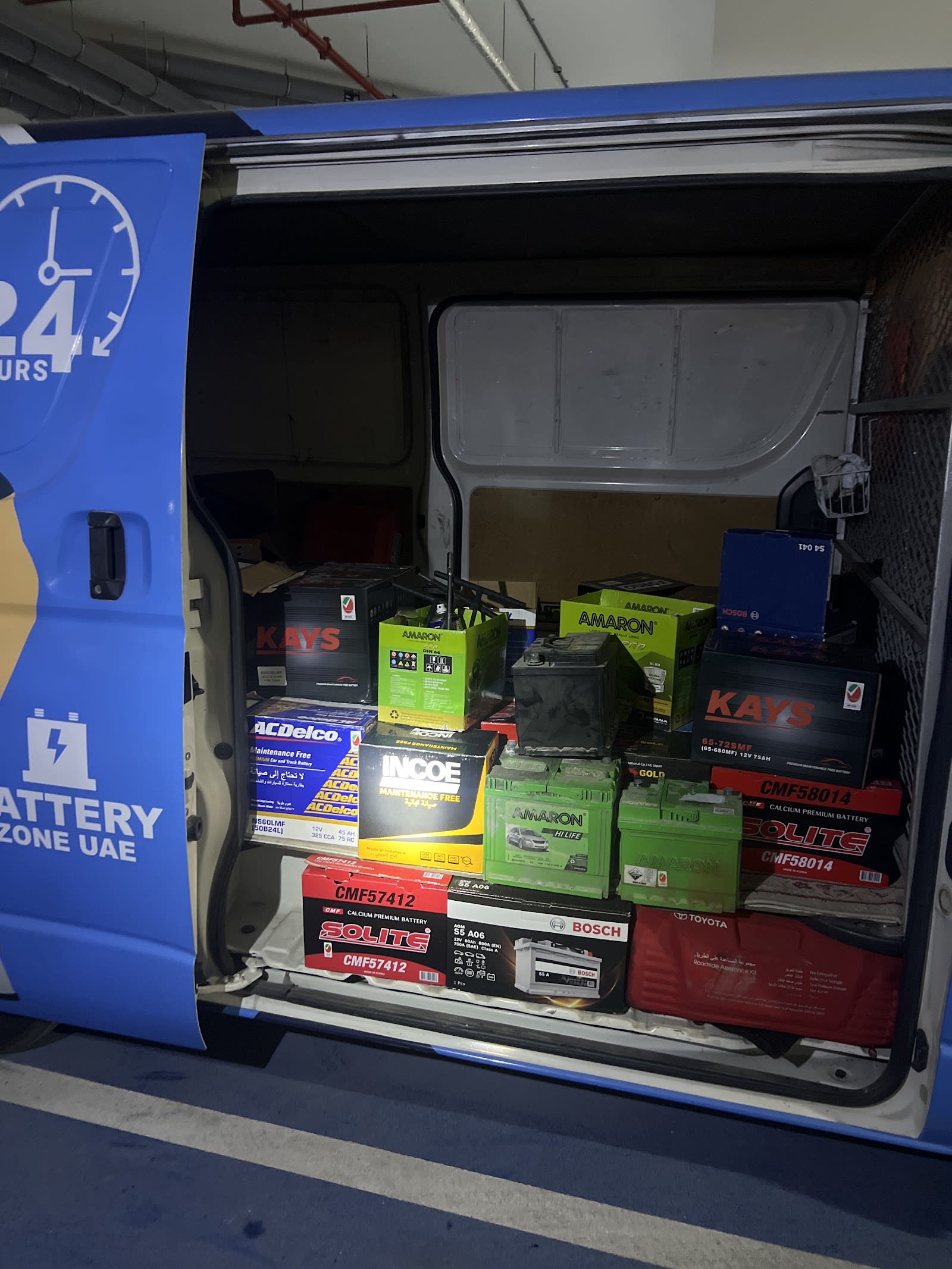 Top-Rated
Battery Zone UAE Dubai Car Battery Replacement
Dubai · Battery Zone UAE - Zaa'beel Second - DIFC - Dubai
 Top-Rated
Dial A Battery
Dubai · D19 Street - Al Qouz Ind.third - Al Quoz - Dubai
 Top-Rated
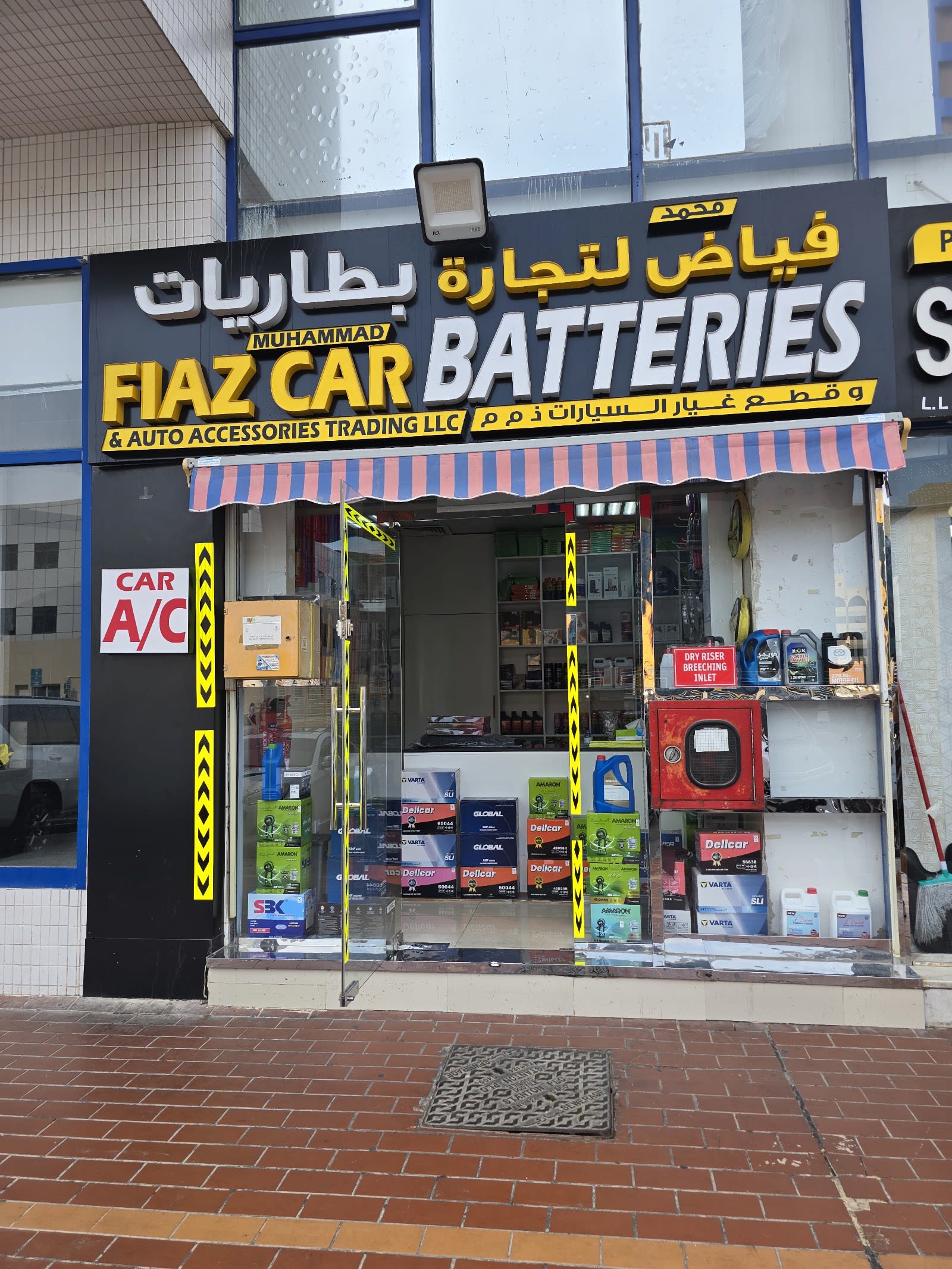
Fiaz car batteries
Abu Dhabi · :O H, mbny' srwr bn mHmd khlyfh - Al Danah - shrq h ,1 - Abu Dhabi
Where to actually buy this
Shops whose own website lists these parts, or whose stock we have recorded ourselves. Last checked July 2026. Not paid placement.
Stocks car batteries — aftermarket, new parts. It carries Amaron, Bosch, Varta and Acdelco and 4 more, fits what it sells and delivers to Dubai.
4.9 on Google from 43 reviews
Stocks car batteries — genuine and aftermarket, new parts. It carries Amaron, Varta, Bosch and ACDelco and 9 more, fits what it sells and delivers to Dubai, Abu Dhabi and Sharjah.
5.0 on Google from 18 reviews
Stocks car batteries — genuine and aftermarket, new parts. It carries Varta and Tuflong, fits what it sells and delivers to Abu Dhabi.
4.0 on Google from 10 reviews
Stocks car batteries — new parts. It carries Amaron, Bosch, Varta and Energizer and 5 more, fits what it sells and delivers to Dubai.
4.4 on Google from 247 reviews
Stocks car batteries — new parts. It carries Amaron, Exide, Bosch and Ac delco and 3 more, fits what it sells and delivers to Abu Dhabi.
4.9 on Google from 36 reviews
- Fasttrack Emarat MarwaFujairah
Stocks car batteries — genuine and aftermarket, new parts. It carries Bridgestone, Continental, Dunlop and Goodyear and 26 more and fits what it sells.
4.4 on Google from 121 reviews
Listings are compiled from each business’s own public information. If you run one of these shops and want the entry corrected or removed, email easycarpartsteam@gmail.com.
Ask a human · free · no account
Rather not ring around?
Tell us the car and the part once — we'll send you the shops that actually stock it.
Free · usually a reply in minutes · no obligation
Still easier on a form? The request goes to the same matched UAE suppliers, free, with only the number of shops you choose able to contact you.
Open the request formKeep reading
Batteries — FAQs
- How long does a car battery last in the UAE?
- Typically 24 to 36 months, against a design life of 4 to 5 years in a temperate climate. UAE workshops and retailers consistently report two to three years, and cars parked outdoors year-round often manage closer to two. The cause is heat: battery ageing roughly halves for every 10C of sustained operating temperature above 25C. The figure that drives service life is the sustained average the battery lives at, not the short peak an engine bay reaches on a July afternoon.
- How much does a car battery cost in Dubai?
- Based on UAE retailer and workshop listings observed in August 2026, roughly AED 180-330 for a small JIS battery, AED 250-450 for a mid-size, AED 300-560 for a common 80D26 size, and AED 400-960 for a large 105D31. AGM for stop-start and German cars runs roughly AED 650-1,300. Real listings show the spread inside a size: an 80D26L appeared at AED 388 for a budget brand and AED 555 for a well-known one. Size matters more than brand, because the cost is largely the lead. These are estimates interpolated from listings, not quotes — always confirm the price includes VAT, fitting and removal of the old battery.
- Is battery fitting free in the UAE?
- For a standard engine-bay battery it is normally included rather than charged separately, at a shop or through a mobile van. Several Dubai mobile operators state that their quoted price covers the battery, delivery, fitting, BMS coding where required, old battery disposal and VAT. A boot-mounted or under-seat battery may legitimately carry a labour charge. Ask what is included before you agree.
- What does 80D26L mean on a battery?
- It is a JIS code. 80 is a performance index that rises with capacity and cranking power, D is the case width and height class, 26 is the case length in centimetres, and L means the positive terminal is on the left when you face the terminals. An 80D26R is the same box with the terminals reversed, and the cables may not reach. Trade nicknames like NS70 map loosely onto these cases and are applied inconsistently by different suppliers — go by the printed code, not the nickname.
- Can I fit a battery with a higher CCA than the original?
- Yes, as long as it physically fits the tray, the terminals match and the hold-down clamps down properly. It will not damage anything. But the benefit here is small: CCA is measured at -18C, and for almost all UAE driving the coldest start of the year is far above that test point. Inland and mountain areas do get genuinely cold — the NCM recorded -1.7C at Raknah in 2021 and an all-time low of -5.7C on Jebel Jais in 2017 — but that is not the duty most cars see. If you are choosing between more CCA and more Ah for the same money, take the Ah.
- Do I need an AGM battery?
- Only if your car came with one, or if it has stop-start with regenerative braking. Most modern German cars and many recent European models require AGM. A car with no stop-start gains nothing measurable from AGM at two to two and a half times the price. Never downgrade an AGM or EFB car to a standard flooded battery. And to correct something often said locally: AGM is not a worse choice in heat than flooded — the literature generally reports AGM resisting heat-induced degradation better, because a vented flooded cell is the one exposed to evaporation.
- Why did my new battery only last a few months?
- Three usual causes. The alternator or regulator is over-volting on a conventional system, typically above 15 V, and cooking it. There is a parasitic drain above about 80 mA flattening it repeatedly. Or the car requires battery registration and the new battery was never coded, so the charging strategy is still tuned to the old one. A battery that sat in stock for many months in high ambient temperature before sale is a fourth possibility, which is why the date code is worth checking.
- What is battery registration and does my car need it?
- Modern cars with an intelligent battery sensor adapt their charging to the battery's age and type. After a replacement the car has to be told a new battery is fitted, otherwise it keeps using the old profile and either under- or over-charges. BMW and Mini call it BEM coding; Mercedes, Audi, VW, Porsche, Volvo and Land Rover have equivalents. Model-year cut-offs vary by marque, so ask about your specific car. In Dubai this is not a barrier to mobile fitting — established operators carry OBD tools and include coding, often at no extra charge — but confirm it is covered when you book.
- Will a weak battery fail the RTA vehicle test?
- The battery is not an inspection item in its own right on any published Dubai testing-centre scope we have seen, and we have not located an official RTA line-item checklist. What it can do is cause failures elsewhere: low system voltage produces spurious dashboard warning lights, dim lamps, a weak horn and slow windows and wipers, and lighting, horn and wipers are checked. An insecure, leaking or heavily corroded battery is also a straightforward safety concern. If a test is due and the battery is marginal, replace it first.
- Is a used battery from the Sharjah market worth buying?
- For batteries specifically, no. You cannot see the state of health at the point of sale, remaining life is unknown, and in this climate a second-hand battery has usually already spent its best years. Once you price in the missing warranty there is no real saving against a new budget battery. That is reasoning from how batteries age here rather than a surveyed finding, but the conclusion is not close. Sajaa and the Sharjah Industrial Area are genuinely useful for many other parts; this is not one of them.
- What is my old car battery worth?
- Less than commonly claimed. UAE scrap buyers quote roughly AED 15-30 for a typical used 12 V car battery, and bulk used lead-acid batteries trade nearer AED 2,000-2,500 per tonne locally. Do not estimate it from a lead price: refined lead is worth several times what a scrap battery fetches per kilo, because most of a battery's mass is casing, acid and non-recoverable material. On a single battery you are talking about tens of dirhams, but it should still be acknowledged as a deduction rather than quietly kept. Ask what they are giving you for it.
- Can I throw away a car battery in the UAE?
- No. A lead-acid battery is hazardous waste. In Dubai, Law No. (18) of 2024 Regulating Waste Management requires a permit from Dubai Municipality for waste-management activities including storing and treating hazardous waste, and Dubai Municipality Circular No. (3) of 2018 sets the specific rules for used lead-acid batteries and directs disposal through permit-holding collectors such as dealerships and battery shops. The obligation sits on the business, not on you. Hand it to the shop or mobile service fitting the new battery, which is both the compliant route and worth a little money to you.
- Why does my car battery die when I go on holiday for the summer?
- Two things acting together. Self-discharge is temperature-dependent: roughly 5-8 per cent of charge per month at 25C, rising to around 15-20 per cent per month at 45C. On top of that the alarm, telematics and sleeping modules draw a standing current of typically 20-50 mA. Over six to eight weeks in an outdoor space in July the combination can take the battery below 12.4 V resting, at which point sulfation starts hardening on the plates and permanently removing capacity. Either fit a smart maintainer or disconnect the negative terminal before you travel.
- Does idling with the AC on drain the battery?
- It can, depending on the vehicle. At idle the alternator output is at its lowest, while the AC compressor, both cooling fans and the blower at maximum represent a large load. Where demand exceeds what the alternator produces at 700-800 rpm, the battery covers the shortfall. It will not kill a healthy battery, but sustained high-load idling keeps the charging system near its ceiling and leaves less headroom to put charge back. We have no comparative UAE-versus-Europe cycling data, so treat that as a mechanism rather than a measured difference.
- Should I buy the battery with the highest Ah that fits?
- Within the same case family, going up one step is usually fine and gives you more reserve and more thermal mass, which helps in the heat. Do not fit a physically larger case that the tray and hold-down cannot secure. An unrestrained battery in a hot engine bay sheds plate material and can crack its case, and it is a safety issue as well as a durability one.
- How do I know the battery I am being sold is new?
- Check the date code punched or printed on the case or the sticker, and buy stock less than six months old. A lead-acid battery stored at high ambient temperature self-discharges at several times its 25C rate and can arrive already partly sulfated. Weight is worth a glance as a crude sanity check — a battery dramatically lighter than others of the same claimed capacity is worth questioning — but it is not a reliable test, because AGM, EFB and flooded of the same nominal Ah weigh different amounts. If you want certainty, buy from a seller who will put the brand, size, date code and warranty term in writing.
- My car starts on jump leads but dies again. Is it the battery?
- Probably not. If it runs perfectly on jump leads and dies the moment they come off, the alternator is not charging and the battery is a symptom. If it starts on jumps, runs, then goes flat again over a day or two, look for a parasitic drain. Only if it jump-starts, runs normally and then fails to start again after a normal drive cycle is the battery itself the likely culprit.
- What is the difference between EFB and AGM?
- Both are designed for stop-start. EFB is an enhanced flooded battery, quoted by manufacturers at roughly double the cycle life of a standard one (around 85,000 engine starts against about 30,000), and is fitted to entry-level stop-start cars without regenerative braking. AGM holds its electrolyte in glass mats, is sealed, takes charge much faster and is quoted at three to four times the cycling life, and is required on cars with regenerative braking. Those are manufacturer figures repeated across the industry rather than independently tested data. You can replace an EFB with an AGM but never the reverse.
Ask a human · free · no account
Still not the question you had?
Ask it directly — a person reads every message.
Free · usually a reply in minutes · no obligation