Brake pads, discs, calipers and brake fluid for your car in the UAE
The quick answer
Brakes are the one system on your car where the difference between a good part and a cheap part is measured in metres of stopping distance. A 2.7-tonne Nissan Patrol braking from 120 km/h has to dissipate roughly 1.5 megajoules of kinetic energy as heat, against about 540 kilojoules for a 1.4-tonne Corolla stopping from 100 km/h — nearly three times the thermal load. That physics is identical in Munich and in Dubai; nothing in the energy calculation is UAE-specific. What is specific here is the mix and the environment. The UAE parc is skewed heavily towards vehicles at the Patrol end of that range, it runs them into 45°C air that carries heat away more slowly, and it parks them in stop-start traffic where the discs never get back to a cold baseline. That is why a service interval written for a European fleet mix travels badly, and why the honest answer to "how long do pads last here" is a band rather than a number.
Ask a human · free · no account
Not sure which part fits your car?
Tell us the make, model and year — we check fitment and come back with prices from UAE sellers who have it on the shelf.
Free · usually a reply in minutes · no obligation
Key facts
- A 2.7 tonne Nissan Patrol braking from 120 km/h dissipates roughly 1.5 MJ of kinetic energy, against about 540 kJ for a 1.4 tonne Corolla from 100 km/h - nearly three times the thermal load. That physics is identical anywhere; what is UAE-specific is that the local parc is skewed heavily towards the heavy end of that range and runs it at 45C, which is why a service interval written for a European fleet mix travels badly.
- Assuming 70% front brake bias, a single 120 km/h stop in a 2.7 t SUV puts about 525 kJ into each front disc. At an assumed 9 kg of iron per disc and 460 J/kg-K that is a rise of about 127C; at 12 kg, closer to a Patrol- or LC300-class front disc, about 95C. Call it 90-130C before any cooling occurs - the disc mass is an assumption, not a measurement.
- At a given disc temperature, 45C air carries away roughly 5-7% less heat than 20C air (convection alone is 6.6% less; radiation from a 400C disc falls only about 1.4%). Separately and more importantly, at steady state the whole system sits about 25C hotter - simply because the air it dumps into is 25C hotter - so caliper, piston seal and fluid all start from a higher baseline.
- Sheikh Zayed Road is posted at 120 km/h on parts of its length but drops to 100 between Dubai World Trade Centre and Interchange 2. Al Khail Road (E44) is posted at 100, raised to 110 only on some sections such as Business Bay Crossing to Meydan. It is not a 120 road.
- Dubai's traffic pattern combines sustained high-speed running with long stationary periods. The two do different damage: the high-speed stop-go generates the heat, and the stationary periods prevent it escaping. Holding the car against transmission creep causes essentially zero pad wear, because there is no relative motion at the interface - the harm is thermal.
- Holding the brake pedal at a long signal with hot discs imprints pad material onto one spot, producing disc thickness variation and judder. Shift to neutral rather than using the electronic parking brake: on most cars the EPB clamps the rear calipers, so it protects the hot front discs by doing the same thing to the hot rear ones.
Rather fill in a form? Send the same request here and matched UAE suppliers reply on WhatsApp either way.
Open the request formBrakes — types and specifications
- Brake pads
- Front and rear friction sets by compound
- Brake discs
- Vented, solid and slotted rotors
- Brake calipers
- New, remanufactured and seal kits
- Brake fluid
- DOT 3, DOT 4, DOT 4 LV, DOT 5.1
- Caliper slide pin kits
- Pins, boots and silicone or PAG brake grease
- Brake pad wear sensors
- Single-use, replace with every pad set
- Brake hoses
- Flexible lines, a 6 to 10 year item by general guidance
- Brake master cylinder
- Pressure generation and boosters
- Brake drums and shoes
- Rear drum systems and parking brake shoes
- ABS sensors
- Wheel speed sensors and reluctor rings
- Brake pad hardware kits
- Shims, clips and abutment plates
- Handbrake cables
- Parking brake cables and adjusters
How a disc brake works, and why 45C changes the arithmetic
A disc brake is a machine for converting motion into heat and then throwing that heat away. Understanding the second half is what makes this page useful in the Gulf.
1. You press the pedal. A pushrod moves a piston in the master cylinder, pressurising the brake fluid. Pedal effort is multiplied by the vacuum or electric booster — typically around 4:1 to 5:1 for a single-diaphragm servo, higher for a tandem or dual-diaphragm unit — and again by the pedal's own leverage.
2. Fluid pressure — commonly 40 to 100 bar in a hard road stop, and over 150 bar in a panic stop — travels through steel lines and flexible hoses to each caliper.
3. The pressure acts on the caliper piston area. A single 57 mm piston at 80 bar produces about 20 kN of clamp force per piston face (that is our own arithmetic from the piston area and the pressure, not a manufacturer figure). That squeezes the pads against both faces of the disc.
4. Friction between pad and disc converts the car's kinetic energy into heat. Peak interface temperatures in a hard stop are commonly quoted at 500–700°C; sustained descent or repeated high-speed stops can push a front disc past 700°C, at which point the disc glows visibly at night.
5. The disc dumps that heat to the air — by convection through the internal vanes on a vented disc, and by radiation from the faces. This is the step the UAE makes harder.
The heat maths, with the assumptions on the table. Take the Patrol stop above: 1.5 MJ total, roughly 70% of it through the front axle, so about 1.05 MJ into two front discs — 525 kJ per front disc. Grey cast iron has a specific heat capacity of about 460 J/kg·K. The answer then depends entirely on disc mass, which is the number nobody publishes. At an assumed 9 kg per front disc the temperature rise is about 127°C; at 12 kg, which is closer to what a Patrol- or Land Cruiser 300-class front disc actually weighs, it is about 95°C. So: roughly 90 to 130°C from a single 120 km/h stop, before any cooling occurs at all. Three of those in quick succession on the way to a merge and you are at working temperatures where pad compound choice stops being a comfort preference. We are being explicit about the disc mass because it is an assumption, not a measurement — if you want the real number for your car, weigh the old disc when it comes off.
Now the cooling side, and here two separate things get conflated everywhere else.
The first is real and modest. At a given disc temperature, hotter ambient air carries away less heat. A disc at 400°C in 20°C air has a 380°C driving difference for convection; in 45°C air it has 355°C — about 6.6% less convective cooling at identical airflow. Radiation is far less sensitive: from a 673 K disc, raising ambient from 293 K to 318 K costs only about 1.4%. Combined, call it 5–7% less heat rejection. On one stop that is nothing.
The second is bigger and is not a consequence of the first. At steady state, the whole system simply sits about 25°C hotter — because that is exactly how much hotter the air it is dumping into is. Under linear convection at a fixed heat input, equilibrium temperature rises by the ambient rise; adding radiation makes it slightly less than 25°C, not more. It is an identity, not a computed result, and it matters more than the percentage: the caliper starts 25°C hotter, the piston seal starts 25°C hotter, and the fluid sitting behind that piston starts 25°C hotter before you have asked the car to do anything demanding.
That is the entire UAE brake story in one sentence — nothing here fails because of one stop; things fail because the system never returns to a cold baseline.
What the braking system is made of
When a garage quotes you "a brake job", these are the parts that can legitimately appear on the invoice. Knowing the list is the cheapest defence against being sold four items when you needed one.
Brake pads — friction material bonded or riveted to a steel backing plate. Consumable. New friction material is typically 8–12 mm on a passenger car. Be careful with quoted figures: a "12 mm pad" often means total thickness including the 4–6 mm steel backing plate, so always establish which number you are being given. Replacement is normally recommended at 3 mm of friction material — that is a service recommendation, not a UAE legal minimum, and no such legal minimum is published.
Brake discs (rotors) — the grey cast iron ring the pads clamp. Consumable, but on a much longer cycle than pads.
Calipers — the hydraulic clamp. Single-piston sliding (most cars, most rear axles), twin-piston sliding, or fixed multi-piston (performance cars, some large SUVs). Not a consumable, but a common UAE failure point.
Caliper carrier / bracket and slide pins — the sliding caliper's guide rails, with rubber boots and specialist grease. Cheap. Ignored. The cause of most uneven-wear complaints we see.
Pad hardware kit — anti-rattle clips, shims, abutment plates. Often supplied with quality pads; often reused by lazy fitters, which causes noise.
Brake fluid — the hydraulic medium and, as covered below, a consumable with a life measured in years rather than kilometres.
Flexible brake hoses — rubber, and rubber is the material heat and UV punish hardest. General industry guidance is replacement at 6–10 years regardless of appearance; there is no UAE-specific regulatory or manufacturer mandate behind that band.
Master cylinder and booster — pressure generation.
Wear sensors — a wire loop in the pad that grounds against the disc and lights a dash warning. Common on German cars; usually a separate consumable at AED 15–60 each, and single-use.
Rear drums and shoes — still fitted to the rear of some small cars and pickups.
Parking brake — either a separate drum-in-hat shoe set, a cable-actuated mechanism in the rear caliper, or an electric motor on the caliper (EPB), which needs a scan tool to retract.
ABS / ESP — wheel speed sensors, hydraulic modulator, control unit. Not friction parts, but an ABS fault light will fail a vehicle inspection.
Brake pad compounds: the honest comparison
There are four broad friction families, and the marketing around them is worse than in almost any other parts category. The short version: there is no compound that is best at everything, and the most expensive box on the shelf is frequently not the one that stops your car in the shortest distance.
Organic / NAO (non-asbestos organic) — glass, rubber, aramid and resin fibres with little or no metal. Quiet, gentle on discs, low dust. They fade badly above roughly 250–300°C and wear quickly under load. Fine on a light city car. A poor choice on anything over two tonnes here.
Semi-metallic — 30–65% steel wool, iron powder and copper by weight. High and stable friction to 500°C and beyond, and they conduct heat well, which pulls heat out of the friction interface. That last property cuts both ways: the heat has to go somewhere, and where it goes is the caliper and the fluid. Noisy, dusty, and hardest on discs. This is the classic heavy-duty and pickup compound.
Low-metallic NAO ("low-met") — an organic matrix with 10–30% steel or copper added. This is what most European manufacturers fit as original equipment, and for a reason: it has close to semi-metallic bite and heat range with much of the organic pad's manners. It dusts, and the dust is dark and sticks to alloy wheels. On a heavy UAE SUV this is very often the correct answer.
Ceramic — ceramic and copper fibres in a denser matrix. Genuinely quiet, genuinely low dust, and the dust is light-coloured so wheels look cleaner. But ceramics generally have lower cold friction, are more expensive, and — the part nobody says — they are relatively poor thermal conductors compared with semi-metallics, so they tend to keep heat in the disc rather than drawing it into the pad. On a 2.5-tonne vehicle that is not automatically a benefit. To be straight with you: the conductivity comparison is a qualitative, directionally accepted point in friction-material engineering, and we are not going to attach a number to it. Several ceramic formulations sold as premium are optimised for noise and dust on mid-size sedans and are simply out of their depth on a loaded Land Cruiser.
Reading the edge code. Most pads carry a two-letter SAE J866 friction code stamped on the backing-plate edge, e.g. FF. The first letter is normal (cold) friction, the second is hot friction. The scale is: C = up to 0.15, D = 0.15–0.25, E = 0.25–0.35, F = 0.35–0.45, G = 0.45–0.55, H = above 0.55 μ. A pad coded FF holds its friction when hot; a pad coded FE loses grip as it heats. This is one of the few pieces of hard data printed on a cheap pad, and it is worth thirty seconds with a torch. The honest caveats, and they are significant: the code is self-declared, it is an average over a test schedule, the hot test runs only to about 345°C (650°F) — so the code tells you nothing about what happens above that — and it says nothing at all about wear rate or noise. Use it to reject the obviously weak, not to rank the good.
Who should not buy the expensive pad. If you drive a 1,300 kg hatchback in Dubai Marina, almost never exceed 80 km/h, and care about clean wheels, a mid-price ceramic or OE-grade organic pad is the right purchase and a performance low-met is a waste of money and a dirty wheel. Conversely, if you tow, run a full car of passengers to Hatta or Jebel Jais, or drive a body-on-frame SUV at highway speed, do not buy the quiet, clean pad. Buy the one that still has friction at 500°C and accept the dust.
| Compound | Typical metal content | Cold bite | Above 400C | Disc wear | Dust and noise | Best for | Avoid on |
|---|---|---|---|---|---|---|---|
| Organic / NAO | 0-10% | Good | Poor - fades from ~250-300C | Lowest | Low dust, quiet | Light city cars, rear axles, low-speed use | Anything over 2 t, towing, sustained high speed |
| Low-metallic NAO | 10-30% | Very good | Good to ~550C | Moderate | Dark dust, some noise | European OE replacement; heavy SUVs; UAE highway driving | Owners who cannot tolerate wheel dust |
| Semi-metallic | 30-65% | Fair cold, strong hot | Very good, 550C+ | Highest | Heavy dust, prone to squeal | Towing, pickups, heavy loads, track days | Quiet-cabin luxury cars; systems with marginal fluid |
| Ceramic | Low, plus ceramic fibres | Weakest of the four | Stable to ~400-500C, then falls away | Low | Lightest dust, quietest | Sedans, comfort priority, clean wheels | 2.5 t+ SUVs used hard; heavy braking from 120 km/h |
Brake discs: solid, vented, drilled, slotted, and the drilled verdict
A brake disc is grey cast iron for one reason — it is cheap, it machines well, it damps vibration, and its ~460 J/kg·K heat capacity combined with a mass of several kilograms lets it act as a thermal buffer. Everything else is a variation on how you get air through it.
Solid discs are a single plate, typically 8–14 mm thick. Adequate for the rear axle of most cars and the front of small ones, because the rear axle sees only a minority of the braking work.
Vented discs are two plates separated by internal vanes, typically 20–32 mm total on passenger cars and SUVs, with 30–60 vanes. The vanes act as a centrifugal fan. On directional-vane discs there is a left and a right part number, and fitting them the wrong way round cuts cooling airflow substantially — an error that is easy to make and invisible once the wheel is on.
Cross-drilled discs. The holes existed originally to vent gases from asbestos-era pads that outgassed under heat. Modern pads barely outgas. What remains is: less mass, less swept area, a cosmetic appeal, and a set of stress raisers. Every hole is a crack initiation site, and in a climate where the disc is already running hotter and where a driver may hit a puddle after a car wash with a 400°C disc, cracks radiating from the drillings are a normal outcome rather than an exotic one. Drilled discs also chew pads faster because each hole edge is effectively a cutting edge passing the pad face thousands of times a minute. Verdict: for a UAE road car, cross-drilled discs are the wrong choice. They are a downgrade sold as an upgrade. The exception is a genuine cast-in-hole disc from a manufacturer's own performance division, where the holes are cast rather than drilled through the iron grain — those are a different and far more expensive object, and they still wear pads faster.
Slotted discs have shallow grooves machined into the face. They shear off the glazed surface layer and give gas and dust somewhere to go, without introducing through-holes. Pad wear increases modestly. For a heavy SUV that tows, or for a driver who does repeated hard stops, a slotted disc is a defensible upgrade in a way a drilled one is not. It will be noisier at low speed.
Two-piece / floating discs use an aluminium hat bolted or pinned to an iron friction ring. Less mass, and critically the iron ring can expand without dragging the mounting face with it, which reduces coning and thermal judder. Expensive, and rarely available for mainstream models.
Carbon-ceramic (CCB / PCCB) discs tolerate over 1,000°C, weigh roughly half of iron, and effectively do not fade. They also have weak cold friction, are extremely expensive to replace, are damaged by fitting the wrong pad, and are sensitive to impact. They are correct on a supercar and nowhere else. If your car came with them, budget accordingly and do not let a general garage fit iron-disc pads to them.
| Type | Typical thickness | Advantages | Disadvantages | UAE verdict |
|---|---|---|---|---|
| Solid | 8-14 mm | Cheap, simple, light | Limited heat capacity, fades under repeated load | Fine on rear axles and small cars only |
| Vented | 20-32 mm | Internal fan cooling, high heat capacity, standard OE | Heavier, vanes can pack with dust and sand | The default correct choice for almost every UAE front axle |
| Cross-drilled | Varies | Looks fast, marginally lighter | Crack initiation at holes, faster pad wear, reduced swept area | Avoid. A downgrade sold as an upgrade in this climate |
| Slotted | Varies | Cleans the pad face, no through-holes, no crack sites | Faster pad wear, low-speed noise | Defensible for towing and heavy SUVs; unnecessary otherwise |
| Two-piece / floating | 28-36 mm ring | Less coning and thermal judder, lower unsprung mass | Cost, limited availability, ring wears out separately | Excellent if offered for your car and you can justify the price |
| Carbon-ceramic | 32-40 mm | 1,000C+ capable, ~50% lighter, effectively fade-free | Very poor cold bite, extreme cost, pad-compound sensitive | Only if factory-fitted. Never mix with iron-disc pads |
Front versus rear: why the front does most of the work
Under braking, weight transfers forward. The car pitches, the front tyres are pushed into the road and the rear tyres unload. Because friction available at a tyre is proportional to the load on it, the front axle typically does 70–80% of the braking on a road car, and more on a hard stop in a nose-heavy vehicle. (The 70% figure is the one used in the disc-temperature calculation earlier on this page — it is the bottom of the normal band, deliberately, so the temperature estimate is conservative.)
That single fact explains almost every difference you will see between front and rear brakes:
Front discs are vented; rear discs are frequently solid or thin vented.
Front discs are larger in diameter — often 30–60 mm larger than the rears on the same car.
Front calipers have larger or more numerous pistons.
Front pads wear roughly two to three times faster than rear pads. A common service pattern is two sets of front pads for every one set of rears.
Rear discs on some cars nonetheless wear out before the rear pads, because the parking-brake mechanism and lower rear pad pressure lets a thin rear disc corrode and score unevenly.
This is proportioned by the EBD function in the ABS module on modern cars, and by a mechanical proportioning valve on older ones. It is why fitting aggressive pads to only one axle is a bad idea — you change the front/rear balance the manufacturer engineered, and on a wet or sandy surface that shows up as premature rear lock-up or, more commonly, ABS intervening earlier and stopping distance getting longer.
How to tell your brakes are worn: measure, do not guess
Most brake quotes in this market start with a mechanic looking through a wheel and saying "finished". Some of them are right. Here is how to check for yourself, with numbers.
Pad thickness. Look through the wheel spokes at the outer pad. Friction material sits on a steel backing plate roughly 4–6 mm thick — do not count the backing plate. New friction material is typically 8–12 mm on a passenger car. Replace at 3 mm. At 2 mm you are on borrowed time; below that the rivets or backing plate start scoring the disc and a AED 300 pad job becomes a AED 1,500 pad-and-disc job. Note that the inner pad is the one that usually wears faster and it is the one you cannot see, so a 6 mm outer pad does not mean you have 6 mm.
Disc thickness — the MIN TH figure. Every disc has a minimum thickness cast or stamped into it, usually on the hub face or the outer edge, marked MIN TH, MIN. THICKNESS or just a number in millimetres. It is not the same as the machining limit. Measure with a micrometer or vernier at several points about 10 mm in from the outer edge, past the wear lip. Typical workshop wear allowance on a vented passenger-car disc is 2–3 mm total — 1–1.5 mm per face; on a thin solid rear disc it can be as little as 1–1.5 mm total. These are widely used reference values rather than figures from any one manufacturer's manual, so if you have the manual, use its number. Once you are at or below MIN TH the disc is scrap — it has lost heat capacity and mechanical strength and it will crack or cone.
Lipping. Run a fingernail across the outer edge of the disc. A pronounced ridge where the pad has not swept means the centre of the disc has worn down. A lip of about 1.5 mm or more is a strong hint you are near the wear limit even before you measure.
Judder under braking. A pulsing pedal or a steering-wheel shimmy that appears only when braking from speed is almost always disc thickness variation (DTV) rather than "warping". Iron discs do not warp in the sense people mean; they wear unevenly and pick up uneven pad transfer film. The threshold is startlingly small: 0.010–0.015 mm of thickness variation is enough to feel through the pedal. Lateral runout above roughly 0.05 mm measured with a dial gauge will generate DTV over a few thousand kilometres. Runout is often caused by rust or dirt between the disc and the hub face, or by uneven wheel-nut torque — both of which are fitting errors, not part failures.
Pulling to one side. The car steers left or right under braking. Usually a seized caliper slide pin or piston on the side that is not pulling, sometimes a collapsed flexible hose acting as a one-way valve, occasionally mismatched pads left to right.
A long or spongy pedal. Air in the system, a fluid leak, or fluid that has boiled. A pedal that sinks slowly under steady foot pressure is a failing master cylinder.
Squeal versus grinding. A high squeal is often just vibration — glazed pads, missing shims, or a wear indicator tab contacting the disc at about 3 mm remaining. A metallic grinding noise is backing plate on iron. Stop driving it.
| Symptom or check | What it means | Criterion | Action |
|---|---|---|---|
| Pad friction material thin | Normal wear | Replace at 3 mm; new friction material is 8-12 mm (excluding backing plate) | Replace pads in axle pairs |
| Disc at or below MIN TH | Disc at end of life | MIN TH cast on the disc; typical allowance 2-3 mm total on vented | Replace discs in axle pairs; never machine below MIN TH |
| Ridge / lip on disc outer edge | Substantial disc wear | Lip of ~1.5 mm or more | Measure thickness before deciding |
| Pulsing pedal, steering shimmy when braking | Disc thickness variation (DTV) | 0.010-0.015 mm variation is enough to feel; runout limit ~0.05 mm | Check runout and hub cleanliness; replace or refinish discs |
| Car pulls to one side under braking | Seized slide pin or piston, or collapsed hose | Uneven pad thickness left vs right, or inner vs outer | Free or replace caliper; check hoses |
| Inner pad far thinner than outer | Sliding caliper not releasing | Difference of 3 mm or more across one caliper | Service slide pins and boots; do not just fit new pads |
| Long or spongy pedal | Air, leak, or boiled fluid | Pedal travel increases when hot | Bleed and test fluid moisture; inspect for leaks |
| Pedal sinks slowly under steady pressure | Internal master cylinder leak | Any continuous sink with no external leak | Replace master cylinder |
| Squeal at low speed | Glazing, missing shims, or wear indicator | Often accompanies pads near 3 mm | Inspect; fit hardware kit and correct grease |
| Metallic grinding | Backing plate contacting disc | Zero friction material remaining | Stop driving. Pads and almost certainly discs |
| Brake warning light with no low fluid | Wear sensor circuit grounded | Sensor wire worn through | Replace pads and the sensor - sensors are single use |
Not sure what you're looking at? Send a photo and the car — we'll tell you what you're seeing and what the parts cost. Free, no form.
Why pads and discs go in axle pairs
This is the rule garages state and rarely explain, so here is the explanation.
Friction must match side to side. Two pads from different production batches, let alone different compounds or different states of wear, will not produce identical friction coefficients at the same temperature. A 10% difference in μ between left and right on the front axle produces a measurable yaw moment under braking: the car steers itself. In a roller brake test — which is how UAE vehicle inspection actually measures brakes — that shows up directly as side-to-side imbalance.
The ABS and stability systems assume symmetry. EBD and ESP calculate expected wheel behaviour from a model. Asymmetric friction makes the module intervene where it should not, and in a genuine emergency stop the earlier intervention lengthens the stop.
New pad against worn disc is a bad marriage. A worn disc has a wear lip and a slightly concave swept face. A flat new pad bedded onto it makes contact over only part of its area at first — we are not going to invent a percentage, but the effect is real and well understood: the same clamp force concentrated on less area produces local overheating, glazing, and a pedal that feels wooden for the first few hundred kilometres. It also means you have paid for pads and are not getting their performance.
Discs in pairs, likewise. Replacing one disc gives you a thick new disc on one side and a thin near-limit disc on the other. They have different heat capacities, so under repeated braking they run at different temperatures and therefore different friction. Same problem, same imbalance on a roller tester.
What does not have to be done in pairs: you can replace front pads without touching the rears, and you can replace pads without replacing discs — provided the discs measure above MIN TH, have no significant lip, no cracks, and no heavy scoring. A garage that insists discs must always be replaced with pads is either being cautious or being commercial. Measure and decide.
One caveat worth stating for this market: discs here are frequently replaced rather than skimmed. Machining a disc removes thickness, and thickness is heat capacity — the one thing a UAE front axle has least of to spare. A disc skimmed close to MIN TH is a strong candidate to return with judder. Where a new aftermarket disc pair for a common sedan is in the low hundreds of dirhams, machining is often false economy. That is a judgement from how the arithmetic works, not from a controlled study.
Brake fluid, DOT ratings, and why Gulf humidity makes the flush interval a ceiling
Brake fluid is the most neglected safety-critical consumable on a car in the UAE, and it is neglected because nothing about it looks urgent.
Standard automotive brake fluid — DOT 3, DOT 4 and DOT 5.1 — is glycol-ether based and hygroscopic: it actively pulls water vapour out of the air. It has to be, because the alternative is water pooling as free droplets at the lowest, hottest point in the system, which is the caliper. So the fluid absorbs it and holds it in solution. The cost of that design decision is that the fluid's boiling point falls continuously from the day the bottle is opened.
The specification numbers make the consequence obvious. DOT 4 has a minimum dry boiling point of 230°C and a minimum wet boiling point of 155°C — a 33% drop — where "wet" is defined as 3.7% water by volume. Glycol fluid in service is commonly quoted as taking up around 1–2% water per year, which puts a two-to-three-year-old fluid at or near its wet rating. Those uptake figures are generic industry numbers, not measurements from this climate.
Why the mechanism is worse here — and where the evidence runs out. Water enters through the reservoir (older caps vent directly; most modern reservoirs use a rubber diaphragm that slows but does not stop it) and, over years, by permeation through the flexible hoses, which are themselves running hot. The rate at which water enters depends on the absolute humidity of the air, not the relative humidity, and that half of the argument is arithmetic you can check: coastal UAE summer air at 35°C and 70% RH carries roughly 28 g of water per cubic metre, against roughly 10 g/m³ for a 20°C, 60% RH European summer day. Nearly three times the water available. What nobody has published is a measured UAE-specific absorption rate — so the honest statement is that the driving force is clearly higher here and the mechanism is well understood, but the acceleration factor is not quantified. Treat the 24-month flush as a ceiling rather than a target, and test annually, which is cheap and settles the argument for your specific car.
What boiled fluid feels like. Nothing, until it does. The pedal goes to the floor on the third or fourth hard stop and comes back after a minute of cooling. Water in solution boils at a far lower temperature than the fluid; the vapour is compressible, so pedal travel goes into compressing a gas bubble instead of clamping the pads.
Checking it. An electronic brake fluid tester reads water content in seconds and most workshops have one; above 3% is a flush, above 2% plan one. Colour is a crude proxy at best — fresh fluid is straw-coloured, degraded fluid is dark brown — but colour tells you about oxidation and contamination, not water content, and it is not a substitute for a tester or test strip.
Which grade. Use what the manufacturer specifies, printed on the reservoir cap. You may go up the glycol ladder (DOT 3 → DOT 4 → DOT 5.1) without harm; you must never go down, and you must never put DOT 5 silicone fluid into a system designed for glycol. DOT 5 is a completely different chemistry, does not mix with DOT 3/4/5.1, and is generally unsuitable for ABS systems. Do not be misled by the numbering: DOT 5.1 is glycol, DOT 5 is silicone.
A further note for heavy vehicles: many manufacturers specify DOT 4 LV (low viscosity) for cars with ESP and automatic emergency braking, because the ESP pump has to move fluid quickly through fine orifices. Fitting a thicker fluid can slow system response. Check the cap, not the shelf.
| Grade | Chemistry | Min dry boiling point | Min wet boiling point | Mixable with DOT 3/4/5.1 | Realistic UAE interval |
|---|---|---|---|---|---|
| DOT 3 | Glycol ether | 205C | 140C | Yes | 12-24 months; do not stretch it |
| DOT 4 | Glycol ether + borate ester | 230C | 155C | Yes | 24 months maximum |
| DOT 4 LV | Glycol, low viscosity | 230C | 155C | Yes | 24 months; required by some ESP systems |
| DOT 5.1 | Glycol ether | 260C | 180C | Yes | 24 months; absorbs water at the same rate |
| DOT 5 | Silicone | 260C | 180C | NO - never mix | Not hygroscopic, but unsuitable for most ABS cars. Avoid unless specified |
Calipers: the part that fails here and nobody budgets for
In northern Europe calipers seize because road salt corrodes the piston. There is no road salt here, so the local assumption is that calipers are permanent. They are not — and in our experience the local failure route is different.
A sliding caliper — the type on the vast majority of cars and on almost all rear axles — floats on two guide pins that let the caliper body centre itself over the disc. Each pin runs in a bore, is packed with a brake-specific silicone or PAG (polyalkylene glycol) grease, and is sealed by a rubber boot. Three things attack that assembly here:
1. Heat. The grease runs at caliper temperature, which as established sits higher here. Wrong-family greases thin, migrate and eventually carbonise into a hard varnish that locks the pin in the bore.
2. Dust. If a boot has split, airborne dust gets into the bore and turns the remaining grease into a grinding paste.
3. UV and ozone on the boots. The rubber hardens, cracks at the fold, and the split lets in point 2.
Get the grease chemistry right, because most people do not. The correct products are silicone-based or PAG-based. Ordinary lithium grease and copper anti-seize are the two things that get used when nobody is checking, and the primary reason to avoid them is not temperature — it is elastomer compatibility. Both are petroleum-derived and will swell and degrade the EPDM rubber slide-pin boots and piston seals. Copper anti-seize is additionally not a lubricant at all and promotes galvanic action. Note also that PAO (polyalphaolefin) is a synthetic hydrocarbon, not a substitute for PAG despite the similar abbreviation — if a tin says PAO, it belongs to the family you are trying to avoid on rubber-sealed brake hardware.
The result of a seized slide is a caliper that clamps but does not fully release, or that clamps unevenly. The signature is unmistakable once you know it: the inner pad worn to 2 mm while the outer pad still has 8 mm, or the reverse. That wear pattern is well understood mechanically — on a floating caliper the piston-side inner pad keeps working while the outer barely moves. Whether it is more common in the UAE than elsewhere, and whether heat and dust rather than corrosion dominate as the cause, we cannot show you data for; it is a field observation from this market, offered as one.
The caliper piston can also stick, usually because the square-section piston seal has heat-hardened and lost the elastic "roll-back" that retracts the pad about 0.1–0.15 mm when you release the pedal (a standard engineering reference figure). A caliper that drags produces a hot wheel, a burning smell, a disc with a blue heat-tint, fuel consumption that quietly rises, and a pad that is finished in a few thousand kilometres.
What to do. On every pad change, insist that the slide pins are removed, cleaned, inspected for scoring, re-greased with brake-specific silicone or PAG grease, and fitted with new boots if the old ones are marked at all. A boot and pin kit is cheap. On any caliper showing drag, a seal and piston kit is the economical repair if the bore is clean; if the bore is pitted, fit a remanufactured or new caliper. Reject any caliper — new or used — that arrives with a rusty or scored piston.
The used-caliper question. Unlike pads and discs, a used caliper from the Sharjah market is often a reasonable buy, because the failure modes are visible and the part is rebuildable. Inspect the bore, fit a new seal kit and new boots, and it is a sound repair at a fraction of dealer money. Do not do this with a caliper whose casting shows cracks around the mounting ears.
How long brakes actually last in the UAE
There is no single answer, and any page that gives you one is guessing. What follows are bands by driving profile. They are engineering-judgement estimates for UAE conditions rather than measured data, and we would rather say so than dress them up.
The determinants are: vehicle mass, how often you convert speed to heat, and whether the brake gets a chance to cool. Dubai's traffic pattern is unusually hard on brakes because it combines both extremes — sustained high-speed running followed by long stationary periods.
On the speeds, since people quote them loosely: Sheikh Zayed Road is 120 km/h on parts of its length but drops to 100 between Dubai World Trade Centre and Interchange 2. Al Khail Road (E44) is posted at 100, raised to 110 only on some sections such as Business Bay Crossing to Meydan. It is not a 120 road.
Two mechanisms, and they are not the same thing. The high-speed stop-go is what generates the heat. The long stationary periods are what stop it escaping. Holding the car against transmission creep at a signal produces essentially zero pad wear — there is no relative motion at the interface — so the harm is thermal, not abrasive. Specifically:
Holding the pedal at a long signal with hot brakes transfers pad material onto one spot of the disc. That patch has different friction and slightly different thickness from the rest, and it grows over subsequent stops into judder. This mechanism is described in the technical literature of several major friction manufacturers and is well supported. Where the light is long, shift to neutral, or at least let the car creep a few centimetres so the pad is not resting in one place. A note on the common advice to use the electronic parking brake instead: on most cars the EPB actuates the rear calipers, so it saves your hot front discs while clamping the hot rear ones. Neutral is the cleaner recommendation.
Airborne dust gets into the pad-disc interface. On the abrasion argument specifically, be careful with the popular claim that Gulf dust is silica-rich: published characterisation of dust in the UAE finds it dominated by carbonate minerals — calcite and dolomite — with quartz as a secondary component. That matters, because calcite is about Mohs 3 and cast iron is around Mohs 4–5, while quartz is Mohs 7. Only the quartz fraction is meaningfully abrasive against iron, so dust is a real but smaller contributor than "desert sand grinds your brakes away" implies. We are not going to put a number on the life it costs, because there is not one.
After a shamal or any desert driving, wash the wheels and brakes with water and let them dry with gentle use. Dust and sand do pack into the vanes; how much cooling that actually costs has not been measured that we can find, but the wash costs nothing.
Never hose down brakes that are still hot from a hard drive. Thermal shock into hot iron is one of the few things that genuinely cracks a disc.
A car left standing for weeks at an airport car park in humidity develops a rust film on the discs; the first few stops sound and feel awful and then clear. That is normal. Rust that has pitted the swept face, after months, is not.
On mountain descents — Jebel Jais, Jebel Hafeet, Hatta. Fresh fluid buys you margin, but it is not the fix, and it would be an upsell to present it as one. A driver riding the brakes down 11.7 km of Jebel Hafeet or the long Jebel Jais descent will overheat fresh DOT 4 too. Descend in a low gear so the engine does the braking, and stop to let the brakes cool rather than riding them. Old, wet fluid removes the margin you need for when you get that wrong — which is why a flush before a mountain trip is worth the money, as insurance behind the technique rather than instead of it.
| Profile | Front pads | Front discs | Rear pads | Brake fluid | Notes |
|---|---|---|---|---|---|
| Light sedan, mostly city, gentle driver | 40,000-60,000 km | 80,000-120,000 km | 70,000-100,000 km | 24 months | Discs often outlast two sets of pads |
| Sedan, mixed city and Sheikh Zayed Road commute | 30,000-50,000 km | 60,000-90,000 km | 60,000-90,000 km | 24 months | Judder from DTV is the usual reason discs go first |
| 2.5-3 t SUV (Patrol, Land Cruiser, Tahoe), highway commute | 25,000-40,000 km | 50,000-80,000 km | 45,000-70,000 km | 24 months | Mass is the dominant variable; front pads dominate the bill |
| Heavy SUV, towing or fully loaded regularly | 15,000-30,000 km | 35,000-60,000 km | 35,000-55,000 km | 12-24 months | Fluid interval shortens because peak temperatures are higher |
| Taxi / ride-hail, continuous stop-start | 20,000-35,000 km | 45,000-70,000 km | 40,000-65,000 km | 12-24 months | Very high stop count at low energy per stop |
| Mountain use (Jebel Jais, Jebel Hafeet, Hatta) even occasionally | Treat as heavy profile | Treat as heavy profile | - | 12-24 months | Fluid condition matters more than pad life here |
| Weekend dune / off-road | Inspect at every service | Inspect at every service | - | 12-24 months | Sand ingress dominates; wash brakes after every trip |
What a brake job costs in the UAE
Prices in this market span roughly a factor of ten for the same nominal job, which is why understanding the tiers matters more than finding the lowest number.
Read the figures below as indicative observations of the UAE independent market as at August 2026, not as a price list. There is no authoritative published price survey for brake work here. We are giving you bands because a band is more useful than silence, and we would rather you arrive at a counter with a range in your head than with nothing.
Two honest caveats on the bands. First, the visible market sits partly below them: promotional pad-replacement offers from around AED 99–190 per axle, sometimes with free disc machining, are openly advertised by UAE chains, and at least one UAE cost guide puts a typical pad job at AED 250–1,200 all-in. If someone quotes you below our range, that does not automatically mean they are cutting a corner — check what pad is in the box. Second, we are not going to claim a specific percentage by which independents undercut dealers. Independents are materially cheaper than dealer networks for equivalent work; the exact spread varies by brand and job and any number we gave you would be invented precision.
Labour is the most predictable component: a straightforward pad replacement on one axle typically runs AED 100–250 at an independent garage, and takes 30–60 minutes — longer if hardware is seized or corroded. Pads and discs together on one axle is usually the same labour or a little more, because the caliper is already off.
Things that legitimately move the price:
Vehicle mass and disc diameter. A 380 mm front disc for a large SUV has far more iron than a 280 mm sedan disc.
European versus Japanese/Korean. German premium brands carry higher parts pricing across the board, and often need a wear sensor (AED 15–60 each, single use) and sometimes a scan tool to retract an electric parking brake, which adds labour on the rear axle.
Electric parking brake (EPB). Rear pads on an EPB car cannot be done with a wind-back tool alone on many models; the caliper motor must be put into service mode. Budget extra labour and use a garage with the right software.
Whether discs are actually needed. Measure first. This is the single largest avoidable line on most brake invoices.
Where to save and where not to. Saving on labour by using a competent independent instead of a dealer is sensible and carries little risk. Saving on fluid is false economy — the whole flush is a small number. Saving on pads by buying the cheapest unbranded box is the one place where the saving is real and the risk is also real, which the next section deals with directly.
| Job | Aftermarket / quality brand | Genuine or dealer | Notes |
|---|---|---|---|
| Front pad set, common Japanese/Korean sedan | AED 120-300 | AED 350-700 | One axle's worth of pads; promos exist below this |
| Front pad set, 2.5-3 t SUV (Patrol, Land Cruiser, Tahoe) | AED 250-600 | AED 700-1,500 | Larger pads, higher material volume |
| Front pad set, German premium sedan/SUV | AED 250-650 | AED 800-2,000 | Add wear sensor AED 15-60 each |
| Front disc pair, common sedan | AED 250-600 | AED 700-1,600 | Replace in pairs, never singly |
| Front disc pair, large SUV | AED 600-1,600 | AED 1,800-4,000 | Check MIN TH before buying |
| Labour, pads only, one axle | AED 100-250 | Higher at dealer | 30-60 minutes typical; longer if seized |
| Full brake fluid flush | AED 150-350 | Higher at dealer | Every 24 months maximum in this climate |
| Caliper seal and piston kit (per caliper) | AED 150-400 | Often not sold separately | Economical if the bore is clean |
| Remanufactured or good used caliper | AED 300-900 | AED 1,000-3,500+ new | Used calipers are a reasonable buy if rebuilt |
| Slide pin and boot kit | AED 40-150 | - | Should be part of every pad job here |
| Complete front job: pads + discs + labour, sedan | AED 600-1,200 | AED 1,800-3,500 | Depends heavily on model |
| Complete front job: pads + discs + labour, large SUV | AED 1,200-3,000 | AED 3,500-7,000 | Depends heavily on model |
These are UAE market ranges. The price for your car depends on the model, the year and which brand you fit.
Get the exact priceBrake pad prices we could source and date, and what they are worth
Every figure in this section was read off a named UAE retailer's own published page on the date shown beside it. It is what one shop asked for one part on one day. It is not an average, it is not a survey, and it is not what you will be quoted. Use it to sanity-check a quote, then get the quote.
That is a different kind of number from the bands in the section above, and both are worth having. The bands above are our market observations of the UAE independent trade as at August 2026, labelled as such where they appear, and they cover jobs and vehicle classes that no published price list touches. The figures here cover far less ground, but each one has a shop's name and a date attached to it, so you can go and check it. Where the two disagree we have left both standing and said so, because an online parts catalogue and a dealer service counter are genuinely different transactions for the same box.
Genuine Toyota pad kits, by part number. On 2 September 2026 we read the Toyota brake pad section of the UAE online catalogue run by Auto Parts Market, a direct competitor of ours which we are naming in plain text rather than linking to. The listing reported 2,244 results and displayed each price as a Net figure with the VAT-inclusive figure shown alongside it. The figures below are the Net ones, so add VAT before you compare them with a garage's all-in number.
The table carries fourteen part numbers from the first page of that listing, chosen because they sit in Toyota's 04465 and 04466 disc brake pad kit series. The same page also showed lower-priced items inside those number ranges that we could not confirm are pad kits rather than shims or hardware, so they are deliberately not in the table. This is why we are not giving you a single genuine Toyota pad price: a part number is not a car.
Read the spread rather than any one row, because the spread is the useful part. Genuine Toyota pad kits at one UAE online counter on one day ran from AED 125.14 to AED 478.83 Net. Both ends are genuine Toyota. A quote is not expensive because the box says Toyota, and it is not cheap because it says Toyota either. What decides the number is which kit fits your car, and you get that from the chassis number rather than the model name.
One conflict, stated openly rather than tidied away. These online catalogue prices sit below the AED 350 to 700 dealer band the previous section gives for a genuine front pad set on a common sedan. We have not adjusted that band to match, and we are not presenting these observations as its source. The older band was gathered against the dealer network, this observation is an online catalogue, and the gap between them is a real feature of this market rather than an error in either figure.
| Toyota part number | Price shown, Net of VAT | Series |
|---|---|---|
| 04465-36090 | AED 478.83 | 04465 disc brake pad kit |
| 04465-YZZG3 | AED 332.59 | 04465 disc brake pad kit |
| 04465-52240 | AED 320.14 | 04465 disc brake pad kit |
| 04465-14390 | AED 319.10 | 04465 disc brake pad kit |
| 04465-0K431 | AED 316.50 | 04465 disc brake pad kit |
| 04465-YZZR7 | AED 298.68 | 04465 disc brake pad kit |
| 04465-28340 | AED 294.33 | 04465 disc brake pad kit |
| 04465-AZA15 | AED 293.21 | 04465 disc brake pad kit |
| 04466-48130 | AED 273.59 | 04466 disc brake pad kit |
| 04465-34010 | AED 256.06 | 04465 disc brake pad kit |
| 04465-60050 | AED 205.85 | 04465 disc brake pad kit |
| 04466-42010 | AED 198.70 | 04466 disc brake pad kit |
| 04465-YZZ58 | AED 170.33 | 04465 disc brake pad kit |
| 04465-YZZQ1 | AED 125.14 | 04465 disc brake pad kit |
These are UAE market ranges. The price for your car depends on the model, the year and which brand you fit.
Get the exact priceBrake disc prices we could source and date, per disc and not per pair
The same basis applies here. Every figure below was read off a named UAE retailer's own published page on the date shown beside it, it is what one shop asked for one part on one day, and it is not a quote.
On the same catalogue on 2 September 2026, the Toyota brake disc listing reported 1,345 results. Three of them named the vehicle in the listing text itself, and those three are what we are publishing. Everything else on that page described itself only as Plate, Disc or Brake Rotor with no model named, at prices running from AED 44.31 to AED 1,687.14, and we are not publishing those because we cannot tell you what they fit, whether the low ones are discs at all, or whether the high ones are current.
The single most important thing about the table below: each figure is the price of one disc. Discs are replaced in axle pairs, for the reasons the pairs section on this page sets out, so double the number before you compare it against a garage quote for a front disc job. Doubled, those three run roughly AED 767 to AED 1,056 Net for a pair, before VAT and before any fitting. That doubling is our arithmetic on the figures in the table and not a price anybody quoted.
Something that looks like a conflict appears here as with the pads, and again we are leaving both figures standing — but this one is weaker than it looks and you should have the reason. A genuine Land Cruiser front disc pair at AED 767 Net from an online catalogue is well under the AED 1,800 to 4,000 genuine band the cost section gives for a large SUV front disc pair. Before you treat that as a contradiction, read the application: that part number is listed against a Land Cruiser of 1990 to 1994, and a disc for a thirty-year-old 4x4 is not the same purchase as a disc for a current one. The 4Runner row is listed against 2010 to 2023 and is the more comparable of the three. Both figures can be true. The practical lesson is not that one of them is wrong, it is that the parts line and the labour line on a brake quote need to be priced separately, because a single all-in number hides which of those two markets you are actually buying in.
What this does not license, and we would rather say it than let you infer it. Three Toyota part numbers are not a UAE brake disc price. They tell you nothing about a Nissan Sunny, a Hyundai Accent, a Pajero or any European car, and nothing about the aftermarket tier that most people actually buy. Treat them as three verifiable anchor points at the genuine end of one Japanese brand, which is exactly what they are.
| Toyota part number | Vehicle named in the listing | Price per disc, Net of VAT |
|---|---|---|
| 43512-28090 | Previa / Estima, front | AED 527.77 |
| 43512-60191 | 4Runner, front | AED 517.71 |
| 43512-60011 | Land Cruiser, front | AED 383.40 |
What the fitted job is advertised at, what we will not price, and what a fair quote looks like
The parts figures above are only half of a brake bill. Here is one dated observation from the fitting side, and then the honest limits of what we can price at all.
On 2 September 2026 the Dubai on-site provider Carallz published a price list showing brake pad and rotor fitting at AED 400 under a heading of On-Site Maintenance, Dubai Only, with separate cards for brake pads at AED 250 and brake rotors at AED 250. Every one of those figures carries an asterisk footnoted as model and location dependent, inclusive of VAT. Two caveats you need before you use it: this is that provider's own advertised price rather than a market rate, and the page does not separate parts from labour on those lines, so do not assume either reading.
What we are not going to price, and why. We could not source a defensible AED band for aftermarket brake pads or aftermarket discs on a mainstream Japanese or Korean car, so we are not publishing one. What is openly priced in this market splits into two segments that both mislead. European and performance specialists publish pads and discs that run several times what the same job costs on a Corolla or a Sunny. Unbranded listings publish a price against a part name with no vehicle attached, which is not a price for anything. A band built on either would be wrong for most of the people reading this page, and an invented band would be worse than both. The bands in the cost section stay exactly as they are, labelled as our market observation, and nothing in this section replaces them.
So the number for your car comes from a quote, and the useful skill is reading one. A fair brake quote itemises. Pads, discs, hardware kit, slide pin and boot kit, fluid and labour appear as separate lines with quantities, so you can see that discs are charged as a pair and pads as an axle set rather than guessing. It names the brand and the part number of what is going on the car, not just the words genuine or original, which this market uses interchangeably. It states the measurement that justified replacing the discs, in millimetres, against the MIN TH figure cast into the disc itself. It says whether the slide pins are being cleaned, inspected and re-greased or simply left. And it puts a warranty on the work in writing, with a duration and a mileage.
A quote far below everything else you have been shown usually has one of four things behind it, and none of them is generosity. It is a copy-tier pad, which is the one component this page says to refuse outright. It is pads fitted to a disc nobody measured. It is one axle presented as though it were the whole car. Or the hardware kit, slide pins and boots have been left out, which is precisely the omission that brings the car back with an inner pad at 2 mm while the outer still looks almost new.
Four questions collapse a vague quote into a real one. Which axle is this for. What is the brand and part number of the pad and of the disc. What did the disc measure, and what is the MIN TH stamped on it. Is the slide pin and boot service included in the labour line or is it extra.
| Line as advertised | Price shown | What the page states |
|---|---|---|
| Brake pad and rotor fitting, on-site | AED 400 | Listed under On-Site Maintenance, Dubai Only |
| Brake pads | AED 250 | Marked model and location dependent, inclusive of VAT |
| Brake rotors | AED 250 | Marked model and location dependent, inclusive of VAT |
| What the page does not say | - | It does not separate parts from labour on any of these three lines |
Genuine, original, commercial and copy: the UAE parts vocabulary decoded
Walk into a shop in Sharjah Industrial Area or Deira and you will be offered a part in one of four or five words. For brakes the difference between them is a safety difference rather than a warranty difference.
Before the definitions, the caveat that protects you most: these terms are not used consistently in this market. Plenty of UAE retailers use "genuine" and "OEM" interchangeably, which is the opposite of the crisp distinction drawn below. Treat the vocabulary below as what the words should mean, and confirm what the seller in front of you means by asking which company made the part and asking to see the box.
"Genuine" — the part in the vehicle manufacturer's own box, bought through the dealer network. Toyota box, Nissan box, BMW box. It is made by a supplier, not by Toyota, and you are paying a substantial markup for the box, the distribution and the guarantee that it is the right part.
"Original" / "OEM" — should mean the same part from the company that actually manufactured it, in that manufacturer's own packaging. If your Land Cruiser left the factory with Advics or Akebono pads, an Advics-boxed pad is functionally the OE part at a lower price. This is very often the best value purchase in the entire category. Ask which company made the OE pad for your car — the name is frequently moulded into the back of the pad you are removing.
"Aftermarket" / brand names — Bosch, Textar, Ferodo, ATE, TRW, Brembo, Akebono, Nisshinbo, Blue Print, febi, Delphi and others. These companies design their own compounds. A quality aftermarket pad can outperform the OE pad on a specific axis (heat range, noise, dust) and many carry an ECE R90 approval mark. Good value, wide availability.
"Commercial" / "copy" — the local term for an unbranded or lightly-branded pad, typically from a low-cost manufacturer, often packaged to resemble a known brand. This is where the danger lives. Low-cost friction material can be filler-heavy: it looks like a brake pad, it stops the car in a car park, and it fades under exactly the conditions a heavy vehicle in this heat produces. Some contain excessive metallic filler that destroys discs. Delamination — the friction puck separating from the backing plate under heat, causing loss of braking at one corner — is a well-known industry concern in this tier; we are describing it as a reported failure mode because we cannot point you at a specific cited incident or recall. Our position: this is the single component on the car where the copy tier should be refused outright.
"Used" / "scrap" — the Sajaa and Sharjah used-parts trade is a genuinely useful market with hundreds of dealers, excellent for body panels, lights, mirrors, interiors and many mechanical assemblies. For brakes, here is our rule — it is a judgement, not an industry standard, and no authority publishes one: used calipers and carriers, yes (rebuildable, visibly inspectable). Used discs, almost never (thickness and heat history unknown, and the part is cheap new). Used pads, never.
How to tell a real pad from a copy on the counter. No test is perfect, but stack these:
ECE R90 approval mark moulded or printed on the backing plate, formatted like E11 90R-02A0123/456. R90 requires the replacement pad's friction coefficient to sit within ±15% of the original equipment pad, verified by an accredited test house with factory audits. A copy pad will not carry a legitimate one. Read the mark as a quality signal you can ask for — see the testing section below for what it is and is not, legally.
SAE J866 edge code (FF, GG etc.). Absence is a bad sign.
Weight and density. Filler-heavy pads feel light for their size.
Backing plate finish. Quality pads are typically coated or plated and the friction material is cleanly moulded with a chamfer and often a slot. Rough, unchamfered edges and a visible glue line are warning signs.
Hardware in the box. Quality brands include shims and clips.
Price sanity. If a front pad set for a Land Cruiser is being offered for the price of a car wash, it is not a Land Cruiser front pad set.
The regulatory anchor, and this one is solid. Under UAE Cabinet Resolution No. 12 of 2018, fourteen categories of automotive spare part — explicitly including brake systems and brake pads — may not be imported or placed on the market unless registered under the Emirates Conformity Assessment Scheme (ECAS) and covered by a certificate of conformity. Announced in 2018 with a compliance deadline at the end of that year and in force from January 2019, its stated aim was to filter counterfeit and defective parts out of the market. Ask the seller for the conformity documentation; a legitimate importer will have it and a counter selling copies will not.
| Local term | What it should mean | Front pad set, common sedan | Risk level | Buy it? |
|---|---|---|---|---|
| Genuine | Vehicle manufacturer's own box, dealer network | AED 350-700 | Lowest | Yes, if budget allows or the car is under warranty |
| Original / OEM | Same maker as the factory part, in their own box (Advics, Akebono, Textar) | AED 180-400 | Low | Usually the best value in the category |
| Aftermarket brand | Bosch, Ferodo, ATE, TRW, Brembo, Blue Print, febi etc. | AED 120-350 | Low if ECE R90 marked | Yes - check for the R90 mark and edge code |
| Commercial / copy | Unbranded or lookalike packaging, unverifiable origin | AED 40-110 | High - fade, disc damage, reported delamination | No. This is the one category to refuse on brakes |
| Used (Sajaa / Sharjah market) | Removed from a donor vehicle | n/a | Varies by part | Calipers and carriers yes; discs almost never; pads never |
GCC spec, US spec and JDM imports: why the model name is not enough
The UAE has an unusually mixed vehicle parc, and brakes are one of the systems where that bites hardest. The same nameplate can carry different brake hardware depending on which market the car was built for.
The cleanest documented example is the Nissan Patrol, and it is worth getting the detail right because the exception is the whole point. The Y62 (2017 model year onward) and the Y63 are sold in North America as the Armada, so a US-market VIN decoder will return "Armada" for those Gulf cars. It does not hold for the Y61 Patrol Safari, which is still a familiar sight here and has no North American twin at all — and the pre-2017 Armada was a different, Titan-based vehicle whose brake parts are unrelated. A Safari owner who cross-shops an Armada catalogue is looking at the wrong car entirely. Check the generation before you trust any cross-reference.
The general pattern behind that example:
US-spec imports — a large share of the American SUVs and pickups here, plus a steady flow of accident-repaired and auction cars — can use different part numbers, different disc diameters and different caliper castings from the regionally-supplied version of the same model, and the two markets index them under different catalogues.
JDM imports — Japanese-domestic Land Cruiser Prado, Alphard, Hiace and similar — carry Japanese-market part numbers that do not appear in a Gulf catalogue at all.
Trim and grade differences within a single model year can move you from a 17-inch to an 18-inch wheel and with it a larger front disc.
One claim we are deliberately not making: that GCC-spec cars receive uprated or different brake hardware as a regional specification. GCC-spec vehicles are specified for high ambient temperatures in various ways, but we could not verify a specific model where the GCC brake hardware differs from the US-market equivalent, so we are leaving that assertion out rather than hedging it.
The practical consequence: ordering brake parts by "make, model, year" is unreliable here in a way that it is not in a single-market country.
What to do instead:
1. Give the chassis number. It resolves the exact build. This is why the parts search on this site leads with the chassis number rather than a plate.
2. Measure the disc if in any doubt. Outer diameter, thickness when new, centre bore, bolt circle (PCD), and overall height. Five numbers and there is no ambiguity left.
3. Read the number off the old pad. OE pads and discs frequently carry the manufacturer's own part number.
4. Note the caliper. Single-piston or twin-piston, and whether there is a wear sensor connector — pads differ between sensor and non-sensor variants of the same car.
Fitting and bedding in: the steps that decide whether the job lasts
Most brake complaints after a replacement are fitting faults, not part faults. The sequence below is what a competent job looks like.
Preparation. Chock the wheels, loosen the wheel nuts before jacking, support the car on axle stands, never on a jack alone. If the reservoir is full to the brim, siphon a little off before pushing pistons back, or you will overflow brake fluid onto paint — which it strips.
Removal. Remove the caliper, support it on a hook or stand; never let it hang on the flexible hose, which damages the hose internally. Remove the carrier bracket, then the disc, which is often held by one or two small screws that are usually seized and usually need an impact driver.
The step that is always skipped: the hub face. Clean the hub mounting face back to bare metal with a wire brush or an abrasive disc. Rust or grit under a new disc translates directly into lateral runout, and 0.05 mm of runout becomes judder within a few thousand kilometres. Where a dial gauge is available, check runout on the fitted disc before reassembly.
Slide pins. Remove, clean, inspect for scoring, re-grease with brake-specific silicone or PAG grease — not copper anti-seize, not ordinary lithium — and replace any boot that is cracked or hardened.
Pads. Fit new hardware from the box. A thin smear of brake grease on the backing plate contact points and shim faces only; never on the friction surface. Degrease the new disc — most are coated in a preservative oil that must be removed with brake cleaner before first use.
Torque. Use a torque wrench. The ranges in the table below are generic industry figures, not per-model data — we deliberately have not published specific Land Cruiser or Patrol figures because we could not verify them against manufacturer documentation. Check the figure for your specific vehicle, because they vary and some fasteners are single-use stretch bolts that must be replaced.
Pump the pedal before you move. After any caliper is opened, the pistons are retracted and the first pedal press will go to the floor. Pump until firm before the car moves. If the car has an electric parking brake, run the service-mode retract and re-apply cycle with the scan tool.
Bedding in. New pads and discs need a transfer layer of pad material laid evenly onto the disc face. Standard procedure: 8 to 10 moderate stops from about 60 km/h down to 20 km/h, then a cooling period, then a further 8 to 10 firmer stops from about 90 km/h to 40 km/h, with a minute or so between each so the brakes do not accumulate heat. Do not come to a complete stop and hold the pedal on a hot new disc during bedding — that is precisely how you imprint a patch of pad material and give yourself judder on a brand-new set. Expect the pedal to be slightly wooden for the first 150–300 km and avoid a maximum-effort stop in that window if you can.
| Fastener | Typical range | Note |
|---|---|---|
| Caliper guide pin bolts (sliding caliper) | 25-35 Nm | Often replaced with new; check for thread locker |
| Caliper carrier / bracket to hub | 80-130 Nm | Frequently single-use stretch bolts - replace, do not reuse |
| Fixed caliper to hub | 100-130 Nm | Higher on large SUVs |
| Disc retaining screw | 8-15 Nm | Small screw, easy to shear; usually seized |
| Brake hose banjo bolt | 25-40 Nm | New copper washers both sides, every time |
| Bleed nipple | 7-12 Nm | Overtightening shears the nipple |
| Wheel nuts / bolts, passenger car | 100-130 Nm | Tighten in a star pattern, in stages |
| Wheel nuts / bolts, large SUV and pickup | 120-150 Nm | Uneven torque here is a direct cause of disc runout |
Vehicle testing in the UAE and what actually fails on brakes
Vehicle registration renewal in the UAE requires a periodic technical inspection, and brakes are one of the items measured rather than merely eyeballed.
The exemption, stated correctly — this is where most guides get it wrong. It is not a rule about a vehicle being under three years old. Per RTA's own published service description, if you are the first owner of the vehicle and it is new with zero mileage, it is exempt from technical inspection for three years from the year of manufacture or the year of registration, whichever comes first. Every condition in that sentence is load-bearing. A two-year-old used car, an import, or a car that has changed hands is not covered. If you are buying a sub-three-year-old car from a private seller, budget for a test certificate — the exemption did not transfer to you with the keys. Abu Dhabi applies the same shape of rule: a new zero-mileage vehicle from an authorised UAE dealer is exempt for three years from the year of manufacture or first registration, whichever is earlier.
The fees, from RTA's own service page. Light vehicle technical inspection is AED 150 plus a AED 20 knowledge and innovation fee = AED 170. Re-inspection after a fail adds AED 50 for a light vehicle. Registration renewal for a light private vehicle is AED 350 plus AED 20 = AED 370. Those are two separate transactions, and for any car past its exemption the test is a precondition of the renewal — so the realistic government-fee total for the cars this page is about is around AED 540, before insurance and before any courier fee for the new Mulkiya. Anyone quoting you AED 350–420 as "all-in" is quoting the registration line only.
Where to test. Testing is done at RTA-approved centres — Tasjeel, Shamil, Wasel, Al Jawdah, Al Mutakamela and others. Centres do open and close: RTA announced the permanent closure of the Tamam Al Ghandi Vehicle Testing and Registration Centre in Ras Al Khor with effect from 1 January 2026, directing customers to nearby centres including Al Jawdah, Al Mutakamela in Al Awir and Tasjeel Al Awir. Check the RTA site for the current list rather than trusting any published list, including this one. Sharjah, Ras Al Khaimah and the northern emirates run their own annual testing through Tasjeel and other approved operators; we have not verified each emirate's regime individually, so confirm locally rather than assuming Dubai's rules apply.
How brakes are actually tested. The vehicle is driven onto a roller brake tester that measures the braking force generated at each wheel. Roller testers report total braking efficiency — braking force against vehicle weight — and side-to-side imbalance on each axle. Alongside the roller test, inspectors check pad and disc condition, fluid level, and look for leaks and warning lights. We are not going to quote you a pass threshold. The specific UAE minimum efficiency percentage and maximum permitted imbalance are not published in a form we could verify, and inventing one would be worse than useless. What follows from the roller test's design, rather than from a published rule, is that an axle with mismatched friction can read as imbalanced on a car that feels entirely normal to drive — which is the practical reason pads and discs go in axle pairs.
What fails, in rough order of how often we see it:
1. Pads below limit or discs worn, scored, cracked or lipped. The most common brake failure and the easiest to prevent.
2. Side-to-side imbalance on an axle — a seized slide pin, a collapsed hose, or mismatched pads left and right.
3. Low fluid or a visible leak at hoses, unions or the master cylinder. On fluid condition, note that colour is not a published RTA scored item — that claim circulates in garage marketing and we could not source it — and colour is a poor proxy for water content anyway. Test moisture with a meter or strip; that is the check worth paying for.
4. Handbrake efficiency, which on a car with rear discs and a drum-in-hat parking brake is a separate mechanism that quietly seizes because it is almost never used properly.
5. An illuminated ABS or brake warning lamp. A lit warning light is a fail regardless of whether the brakes themselves are fine.
On the parts side, and read this carefully because the distinction matters. The Gulf standards body has adopted UN ECE Regulation 90 as GSO ECE 90, the standard governing replacement brake lining assemblies, and R90 does cap a replacement pad's deviation from the OE pad's friction performance at ±15%. What we could not establish is that R90 marking is legally mandatory for replacement pads sold in the UAE, or that it is enforced at the border. The operative UAE instrument for brake pads is ECAS registration under Cabinet Resolution 12 of 2018, described in the section above. So the R90 mark is a genuine, meaningful quality signal you should ask for — not a legal requirement we can tell you the seller is breaking by not having it. The two questions to put to any counter: does this pad carry an R90 approval mark, and can you show me the ECAS certificate of conformity?
Practical advice before a test. If your pads are near the limit or your fluid is old, do the work before the test rather than after the fail. A retest costs you the re-inspection fee and a second trip, and an expired registration accrues fines in the meantime.
How to choose: a decision table
Pulling everything above into one place. Find the row that matches your car and your driving, and start there.
A few general rules that override the table:
Never mix compounds left to right on an axle. Ever.
Match the pad to the disc, not to the badge. A performance pad on a thin, near-limit disc is worse than a standard pad on a healthy one, because the pad will put more heat into a disc with less capacity to absorb it.
If your car is under manufacturer warranty, using genuine or OE-manufacturer parts fitted with an invoice is the cheapest form of insurance against a warranty argument.
Fluid is not optional, and it is not expensive. If you do one thing after reading this page, get the fluid moisture-tested.
Buy the pads and the fluid; measure before you buy the discs.
| Vehicle and use | Pad compound | Disc type | Fluid | Watch out for |
|---|---|---|---|---|
| Small/mid sedan, city driving, comfort priority | Ceramic or OE-grade organic | OE vented front, solid rear | OE-specified DOT 4, 24-month flush | Do not overpay for performance you will not use |
| Mid sedan, daily Sheikh Zayed Road commute | Low-metallic NAO or OE-equivalent | OE vented | DOT 4, 24-month flush | DTV judder is the likely reason discs go before pads |
| 2.5-3 t SUV (Patrol, Land Cruiser, Tahoe), family highway use | Low-metallic NAO - not a comfort ceramic | OE vented, correct diameter for your grade | DOT 4, 24-month flush, tested annually | Confirm disc diameter by chassis number, not model name |
| Heavy SUV, towing or fully loaded | Semi-metallic or heavy-duty low-met | OE vented, or slotted if available | DOT 4 or DOT 5.1, 12-24-month flush | Accept the dust and noise; this is a heat problem |
| German premium sedan or SUV | OE-manufacturer pad (Textar, ATE, Ferodo, Brembo) | OE vented | Check cap - many need DOT 4 LV | New wear sensor every time; EPB service mode on rear |
| Pickup used for work | Semi-metallic | OE vented front | DOT 4, 12-24-month flush | Load changes rear balance; do not neglect the rear axle |
| Ride-hail / taxi, continuous stop-start | Low-metallic NAO | OE vented | DOT 4, 12-24-month flush | High stop count, low energy per stop; slide pins seize early |
| Occasional mountain runs (Jebel Jais, Jebel Hafeet, Hatta) | Low-met or semi-met with a GG edge code | OE vented | DOT 5.1, flushed before the trip | Descend in low gear; fluid boiling, not pad wear, is the failure mode |
| Weekend off-road / dunes | Whatever the OE spec is | OE vented | DOT 4, 12-24-month flush | Wash brakes after every trip; inspect boots for dust ingress |
| Any car with factory carbon-ceramic discs | Manufacturer-approved CCB pad only | Factory CCB | As specified | Never fit iron-disc pads; never let a general garage improvise |
Brakes in the UAE — what is different
- Coastal UAE summer air at 35C and 70% relative humidity carries roughly 28 g of water per cubic metre, against roughly 10 g/m3 for a 20C, 60% RH European summer day. The driving force for water uptake into glycol brake fluid is therefore clearly higher here, though no UAE-specific absorption rate has been measured - so treat the 24-month flush as a ceiling and test moisture annually.
- On mountain descents (Jebel Jais, Jebel Hafeet, Hatta) fresh fluid buys margin but is not the fix - fresh DOT 4 will boil too if the brakes are ridden. Descend in a low gear and stop to let the brakes cool; a pre-trip flush at AED 150-350 is insurance behind that technique, not a substitute for it.
- UAE airborne dust is dominated by carbonate minerals - calcite and dolomite - with quartz as a secondary component. Calcite is around Mohs 3 against cast iron at Mohs 4-5, so only the quartz fraction is meaningfully abrasive at the pad-disc interface. Dust contributes to wear, but less than the 'desert sand grinds your brakes' framing implies.
- Caliper slide pins must be greased with a brake-specific silicone or PAG (polyalkylene glycol) grease. Lithium grease and copper anti-seize are the wrong family - both are petroleum-derived and swell EPDM slide-pin boots and piston seals, and copper anti-seize is not a lubricant at all. Note that PAO (polyalphaolefin) is a synthetic hydrocarbon, not a substitute for PAG.
- The inner pad at 2 mm with the outer still at 8 mm is the signature of a seized slide pin on a floating caliper - mechanically well understood. That heat, UV and dust rather than corrosion are the dominant local cause is a field observation from this market, not a documented national failure mode.
- After a shamal or any desert or dune driving, wash the wheels and brakes and dry them with gentle use. Never hose down brakes that are still hot from a hard drive - thermal shock into hot iron genuinely cracks discs. Dust and sand do pack into disc vanes; how much cooling that costs has not, as far as we can find, been measured.
- The RTA technical inspection exemption is a NEW-VEHICLE rule, not an age rule: per RTA's own service page, if you are the first owner and the vehicle is new with zero mileage it is exempt for three years from the year of manufacture or registration, whichever comes first. A used car under three years old, an import, or a car that has changed hands is not covered.
- Abu Dhabi applies the same shape of rule - a new zero-mileage vehicle from an authorised UAE dealer is exempt from technical inspection for three years from the year of manufacture or first registration, whichever is earlier.
- RTA fees (from rta.ae, August 2026): light vehicle technical inspection AED 170 (AED 150 plus AED 20 knowledge and innovation); light vehicle re-inspection +AED 50; light private registration renewal AED 370 (AED 350 plus AED 20). For a car past its exemption the test is a precondition of renewal, so the realistic government total is around AED 540 before insurance - AED 350-420 is the registration line alone, not an all-in figure.
- RTA-approved testing centres include Tasjeel, Shamil, Wasel, Al Jawdah and Al Mutakamela. Centres do close: RTA announced the permanent closure of the Tamam Al Ghandi Vehicle Testing and Registration Centre in Ras Al Khor with effect from 1 January 2026, directing customers to Al Jawdah, Al Mutakamela in Al Awir and Tasjeel Al Awir. Check the RTA site for the current list.
- UAE vehicle inspection measures brakes on a roller brake tester, which reports braking force per wheel, total efficiency and side-to-side imbalance per axle. The specific UAE pass thresholds are not published in a verifiable form, so this page quotes none - but it follows from the test's design that a mismatched axle can read as imbalanced on a car that feels normal to drive.
- Fluid colour is not a published RTA scored inspection item - that claim circulates in garage marketing and could not be sourced. Colour indicates oxidation, not water content; use a moisture meter or test strip, which is the check that actually matters.
- Under UAE Cabinet Resolution No. 12 of 2018, fourteen categories of automotive spare part - explicitly including brake systems and brake pads - may not be imported or placed on the market unless registered under the Emirates Conformity Assessment Scheme (ECAS) with a certificate of conformity. Announced in 2018 with a compliance deadline at end-2018 and in force from January 2019, with the stated aim of filtering out counterfeit and defective parts.
- The Gulf standards body has adopted UN ECE Regulation 90 as GSO ECE 90, which caps a replacement lining's deviation from the OE pad's friction performance at plus or minus 15%. Whether R90 marking is legally mandatory or enforced at the UAE border is not established - the operative UAE instrument for brake pads is ECAS registration. Treat R90 as a quality signal to ask for, not as a legal requirement.
- The UAE parts trade uses genuine (dealer box), original/OEM (the actual factory supplier's own box), aftermarket brand, commercial/copy, and used (Sajaa and Sharjah markets) - but the terms are NOT applied consistently: many UAE retailers use 'genuine' and 'OEM' interchangeably. Ask which company made the part rather than relying on the word.
- For brakes in the Sharjah and Sajaa used-parts market, our rule - a judgement, not an industry standard - is: used calipers and carriers often a sound buy because they are rebuildable and visibly inspectable; used discs almost never, because thickness and heat history are unknown; used pads never.
- The Y62 (2017 model year on) and Y63 Nissan Patrol are sold in North America as the Armada, so a US VIN decoder returns Armada for those. It does NOT hold for the Y61 Patrol Safari, which has no North American twin, or for pre-2017 Armadas, which were a different Titan-based vehicle. Check the generation before trusting the cross-reference.
- The UAE parc mixes GCC-spec, US-spec and JDM-import vehicles of the same nameplate, which can carry different disc diameters, caliper castings and part numbers, and JDM cars carry Japanese-market part numbers absent from Gulf catalogues. Ordering brake parts by make, model and year alone is unreliable here in a way it is not in a single-market country - order by chassis number, or measure the disc.
- Typical UAE independent garage labour for a pad replacement on one axle is AED 100-250, taking 30-60 minutes - longer if hardware is seized. Independents are materially cheaper than dealer networks for equivalent work; the exact spread varies by brand and job and this page does not invent a percentage.
- Indicative UAE parts bands (market observation, August 2026, not a survey): front pad set AED 120-300 aftermarket for a common Japanese or Korean sedan, AED 250-600 for a 2.5-3 t SUV; front disc pair AED 250-600 sedan, AED 600-1,600 large SUV; fluid flush AED 150-350; complete front pads-plus-discs-plus-labour AED 600-1,200 sedan, AED 1,200-3,000 large SUV. Note the visible market sits partly below these - promotional pad offers from around AED 99-190 per axle are openly advertised, and one UAE cost guide puts a typical pad job at AED 250-1,200 all-in.
- Sourced and dated, 2 September 2026: genuine Toyota disc brake pad kits in an online UAE catalogue ran from AED 125.14 (04465-YZZQ1) to AED 478.83 (04465-36090) Net of VAT, across fourteen 04465 and 04466 part numbers recorded from the first page of a stated 2,244 results. Observed at autopartsmarket.ae on 2 September 2026. One retailer on one day, not a market survey, and not a quote. These online prices sit BELOW the AED 350-700 dealer band this page carries for a genuine sedan front pad set; both are retained, because a catalogue and a service counter are different transactions.
- Sourced and dated, 2 September 2026: genuine Toyota front discs at the same catalogue, priced per disc and not per pair, Net of VAT - Previa/Estima AED 527.77, 4Runner AED 517.71, Land Cruiser AED 383.40, out of a stated 1,345 results of which only these three named a vehicle. Observed at autopartsmarket.ae on 2 September 2026. One retailer on one day, not a market survey, and not a quote. Doubled for a pair that is roughly AED 767-1,056 Net, which is arithmetic on those figures and not a quoted price, and again sits below the AED 1,800-4,000 genuine large-SUV band this page carries.
- Sourced and dated, 2 September 2026: a Dubai on-site provider advertised brake pad and rotor fitting at AED 400, brake pads at AED 250 and brake rotors at AED 250, each marked model and location dependent and inclusive of VAT. Observed at carallz.com on 2 September 2026. One retailer on one day, not a market survey, and not a quote. The page does not separate parts from labour on those lines, so neither reading may be assumed.
- No AED band is published for AFTERMARKET brake pads or discs on a mainstream Japanese or Korean car, and this is a deliberate refusal rather than a gap. The only UAE aftermarket brake prices we could source and date are European and performance specialist listings, which run several times the mainstream figure, and unbranded listings that name a part but no vehicle. A band built on either would mislead most readers. The page says so in the text and directs the reader to a quote.
- Because UAE front discs run hotter, skimming a disc close to its minimum thickness is usually false economy here - thickness is heat capacity, and a disc machined near MIN TH is a strong candidate to return with judder. That is a judgement from how the arithmetic works, not from a controlled study.
Brakes suppliers across the UAE
 Top-Rated
Red Fox Auto Care - Al Dhait South
Ras Al Khaimah · near Al Futtaim Honda - Al Dhait - Al Dhait South - Ras Al Khaimah
 Top-Rated
Red Fox Auto Care — Sheikh Khalifa City
Ras Al Khaimah · Red Fox Auto Care, Behind Gargash Mercedes — Sheikh Khalifa City — Ras Al Khaimah
 Top-Rated
Dubai Car Repair Online Service
Dubai · Al Satwa Rd - near Big Mosque - Al Bada' - Dubai
 Top-Rated
Samdo Auto Spare Parts Trading LLC
Dubai · AL Asmawi Commercial Building 1 El - Shop 17 - Al Manama St - Ras Al Khor Industrial Area 2 - Dubai
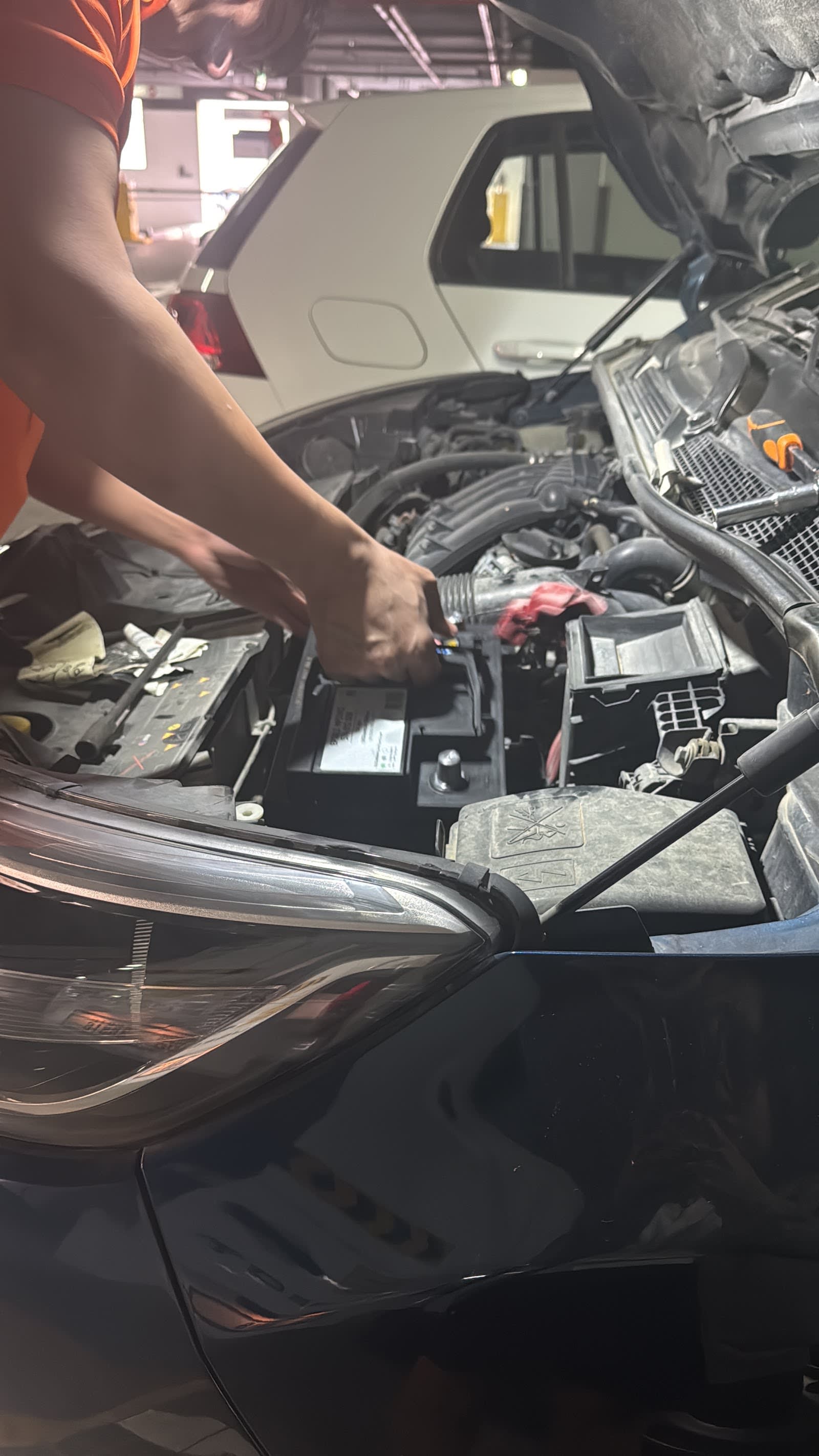 Top-Rated
Fasttrack Emarat - Battery Mobile Service
Dubai · Emarat Atrium Building - Office No. 239 - Sheikh Zayed Rd - Dubai
 Top-Rated
Carzilla Auto Service - Luxury Car Garage in Dubai
Dubai · 41 20C St - Al Quoz - Al Quoz Industrial Area 2 - Dubai - United Arab Emirates
Where to actually buy this
Shops whose own website lists these parts, or whose stock we have recorded ourselves. Last checked July 2026. Not paid placement.
- Model Automotive Parts EstAbu Dhabi
Stocks brake pads, calipers and master cylinders — genuine and aftermarket, new parts. It carries FEBI, Lemforder, Mahle and Behr and 10 more and matches parts to your VIN.
4.0 on Google from 412 reviews
- Al Ghandi Auto PartsDubai
Stocks brake pads, brake discs and calipers — genuine OEM, new parts. It carries IVECO and delivers.
4.1 on Google from 83 reviews
- Dar Al Kanz Auto Spare PartsSharjah
Stocks brake pads, brake discs and calipers — genuine OEM. It carries Euroricambi, ZF, Knorr and Wabco and 1 more, fits what it sells and delivers across all seven emirates.
4.1 on Google from 7 reviews
Stocks brake pads, brake discs and calipers — genuine and aftermarket, new parts. It carries Amaron, Chloride, Ac delco and Castrol and 4 more and delivers.
4.3 on Google from 3 reviews
- Al Ahram Auto Spare PartsSharjah
Stocks brake pads, brake discs and calipers — genuine and aftermarket. It delivers.
4.1 on Google from 64 reviews
- QUALITY MOTOR PARTSAbu Dhabi
Stocks brake pads and brake discs — genuine and aftermarket, new parts. It carries Kixx, QMP and QPC and sells trade as well as retail.
4.3 on Google from 194 reviews
Listings are compiled from each business’s own public information. If you run one of these shops and want the entry corrected or removed, email easycarpartsteam@gmail.com.
Ask a human · free · no account
Rather not ring around?
Tell us the car and the part once — we'll send you the shops that actually stock it.
Free · usually a reply in minutes · no obligation
Still easier on a form? The request goes to the same matched UAE suppliers, free, with only the number of shops you choose able to contact you.
Open the request formKeep reading
Brakes — FAQs
- How often should brake pads be replaced in the UAE?
- There is no fixed interval - it depends on vehicle mass and how often you convert speed into heat. Our estimated bands: a light sedan driven gently in the city, 40,000-60,000 km on the front pads; a sedan on a daily Sheikh Zayed Road commute, 30,000-50,000 km; a 2.5-3 tonne SUV like a Patrol or Land Cruiser, 25,000-40,000 km; the same SUV towing or fully loaded, 15,000-30,000 km. Those are engineering-judgement estimates for UAE conditions, not measured fleet data. Rear pads typically last two to three times as long as fronts. Measure rather than count kilometres: replace at 3 mm of friction material, where new friction material is 8-12 mm (excluding the 4-6 mm steel backing plate).
- What does a genuine Toyota brake pad set cost in the UAE?
- We can give you observed figures rather than a market price, and the difference matters. On 2 September 2026 we read the Toyota brake pad section of the UAE online catalogue run by Auto Parts Market, a direct competitor which we name in plain text rather than link to. Of the fourteen 04465 and 04466 disc brake pad kit numbers we recorded from the first page of a stated 2,244 results, prices ran from AED 125.14 for 04465-YZZQ1 to AED 478.83 for 04465-36090, with 04465-YZZ58 at AED 170.33 and 04465-14390 at AED 319.10 in between, all Net of VAT. Observed at autopartsmarket.ae on 2 September 2026. One retailer on one day, not a market survey, and not a quote. The spread is the answer: a Toyota part number is not a Toyota, and those kits cover everything from a Yaris to a Land Cruiser. Get the pad kit number for your chassis number before you price anything, and note that these online catalogue prices sit below the AED 350 to 700 dealer-counter band this page also carries, which we have left standing because a catalogue and a service counter are different transactions.
- What does a genuine Toyota front brake disc cost in the UAE?
- Three dated observations, and one warning that matters more than the numbers. On 2 September 2026 the Toyota brake disc listing at that same catalogue reported 1,345 results, of which three named the vehicle in the listing text: a Previa or Estima front disc at AED 527.77, a 4Runner front disc at AED 517.71 and a Land Cruiser front disc at AED 383.40, all Net of VAT. Observed at autopartsmarket.ae on 2 September 2026. One retailer on one day, not a market survey, and not a quote. The warning: each of those is the price of one disc, and discs are always replaced in axle pairs, so double it before comparing against a garage quote. Doubled, that is roughly AED 767 to AED 1,056 Net for a pair on those three vehicles, which is our arithmetic on those figures rather than a price anyone quoted. Three Toyota part numbers are not a UAE disc price: they say nothing about a Sunny, an Accent, a Pajero, any European car, or the aftermarket tier most people actually buy.
- What is a fair price for a brake job in the UAE, and what should the quote show?
- This page carries two kinds of figure and it is worth knowing which is which. The bands in the cost section are our own market observations of the UAE independent trade as at August 2026, labelled as such, and there is no authoritative published price survey for brake work here. Separately, on 2 September 2026 the Dubai on-site provider Carallz advertised brake pad and rotor fitting at AED 400, brake pads at AED 250 and brake rotors at AED 250, each marked model and location dependent and inclusive of VAT. Observed at carallz.com on 2 September 2026. One retailer on one day, not a market survey, and not a quote, and that page does not separate parts from labour on those lines. Neither kind of figure is a price for your car. What tells you a quote is fair is its shape: separate lines with quantities for pads, discs, hardware kit, slide pin and boot kit, fluid and labour; the brand and part number of what is being fitted; the disc measurement in millimetres against the MIN TH figure cast into the disc; and a written warranty with a duration and a mileage. A quote far below the others is usually a copy-tier pad, pads fitted to an unmeasured disc, one axle presented as the whole car, or the slide pin service left out.
- Are ceramic brake pads better than semi-metallic?
- Not automatically, and often not for UAE conditions. Ceramic pads are quieter, produce less dust and the dust is lighter in colour. But they generally have weaker cold bite, cost more, and are relatively poor thermal conductors compared with semi-metallics - they tend to keep heat in the disc rather than drawing it into the pad. That conductivity point is a qualitative one accepted in friction-material engineering rather than a published number. On a 2.5-tonne SUV braking hard from 120 km/h in 45C ambient, a good low-metallic or semi-metallic pad generally holds up better when hot. Ceramic is the right answer for a mid-size sedan where clean wheels and a quiet cabin are the priority.
- How do I know if my brake discs need replacing or just the pads?
- Measure the disc thickness with a micrometer at several points about 10 mm in from the edge, past the wear lip, and compare it to the MIN TH figure cast or stamped on the disc itself. If the disc is above MIN TH, has no cracks, no heavy scoring and no pronounced lip, pads alone are enough. Typical workshop wear allowance on a vented passenger-car front disc is only 2-3 mm total, though your manual's figure beats any generic one. A garage that insists discs must always be changed with pads is either being cautious or being commercial - ask them to show you the measurement.
- What causes brake judder and is it really warped discs?
- Iron discs do not warp in the way the word suggests. Judder is caused by disc thickness variation (DTV) - the disc has worn or picked up uneven pad transfer film, so its thickness varies slightly around the circumference. As little as 0.010-0.015 mm of variation is enough to feel through the pedal. The usual root causes are lateral runout above about 0.05 mm from rust or dirt under the disc at fitting, uneven wheel-nut torque, or holding the pedal hard on a hot disc at a long traffic signal.
- Why do my brakes judder after sitting at long traffic lights in Dubai?
- Because holding a hot disc against a stationary pad transfers pad material onto one spot. That patch has slightly different thickness and friction from the rest of the disc, and it grows over subsequent stops into a pulsing pedal. This mechanism is described in the technical literature of several major friction manufacturers. Note that holding the car against transmission creep causes essentially no pad wear - there is no relative motion - so the harm is thermal, not abrasive. At long signals, shift to neutral, or let the car creep a few centimetres so the pad is not resting in one place. Using the electronic parking brake is often suggested, but on most cars the EPB clamps the rear calipers, so it protects the front discs while doing the same thing to the hot rear ones. Neutral is the cleaner answer.
- How often should brake fluid be changed in the UAE?
- Every 24 months at the outside, and treat that as a ceiling rather than a target here. Glycol brake fluid is hygroscopic and absorbs water out of the air, at rates commonly quoted at roughly 1-2% per year - a generic industry figure, not a UAE measurement. DOT 4's boiling point drops from a minimum 230C dry to a minimum 155C wet, where wet means 3.7% water by volume, a 33% loss. Coastal UAE summer air at 35C and 70% RH carries roughly 28 g of water per cubic metre against roughly 10 g/m3 for a 20C European summer day, so the driving force is clearly higher here even though no one has published a UAE-specific absorption rate. Have the moisture content tested annually; above 3% means flush now.
- What does dark brown brake fluid mean?
- It means the fluid is oxidised and has picked up contamination from seals and hoses. Fresh brake fluid is pale straw-coloured. But colour is a crude indicator of age, not a measurement of water content, which is what actually lowers the boiling point - use an electronic tester or a test strip. One thing to correct: you will see it claimed that UAE inspectors score fluid colour during vehicle testing. We could not source that from RTA or any testing centre; it appears in garage marketing. What a contaminated or compromised system will show up as is weak or uneven braking force on the roller test.
- Can I use DOT 5 brake fluid instead of DOT 4?
- No. DOT 5 is silicone-based, chemically incompatible with DOT 3, DOT 4 and DOT 5.1 glycol fluids, does not mix with them, and is generally unsuitable for ABS systems. Note the confusing numbering: DOT 5.1 is glycol and is compatible; DOT 5 is silicone and is not. You may go up the glycol ladder - DOT 3 to DOT 4 to DOT 5.1 - but never down, and always check the reservoir cap. Some cars with ESP require DOT 4 LV specifically because the pump needs a low-viscosity fluid.
- Why does my brake pedal go soft after driving down Jebel Jais or Jebel Hafeet?
- Almost certainly boiling brake fluid. On a long descent the brakes stay hot continuously, and if the fluid has absorbed water, the water in solution vaporises well below the fluid's own boiling point. Vapour is compressible, so pedal travel goes into compressing a bubble instead of clamping the pads. The pedal returns after a few minutes of cooling, which is why people dismiss it. The fix is technique first: descend in a low gear so the engine does the braking, and stop to let the brakes cool rather than riding them - fresh fluid will overheat too if you ride the brakes down 11.7 km of Jebel Hafeet. A flush before a mountain trip (AED 150-350) buys back the margin you need for when the technique slips, but it is insurance behind the technique, not a substitute for it.
- Are drilled brake discs a good upgrade for a car in Dubai?
- No. Cross-drilled discs originated to vent gases from asbestos-era pads that outgassed under heat; modern pads barely do. What remains is reduced mass, reduced swept area, faster pad wear because every hole edge acts as a cutter, and a set of stress raisers where cracks start. In a climate where discs already run hotter, that is a downgrade sold as an upgrade. If you want a genuine improvement for heavy or towing use, a slotted disc gives you the pad-cleaning benefit without the through-holes.
- Why is my inner brake pad worn out when the outer one still looks fine?
- The caliper is not sliding freely. On a floating caliper the piston-side inner pad keeps working while the outer barely moves, so a seized guide pin produces exactly that pattern - a difference of 3 mm or more across one caliper is the signature. Locally the causes we see are heat degrading the slide-pin grease, UV cracking the rubber boots, and dust getting into the bore through the split. That is a field observation from this market rather than a documented national failure mode; the mechanics of the wear pattern itself are not in dispute. Fitting new pads without freeing and re-greasing the slides just repeats the failure sooner. Use a brake-specific silicone or PAG grease - not lithium, not copper anti-seize, both of which attack the rubber.
- Do brake pads have to be replaced in pairs?
- Yes - both wheels on the same axle, always. Different friction coefficients left and right create a yaw moment under braking, so the car steers itself, and the ABS and EBD systems assume symmetry. UAE vehicle inspection measures brakes on a roller tester, and roller testers report side-to-side imbalance per axle directly, so an asymmetric axle can read as a problem on a car that feels normal to drive. You do not need to do front and rear at the same time - front pads typically wear two to three times faster.
- What does the ECE R90 mark on a brake pad mean?
- It is a type approval confirming the replacement pad performs within plus or minus 15% of the original equipment pad's friction coefficient, verified by an accredited test house with factory audits. The mark is formatted like E11 90R-02A0123/456 on the backing plate, and the Gulf standards body has adopted UN ECE R90 as GSO ECE 90. Be clear about its status here: we could not establish that R90 marking is legally mandatory for replacement pads sold in the UAE or that it is enforced at the border - the operative UAE requirement for brake pads is ECAS registration under Cabinet Resolution 12 of 2018. So treat R90 as a meaningful quality signal to ask for, not as a law the seller is breaking. A pad without a legitimate R90 mark is one whose friction performance nobody has independently verified.
- Is it safe to buy used brake parts from the Sharjah market?
- It depends entirely on the part, and what follows is our rule rather than an industry standard - no authority publishes one. Used calipers and carrier brackets are often a sound buy: the failure modes are visible, the part is rebuildable with a new seal and boot kit, and you can inspect the bore before paying. Used discs are almost never worth it, because their remaining thickness and heat history are unknown and new discs are inexpensive. Used pads should never be fitted. Reject any caliper casting with cracks around the mounting ears.
- What are commercial or copy brake pads and should I avoid them?
- Commercial or copy is the local trade term for unbranded or lookalike-packaged friction material of unverifiable origin, typically at a fraction of branded pricing. On brakes specifically, this is the tier we would refuse. Filler-heavy compounds stop adequately in a car park and fade under exactly the conditions a heavy vehicle in UAE heat produces, and excessive metallic filler damages discs. Delamination - the friction material separating from the backing plate under heat - is a well-known industry concern in this tier, though we cannot point to a specific cited incident or recall, so we describe it as a reported failure mode rather than a documented one. Ask for the ECE R90 mark and the ECAS certificate of conformity.
- What is the difference between genuine, OEM and aftermarket brake pads?
- In principle: genuine means the vehicle manufacturer's own box through the dealer network - highest price, lowest ambiguity. OEM or original means the same part from the company that actually made the factory pad, in its own packaging: if your car left the factory on Advics or Textar pads, an Advics or Textar box is functionally the OE part at a substantially lower price. Aftermarket brands such as Bosch, Ferodo, ATE, TRW and Brembo design their own compounds and can outperform the OE pad on a specific axis. The OEM tier is usually the best value. In practice, be careful: many UAE retailers use genuine and OEM interchangeably, which is the opposite of that distinction, so ask which company made the part and ask to see the box rather than relying on the word.
- Is my car exempt from the RTA vehicle test if it is under three years old?
- Not necessarily, and this is the most commonly mis-stated rule in the UAE. It is not an age rule. Per RTA's published service description, the exemption applies if you are the first owner and the vehicle is new with zero mileage, and it runs for three years from the year of manufacture or the year of registration, whichever comes first. A two-year-old used car, an import, or a car that has changed hands is not covered and needs a test certificate. Abu Dhabi applies the same shape of rule for a new zero-mileage vehicle bought from an authorised UAE dealer. Current RTA fees are AED 170 for a light vehicle test (AED 150 plus AED 20 knowledge and innovation) and AED 370 for light private registration renewal (AED 350 plus AED 20) - roughly AED 540 together, before insurance.
- Do brake parts fail the RTA vehicle test, and what fails most often?
- Yes, and brakes are measured on a roller brake tester rather than just inspected. Roller testers report braking force per wheel, total efficiency and side-to-side imbalance per axle. The specific UAE pass thresholds are not published in a form we could verify, so we will not quote you a number. The common brake failures, roughly in order: pads below limit or discs worn, scored, cracked or lipped; side-to-side imbalance on an axle from a seized slide pin or collapsed hose; low fluid or a visible leak; weak handbrake efficiency, which quietly seizes on drum-in-hat parking brakes that are never used; and any illuminated ABS or brake warning lamp, which fails the car regardless of the brakes' actual condition. A retest adds AED 50 for a light vehicle plus a second trip.
- How should I bed in new brake pads and discs?
- New friction needs an even transfer layer of pad material laid onto the disc. Degrease the new disc first - most ship with a preservative oil. Then do roughly 8-10 moderate stops from about 60 km/h to 20 km/h, let the brakes cool, then 8-10 firmer stops from about 90 km/h to 40 km/h with a minute between each. Critically, do not come to a full stop and hold the pedal on a hot new disc during bedding: that imprints a patch of pad material and gives you judder on a brand-new set. Expect a slightly wooden pedal for the first 150-300 km.
- Why do brake parts wear faster in the UAE than the manufacturer's manual suggests?
- Mostly the fleet mix and the heat, and less than you would think from the dust. A 2.7-tonne SUV stopping from 120 km/h dissipates about 1.5 MJ against 540 kJ for a 1.4-tonne sedan from 100 km/h, and the UAE parc is skewed heavily towards the heavy end - though note that physics is the same anywhere, so it is the mix that is local, not the calculation. Heat rejection is the genuinely local factor: at a given disc temperature 45C air carries away roughly 5-7% less heat than 20C air, and more importantly the whole system simply sits about 25C hotter at steady state because that is how much hotter the air it dumps into is, so it never returns to a cold baseline in traffic. On dust: UAE airborne dust is dominated by carbonate minerals - calcite and dolomite - with quartz secondary, and only the quartz fraction is meaningfully abrasive against cast iron, so it contributes but not as much as the popular 'desert sand grinds your brakes' framing implies.
- Can I just replace one brake disc if only one is damaged?
- No. A thick new disc on one side and a thin near-limit disc on the other have different heat capacities, so under repeated braking they run at different temperatures and therefore produce different friction. That is a braking imbalance, it shows up as side-to-side imbalance on a roller brake test, and it makes the ABS intervene where it should not. Discs and pads both go in axle pairs. The only question worth arguing about is whether the discs need replacing at all - measure against the MIN TH figure before you buy.
- Is a Gulf Nissan Patrol the same as a US Nissan Armada for brake parts?
- For some generations, yes - and getting this wrong sends you to the wrong catalogue. The Y62 (2017 model year onward) and the Y63 Patrol are sold in North America as the Armada, so a US-market VIN decoder will return Armada for those cars. It does not hold for the Y61 Patrol Safari, which is still common in the Gulf and has no North American twin at all, and the pre-2017 Armada was a different, Titan-based vehicle whose brake parts are unrelated. Check the generation before trusting any cross-reference, and order by chassis number. If in doubt, measure the disc: outer diameter, new thickness, centre bore, PCD and height leave no ambiguity.
Ask a human · free · no account
Still not the question you had?
Ask it directly — a person reads every message.
Free · usually a reply in minutes · no obligation