NiBK brake pads in the UAE
Disc brake pads, drum brake shoes and linings, and disc rotors
NiBK is a trademark of its owner. We are not an authorised NiBK dealer or distributor, and nothing here is endorsed by them. The name and mark are shown to say which parts we quote and source.
The quick answer
NiBK is the brake brand of JNBK Corporation, a Japanese company founded in 1998 and based in Shinjuku, Tokyo, which launched the NiBK name in 2008 with pads and shoes for Japanese and Korean cars. On the evidence of both companies' own websites it is not a Nisshinbo product line: Nisshinbo Brake Inc. is a different company at a different address, and neither site mentions the other. NiBK covers disc pads, drum brake shoes and linings, and disc rotors, with pad formulas sorted into six vehicle classes from light cars to trucks. JNBK publishes no UAE distributor and no manufacturing country, so the check you can make yourself is the part number against its online catalogue, which lists 170 make entries.
Ask a human · free · no account
Looking for genuine NiBK?
We'll only send you shops that actually stock it.
Free · usually a reply in minutes · no obligation
Key facts
- NiBK is the brake brand of JNBK Corporation. JNBK gives 1998 as its year of foundation, Japan as its location and Tokyo as the place its brake range began development. The NiBK name was launched in 2008.
- NiBK is not presented as a Nisshinbo product by either side. Nisshinbo Brake Inc. gives a Nihonbashi, Tokyo head office and an establishment date of 1 April 2009, lists plants in Japan, the United States, Thailand, South Korea and China, and does not mention JNBK or NiBK.
- JNBK says NiBK friction comes in two main groups, ceramic and semi-metallic, across 12 material types, and publishes a table that assigns formula codes to six vehicle classes from light cars to heavy trucks.
- The range is disc pads, drum brake shoes and linings, and disc rotors. JNBK dates its rotors to 2014, a Performance range to 2016 and its motorcycle brakes to 2011.
- In NiBK's catalogue, part numbers starting PN are labelled brake pads, RN are labelled rotor discs and FN are labelled brake shoes.
- JNBK's catalogue lists 170 make entries and searches by vehicle-maker number, NiBK number, WVA number, FMSI number or VIN. Its own disclaimer says the catalogue data is advisory and for reference only.
- JNBK states that NiBK products meet ISO 9001, ISO 14001, IATF 16949, ECE R90, SAE J2975, AMECA and a Link SAE J661 rating of F and G. We have not seen the certificates themselves.
- JNBK's own pages name no UAE distributor and no manufacturing country for NiBK pads. Its news page lists Automechanika Dubai, 3 to 5 June 2014, among its past exhibitions.
Rather fill in a form? Send the same request here and matched UAE suppliers reply on WhatsApp either way.
Open the request formNiBK — the range
| Range | How it is built | What it is for |
|---|---|---|
| Ceramic pads, light vehicles | Ceramic friction formulas J804C and J750C | Light vehicles |
| Ceramic pads, light and medium vehicles | Ceramic friction formulas J509C2, J631CR, J803C, J524C and J251CR | Light and medium-weight vehicles |
| Ceramic pads, medium vehicles and 4WD | Ceramic friction formulas J525C and J752C | Medium-weight vehicles, 4WD, pick-ups and vans |
| Hybrid ceramic and low-metallic pads | Hybrid ceramic and low-metallic formulas J861VR and J220HR | 4WD, pick-ups and vans |
| Performance and sport pads | Performance formulas J701S and J250SR, with a carbon ceramic sport formula marked J701S to J704S | Sport driving, used with sport-designed rotors and callipers |
| Heavy-duty low-metallic pads | Low-metallic formulas J806M and J606M | Trucks |
| Passenger car brake shoes | Organic and non-ferrous fibre formulation | Drum-braked passenger car axles |
| Truck and bus shoes and linings | Rock wool and steel fibre with brass, acrylic and glass fibres | Air brake systems on commercial vehicles |
| Standard rotors | Blank or plain disc made to precise tolerances, with the catalogue giving the type and G3000 structure material | Replacement of a plain rotor on cars and trucks |
| Cross-drilled and slotted rotors | Performance disc with drilled holes or slots to clear dust and water | Drivers who want a performance rotor and accept the trade-offs |
Source: JNBK Corporation, brake pads formula table with the six vehicle classes, read 2026-10-07; JNBK Corporation, shoes and linings, read 2026-10-07; JNBK Corporation, disc rotor range, read 2026-10-07
Which one fits your car
| If this is your car | Use | Why |
|---|---|---|
| Light vehicle with disc brakes | Ceramic pads, light vehicles | Match the number from the catalogue rather than the class. Front and rear pads are separate numbers. |
| Vehicle in the light to medium weight bracket | Ceramic pads, light and medium vehicles | The widest class in JNBK's table, with five formula codes. The code is marked on the back plate. |
| 4WD, pick-up or van | Hybrid ceramic and low-metallic pads | JNBK lists a ceramic class and a hybrid class for these vehicles. Check which one the catalogue assigns to your number. |
| Car driven hard on a track or rally stage | Performance and sport pads | JNBK says to use these only with sport-designed rotors and callipers. |
| Truck with disc brakes | Heavy-duty low-metallic pads | A separate class from the passenger formulas. Do not substitute a car pad. |
| Older car running drums on the rear | Passenger car brake shoes | Shoes carry FN numbers in the catalogue. They are not pads and do not cross to them. |
| Replacing a worn or grooved disc along with the pads | Standard rotors | JNBK's own guidance is to skim or replace a rotor with grooves deeper than 0.3 mm. |
The range descriptions are the manufacturer’s. Matching them to a car is our guidance, and it is a starting point rather than a fitment check — the part number is what actually decides. Send us the make, model and year and we will confirm it.
Original equipment
We name no vehicle maker as a NiBK factory customer, because JNBK names none. Its site presents NiBK as a range of brakes with formulas tuned for each vehicle class, and nothing we read says that a vehicle maker fits it on an assembly line. What the catalogue does carry, on every part page we opened, is a cross-reference list that includes vehicle-maker part numbers, such as Toyota and Lexus numbers beside the NiBK number for the same pad. A cross-reference says the NiBK part is listed against that number. It is not an original-equipment contract, and a reseller who reads one as the other is promising something JNBK has not.
Where it is made
JNBK says it is located in Japan and that development of its brake range began in Tokyo. That is where the company sits, and it is not a statement about where a pad is pressed or a rotor is cast. Nothing on the pages we read says which country makes which NiBK part, so this page names no manufacturing country. If the country matters to you, read it from the carton.
NiBK in the UAE
JNBK names no distributor in the United Arab Emirates anywhere on the pages we read, and we found no distributor locator on its website. What it does say, on a notice thanking visitors to a 2012 exhibition, is to call its distributor in your own country, which describes a country-by-country distribution model without listing the countries. It also lists Automechanika Dubai among its past exhibitions, dated 3 to 5 June 2014 on its news page. That shows the maker has looked at this market. It says nothing about who sells NiBK here now. The enquiry form on JNBK's site offers the United Arab Emirates as a country, so asking JNBK who covers this market is a route that exists. We name no UAE business as a NiBK distributor. Any seller calling itself an authorised NiBK distributor is describing itself, and the way to test the claim is to ask for the authorisation on JNBK's paper.
Who NiBK is, and why it is not Nisshinbo
NiBK is a brand name, and the company behind it is JNBK Corporation. JNBK itself writes the name both ways, NiBK and NIBK, sometimes on the same page, and both mean the same brand. JNBK's own About page gives 1998 as its year of foundation and Japan as its location, says development of its brake range started in Tokyo, and prints a Shinjuku, Tokyo address. It dates the NiBK launch to 2008, when it began producing pads and shoes for Japanese and Korean vehicles under the NiBK name. The range then grew in steps JNBK itself dates: continental European coverage in 2009, motorcycle brakes in 2011, American vehicles in 2013, disc rotors in 2014 and a Performance range in 2016.
The name invites a specific mistake. NiBK and Nisshinbo read alike, both are Japanese and both sit in brakes. Neither company presents them as one business. Nisshinbo Brake Inc. says on its own site that it is part of Nisshinbo Holdings, gives a head office in the Nihonbashi district of Tokyo and an establishment date of 1 April 2009, and lists its plants and group companies in Japan, the United States, Thailand, South Korea and China. JNBK is not among them, and the name NiBK does not appear on the pages we read. JNBK's pages, for their part, never mention Nisshinbo.
That is evidence of two separate companies, not a proof of it, and the difference matters. We found no statement from either side about common ownership, and no statement denying it either. On everything either company publishes, a NiBK pad is a JNBK product and a Nisshinbo pad is a Nisshinbo product, and that is how this page treats them. It is also why NiBK has a page of its own here instead of a section on the Nisshinbo one. If you are comparing the two, the Nisshinbo page sets out what that company does publish.
Twelve materials, six pad classes and a code on the back plate
JNBK's product page states the idea behind its friction range in one line: no single formula can deliver the characteristics needed for every application, so each NiBK formula is created for a specific vehicle type. Its About page counts 12 material types in two main groups, ceramic and semi-metallic, and the formula page names the base materials as non-asbestos organic, nonabrasive low metallic and several types of ceramic wool, each with different additives.
The formula table sorts pads into six classes. Ceramic for light vehicles, ceramic for light and medium-weight vehicles, ceramic for medium-weight vehicles and for 4WD, pick-ups and vans, a hybrid ceramic and low-metallic class for 4WD, pick-ups and vans, a performance class, and a heavy-duty low-metallic class for trucks. Each class has formula codes, such as J525C or J861VR, and JNBK says the code is marked on the back plate of the pad. That is the useful part for a buyer. Turn the pad over and the code tells you which of the six classes you are holding.
Two cautions come from JNBK's own wording. The code list is dated: the page says the marked codes are those as of 2019, so a newer box may carry a code that the table does not show. And the friction ratings are the maker's. JNBK says all of its general formulations reach an F to G rating on the LINK dynamometer test and its sport formulations an H to I, but the page does not publish the test figures behind the letters. A letter on its own is a claim to ask about, not a measurement we can check.
Within the sport group, JNBK separately announces a carbon ceramic sport pad whose back plate marks run from J701S to J704S, and a heavy-duty family built from rock wool and steel fibre for cranes and off-road trucks. Both are specialist ranges, and JNBK is explicit that its sport formulas should be used only with sport-designed rotors and callipers.
Finding the right NiBK number: PN, RN, FN and the catalogue
A lot of the demand for this brand is people looking for its catalogue, so it is worth being exact about what that catalogue is. It is an online lookup on JNBK's own site, in three parts: cars, bikes and a list of new products. You can search by a vehicle-maker part number, a NiBK number, a WVA number, an FMSI number or any other part number, and there is a VIN box. The car side lists 170 make entries, counting variants separately, so Toyota, Toyota (FAW) and Toyota (GAC) are three entries. The names a buyer in the UAE would look for are there, among them Toyota, Lexus, Nissan, Infiniti, Mitsubishi, Land Rover, Jeep and Ford, and so are Chinese makes such as Haval, Chery, Jetour, MG, Geely and GAC.
A make being on the list is not the same as your model being covered, and JNBK says as much. The catalogue footer states that the catalogue data is advisory and can be used for reference only. Treat it as the fastest way to get a candidate number, then confirm that number against the old part, against the vehicle maker's own number, or against the FMSI number, one of the reference numbers the catalogue itself lets you search on.
A part page shows what you need to compare. For a pad that is length, width and thickness in millimetres, the number of pieces in the set, sometimes the brake system maker, any variations, and a cross-reference table. The pad we opened, PN1324, lists two variations, PN1324S and PN1324C, so one catalogue number can map to more than one version. We found no published key for those suffixes and will not guess. Its cross-references run from Toyota and Lexus part numbers through Akebono, Bendix, Hitachi and Kashiyama numbers to FMSI codes. That table is how a counter matches a NiBK pad to the number on your old one.
The catalogue labels each number by type on its page heading. Numbers beginning PN are headed brake pads, RN are headed rotor discs and FN are headed brake shoes. It is also still growing. The new products list, which we read on the day this page was written, shows additions dated as late as 29 September 2026, mostly rotors.
Shoes, linings and rotors: the rest of the range
NiBK is not only pads. For drum brakes JNBK describes three families. Brake shoes for passenger cars use an organic and non-ferrous fibre formulation that it describes as quiet, low dust and gentle on drums. Shoes and linings for trucks and buses use a combination of rock wool and steel fibre with brass, acrylic and glass fibres, and JNBK says that formula suits the air brake systems used in commercial vehicles. Linings for heavy-duty and off-highway vehicles use specialised steel wool and are meant for severe conditions.
The rotor range arrived in 2014. JNBK describes a standard plain rotor, which it says is manufactured to precise tolerances and suits cars and trucks, and a cross-drilled and slotted performance range. For the slotted design it says the slots sweep debris from between rotor and pad, help prevent pad glazing and give water an escape path. The one rotor page we opened, RN2864V, lists a vented front disc with a 323 mm outer diameter and G3000 structure material, and cross-references BYD part numbers. JNBK says all of its rotors are made to match the exact original fit and construction. That is JNBK's description of its own product, and it is as far as the claim goes.
JNBK also talks about pads and rotors as a pair. Its rotor page says that fitting NiBK pads to new or undamaged rotors and using them continuously extends rotor life, and its fitting advice, covered below, says a rotor with grooves deeper than 0.3 mm should be skimmed or replaced before new pads go on. In practice that means a brake job on a grooved disc is two parts, whichever brand you choose.
Fitting and bedding in, in the maker's own words
JNBK publishes fitting guidance that is specific enough to be useful. It lists three things to check before the pads go on. The calipers and hydraulics: pins and sliders should not be bent or rusted and need lubricating so the pads release from the rotor, the brake fluid should be the correct type and replaced before it absorbs enough moisture to lower its boiling point below specification, and hoses and cylinders should be sound. The rotor: grooves deeper than 0.3 mm mean the disc needs skimming or turning on an on-car lathe, otherwise the new pads will not make proper contact. And lubrication.
On lubrication, JNBK separates two greases. NiBK anti-squeal grease, which it says comes in the pad box, goes on the edges and centre of the back plate and on the holding clips or sliders. A high-temperature grease of any commonly used brand goes on the caliper pins. Its warning is blunt: never put lubricant on the friction material or the rotor surface.
Bedding in is the other half. JNBK says a new set takes about 500 km to run in properly and asks drivers not to judge it on first impressions. It adds two situations that need gentler first miles: slight but continuous braking for the first two weeks if the rotor carries material from earlier pads or is rusted, and for the first week if a new rotor is coated with zinc, Dacromet or Geomet for rust protection.
JNBK also explains something called scorching. It describes it as a plasma treatment of the pad surface during production that heats the friction material to 600 to 700 degrees Celsius and carbonises the first 0.5 to 1.5 millimetres, with the stated aim of shortening the bedding-in time. We cannot verify the process and do not need to. It is a manufacturer's explanation of why a new NiBK pad may feel different from an unscorched one in the first miles.
On life, JNBK says a NiBK pad set should allow about 40,000 km before it is worn out, then adds that this depends on driving style and the condition of your rotors. That is JNBK's expectation, with its own caveat attached, and it is not a promise we are making for your car.
What the certificate list says, and what it cannot
JNBK's certificates page states that NiBK products meet ISO 9001, ISO 14001, AMECA, ECE R90, the Link Standard SAE J661 rated F and G, IATF 16949 and SAE J2975. The page shows the badges and no documents. We have not seen a certificate, a certificate number or an approval number for any of them, so this page reports the list as JNBK's statement and stops there.
It is still worth knowing what kind of thing is on the list. IATF 16949 is a quality management system standard for automotive production organisations, and ISO 9001 and ISO 14001 are management-system standards for quality and for the environment. Those describe how a company is run. They do not test a particular pad, and a factory can hold them while any one part number has been tested to something else or not at all. Whether the other names on the list attach to a given NiBK part number is something the list does not say.
JNBK does give you a way to ask better questions. Its Materials and Test Reports page lists five test reports, each filed under a formula code: one for J601CR, two for J606M, and two for J609L. We did not open the reports. The useful move is the one the filing suggests. Find the formula code on the back plate of the pad you are being sold, then ask the seller which report covers that formula. A seller who can answer that knows the product.
Buying NiBK in the UAE, and the warranty's last line
This is the part where a brand page usually names a distributor, and this one does not. JNBK names no UAE distributor on any page we read. The reasoning is in the note near the top of this page and it comes down to one rule: a business describing itself as an authorised distributor is not the same as the manufacturer naming it. We hold no record of which shops stock NiBK specifically. The shop list lower down is chosen on brake categories, and the sentence that introduces it says so.
What JNBK does publish is a warranty, and it is worth reading before you buy. If JNBK finds and confirms a defect, it says it will first try to replace the part and, if it cannot send a replacement, refund the total sale amount. The same applies to an item sent incorrectly and confirmed by JNBK. The exclusions are what you would expect: a part whose appearance has been deliberately or carelessly altered, problems from not following correct installation, including tightening, confirming the car of application and changing a part within the specified mileage, disasters such as earthquakes and floods, and one line worth noticing, a case where the purchase source of the part in trouble is not identified.
That last exclusion has a practical meaning here. Keep the invoice, with the seller's name on it, and keep the old part's number. The page also tells the buyer to remove the part, keep it carefully and send it back to JNBK for examination, and it does not say how a buyer in the UAE does that. The realistic route runs through the shop that sold the pad, which is a further reason to buy from one you can walk back into.
The simple discipline for the counter is the same as for any brake part. Bring the old pad or its number. Ask for the NiBK number, check it against the catalogue and against the vehicle maker's number, and read the formula code off the back plate. Ask which axle the pad is for, because front and rear are separate numbers. And ask what is going on the other parts of that corner, because a pad is only one of them.
What this page does not claim
Several things a page about a brake brand might be expected to assert are missing, and each is missing on purpose.
There is no manufacturing country, because JNBK names none. There is no list of vehicle makers that fit NiBK at the factory, because JNBK names none, and a cross-reference is not a contract. There is no UAE distributor, because none is named on a first-party page. There is no way of telling a genuine box from a copy, because JNBK publishes no authentication check that we found, and a colour or a sticker described by a reseller is not one. There is no statement on how common copies are in the UAE, because we have no measurement and a made-up figure would be its own small fraud.
There is no price, because installed prices depend on the axle, the formula, the vehicle and the shop, and they date quickly. And there is no claim that NiBK and Nisshinbo are unrelated in any deeper sense than the one stated at the top: on what each company publishes, they are two companies, and neither mentions the other.
Shops for brakes in the UAE
These shops are here because their recorded stock covers at least one of brake pads, brake discs and brake shoes — not because we have confirmed that each one carries NiBK. We hold no reliable shop-by-shop record of which brands are on which shelf, so ring or message before you travel.
Where to actually buy this
Shops whose stock we have recorded ourselves. Last checked July 2026. Not paid placement.
- AKMAL AUTO PARTSAbu Dhabi
Listed for engine parts and suspension and steering parts — genuine and aftermarket. It carries Hiberyl and matches parts to your VIN.
- Popular Auto PartsAbu Dhabi
Listed for engine parts and brake parts — genuine and aftermarket. It carries Mopar and matches parts to your VIN.
3.8 on Google from 405 reviews
Listed for body panels and lights and A/C and cooling parts — aftermarket. It carries Depo, TYG, Double horse and Viewmark and 4 more and delivers.
3.9 on Google from 16 reviews
- AL ASWAR SPARE PARTSSharjah
Listed for oils and filters and batteries — genuine OEM, new parts. It carries Toyota, Nissan, Lexus and Infiniti.
4.7 on Google from 3 reviews
Listed for brake parts and body panels and lights — genuine and aftermarket, new parts. It carries Febi bilstein, Ferodo, Textar and TRW and sells trade as well as retail.
4.3 on Google from 77 reviews
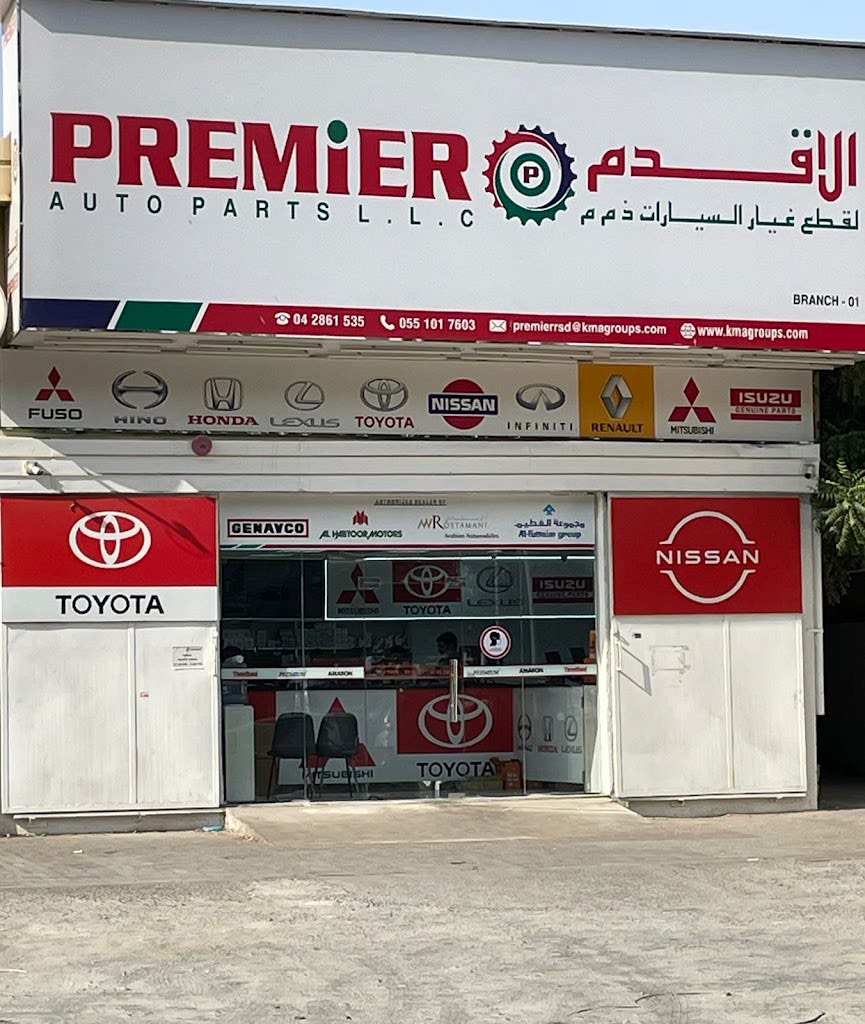
- PREMIER AUTO PARTSDubai
Listed for accessories and car electronics — genuine OEM, new parts. It carries Threebond, Autograde and Amaron and sells trade as well as retail.
4.3 on Google from 141 reviews

Listings are compiled from each business’s own public information. If you run one of these shops and want the entry corrected or removed, email easycarpartsteam@gmail.com.
Still easier on a form? The request goes to the same matched UAE suppliers, free, with only the number of shops you choose able to contact you.
Open the request formKeep reading
NiBK — common questions
- What is NiBK?
- NiBK is the brake brand of JNBK Corporation, a Japanese company that gives 1998 as its year of foundation and Tokyo as the place its brake range began development. The NiBK name was launched in 2008. The range covers disc pads, drum brake shoes and linings, and disc rotors.
- Is NiBK the same as Nisshinbo?
- On everything either company publishes, no. NiBK belongs to JNBK Corporation of Shinjuku, Tokyo. Nisshinbo Brake Inc. is part of Nisshinbo Holdings, has a head office in the Nihonbashi district of Tokyo and lists no JNBK or NiBK on its company or network pages. We found no statement of common ownership from either side.
- Who makes NiBK brake pads, and where?
- JNBK Corporation makes the NiBK brand and says it is located in Japan. JNBK's pages do not say where a given pad is pressed, so this page names no manufacturing country. If the country matters to you, read it from the carton.
- How do I find the right NiBK pads for my car?
- Use JNBK's online catalogue. It searches by vehicle-maker number, NiBK number, WVA number, FMSI number or VIN, and its car list has 170 make entries. Its own footer says the data is advisory and for reference only, so confirm the NiBK number against the old pad or the vehicle maker's number before you buy.
- What do the codes on the back of a NiBK pad mean?
- JNBK says its formula codes, such as J804C, J525C, J861VR or J606M, are marked on the back plate, and its formula table assigns them to six classes: ceramic for light vehicles, ceramic for light and medium vehicles, ceramic for medium vehicles and 4WD, hybrid ceramic and low-metallic for 4WD, performance, and heavy-duty low-metallic for trucks. The table is dated as of 2019, so a newer code may not appear in it.
- Are NiBK pads ceramic?
- Most of its pad classes are. JNBK says NiBK friction comes in two main groups, ceramic and semi-metallic. Four of its six pad classes are ceramic or hybrid ceramic, the performance class includes a carbon ceramic sport pad, and the heavy-duty class for trucks is low-metallic.
- Does NiBK make brake discs?
- Yes. JNBK dates its rotor range to 2014 and describes a standard plain rotor and a cross-drilled and slotted performance range. In the catalogue, rotor numbers begin RN and are headed rotor discs. It also makes drum brake shoes and linings, whose numbers begin FN.
- How long do NiBK pads last and how long do they take to bed in?
- JNBK says a NiBK set should allow about 40,000 km before it is worn out, depending on driving style and the condition of the rotors, and that a new set takes about 500 km to run in properly. Both figures are the manufacturer's expectations, not a guarantee for your car.
- Does NiBK have a UAE distributor?
- JNBK names none on the pages we read, and we found no distributor locator on its site. It lists Automechanika Dubai among past exhibitions, dated 3 to 5 June 2014, and its enquiry form offers the United Arab Emirates as a country. We name no UAE business as an authorised distributor, because a seller describing itself that way is not verification.
- Does NiBK come with a warranty?
- JNBK publishes a quality warranty. If it confirms a defect it will first try to replace the part and otherwise refund the total sale amount. It excludes altered parts, incorrect installation, disasters and cases where the purchase source of the part is not identified, so keep the invoice with the seller's name on it.
- How much do NiBK brake pads cost in the UAE?
- No number appears on this page. Prices depend on the axle, the formula class, the vehicle and the shop, and a figure on a brand page ages quickly. Give us the car and we will find what is being asked for the part today.
Ask a human · free · no account
Not sure the NiBK part you found is the real one?
Send us the number on the box and the car — we'll tell you.
Free · usually a reply in minutes · no obligation
Where these facts came from
Checked against the manufacturer’s own published material on the dates below. Anything we could not source is named as unsourced on this page rather than left out.
- JNBK Corporation, About us: foundation in 1998, the 2008 NiBK launch and the product timeline — read 2026-10-07
- JNBK Corporation, brake pads formula table with the six vehicle classes — read 2026-10-07
- JNBK Corporation, shoes and linings — read 2026-10-07
- JNBK Corporation, disc rotor range — read 2026-10-07
- JNBK Corporation, tips on installation, bedding in and choosing pads — read 2026-10-07
- JNBK Corporation, certificates and quality warranty — read 2026-10-07
- JNBK Corporation, online car catalogue and a part page (PN1324) — read 2026-10-07
- JNBK Corporation, news and expos including Automechanika Dubai 2014 — read 2026-10-07
- Nisshinbo Brake Inc., company overview — read 2026-10-07
- Nisshinbo Brake Inc., sites and group companies — read 2026-10-07
- IATF Global Oversight, what IATF 16949 is (third-party source) — read 2026-10-07