Diamond Pro Films PPF in the UAE
Paint protection film and nano ceramic window tint · Checked 26 November 2026
Diamond Pro Films is a Gulf paint-protection-film and window-tint brand, founded in Kuwait in 2018, with an office in Dubai. Credible on paper: Diamond Pro X carries a 15-year warranty. But its test data is self-published and its network small.
Diamond Pro Films is a Gulf paint-protection-film and window-tint brand, founded in Kuwait in 2018, with an office in Dubai. It sells six paint protection films, from the 5-year Lite to the 15-year Diamond Pro X, plus a five-shade nano ceramic window tint and a TPU windscreen film. This page sets out every figure the brand publishes, what its Estoril-certified warranty actually pays for, which tint shades are legal in Dubai, how it compares with XPEL, STEK, SunTek and 3M, and where it falls short.
Opens WhatsApp with Diamond Pro Films directly.
Key facts
- Diamond Pro Films was founded in Kuwait in 2018 and lists its Dubai office at OneSpace Business Center, Green Community (checked 26 November 2026).
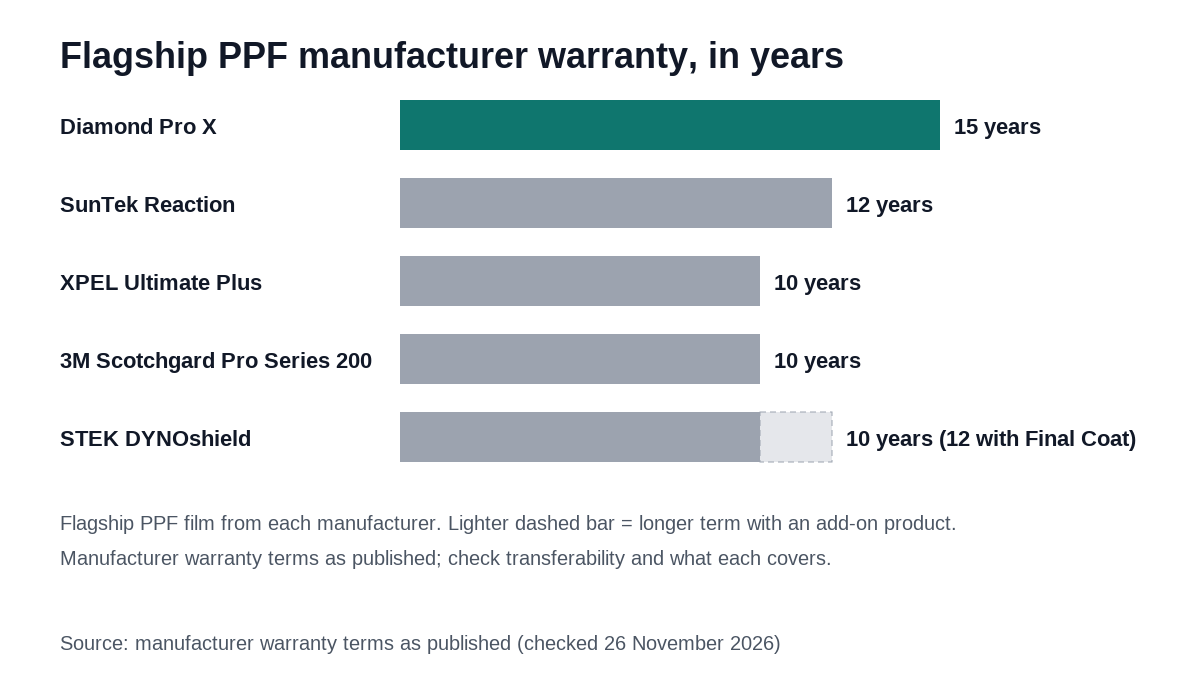
- Diamond Pro X carries a 15-year warranty, against 10 years on XPEL Ultimate Plus, 10 years on STEK DYNOshield (12 with Final Coat) and 12 years on SunTek Reaction.
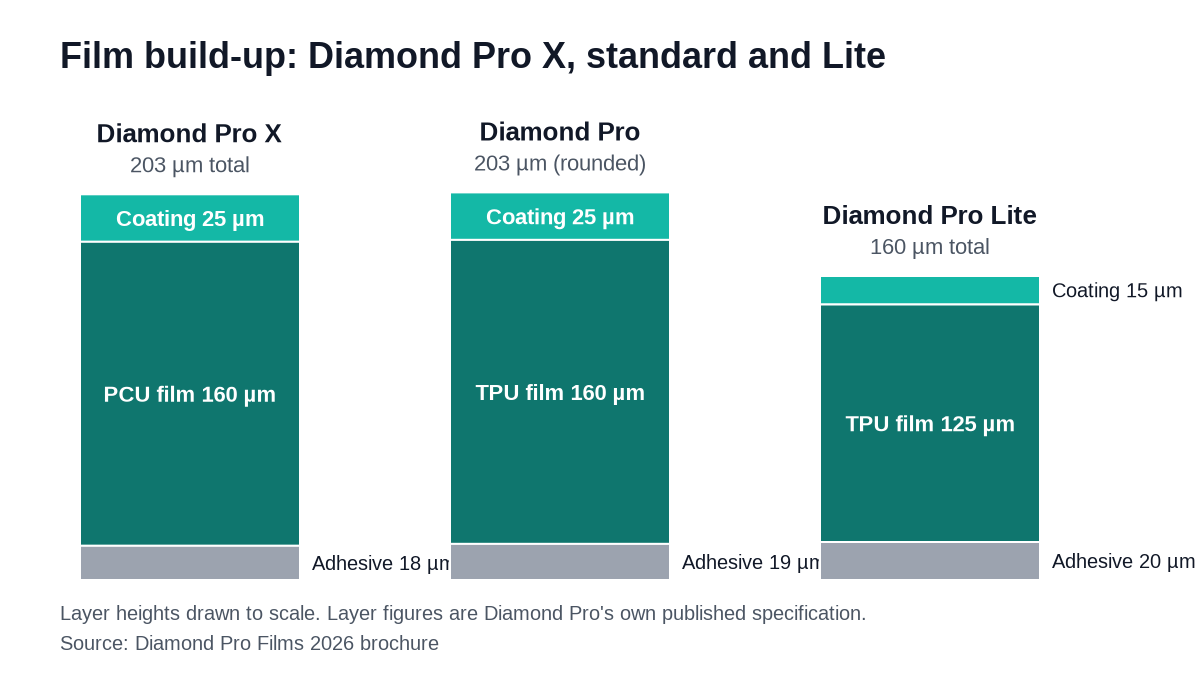
- Diamond Pro X is 8.0 mil (203 µm) thick: a 160 µm PCU film layer, a 25 µm self-healing coating and an 18 µm adhesive, per Diamond Pro's spec sheet.
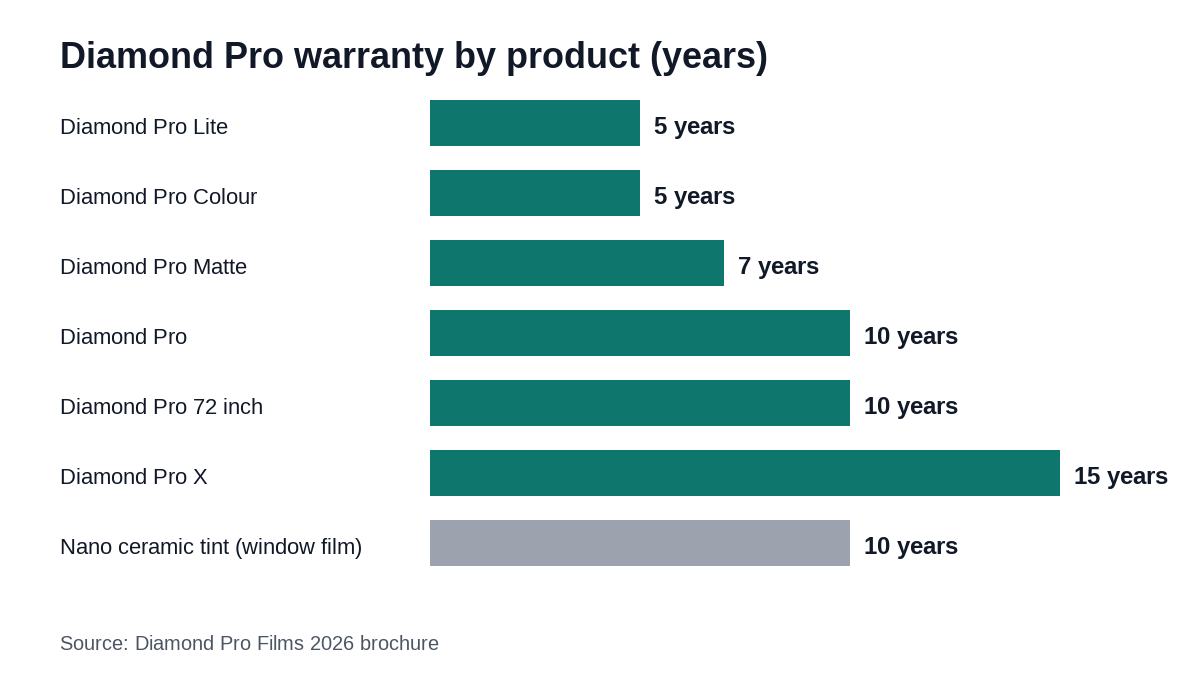
- Diamond Pro's PPF warranties run 15 years (X), 10 years (standard and 72-inch), 7 years (Matte) and 5 years (Lite and Colour).
- Every Diamond Pro PPF roll is 15 m (50 ft) long; five films come 1.52 m (60 in) wide and the 72-inch film comes 1.82 m wide.
- Diamond Pro publishes a 145.7 GU gloss level, over 390% elongation, 33 MPa tensile strength and a ΔE below 1 after 1,000 hours for Diamond Pro X, all from its own testing.
- Diamond Pro's nano ceramic tint comes in five shades from 70% VLT (DP00) to 5% VLT (DP90), each rated at 99% UV rejection, with TSER from 50% to 75%.
- Only two Diamond Pro tint shades, DP00 at 70% VLT and DP30 at 50% VLT, meet Dubai's 50% VLT minimum for side and rear glass on private cars.
- The PPF warranty pays in replacement film only, needs proof of purchase from an authorised dealer, and excludes rentals, courier fleets and racing cars.
- Diamond Pro's TPU windscreen film is 2 mil thick with 87% VLT, 99% UV rejection and 18% TSER; no warranty term is published for it.
At a glance
- Type
- Paint protection film and nano ceramic window tint
- Origin
- Founded in Kuwait in 2018 and developed for the Middle East market; Dubai office at OneSpace Business Center, Green Community. Ownership and legal entity are not published.
- Positioning
- Gulf-developed premium film brand with the longest fixed-term manufacturer PPF warranty among the brands this site covers (15 years on Diamond Pro X; Hexis and KAVACA publish conditional lifetime terms), but a far smaller installer network and public footprint than XPEL, STEK or 3M
- Warranty
- PPF: 15 years on Diamond Pro X, 10 on Diamond Pro and the 72-inch film, 7 on Matte, 5 on Lite and Colour. Certified under the name Estoril, against manufacturing defects such as fading, colour change, cracking, bubbling and delamination; compensation is replacement film only, claims go to the installer first, and commercial vehicles are excluded. Nano ceramic tint: 10 years, authorised-dealer install and digital registration required.
- In the UAE
- Dubai office at OneSpace Business Center, Green Community. Diamond Pro's own approved-applicator list includes UAE applicators in Dubai and Abu Dhabi (checked 26 November 2026), a far smaller network than XPEL's. Diamond Pro states it also has distributors and approved installers in Saudi Arabia, Kuwait, Qatar, Bahrain, Oman and the United Kingdom.
Product range
Diamond Pro X
The flagship gloss film: 8.0 mil (203 µm) with a PCU (polycarbonate urethane) layer from a German raw-material source, per Diamond Pro. 15-year warranty, 1.52 m roll
Diamond Pro
The core gloss film: 8 mil (203 µm) TPU from a Japanese source. 10-year warranty, 1.52 m roll
Diamond Pro Matte
Satin finish over the same self-healing chemistry: 8 mil (203 µm) TPU. 7-year warranty, 1.52 m roll
Diamond Pro Lite
The entry gloss film: 6.3 mil (160 µm) TPU from a Spanish source. 5-year warranty, 1.52 m roll
Diamond Pro Colour
Coloured paint protection film: 8 mil (203 µm) TPU. 5-year warranty, 1.52 m roll
Diamond Pro 72 inch
The core TPU film on a wide 1.82 m (72 in) roll for large panels. 10-year warranty
Nano Ceramic Window Tint
Five shades from DP00 (70% VLT) to DP90 (5% VLT), 99% UV rejection, 10-year warranty. Only DP00 and DP30 meet Dubai's 50% VLT minimum on side and rear glass
TPU Windscreen Protection Film
Optically clear 2 mil film for windscreens: 87% VLT, 99% UV rejection, 18% TSER. No warranty term published
Door Edge PPF
Precision-cut film for door edges, sold alongside installer support products
Product, warranty and pricing details reflect manufacturer and authorised-installer information and can vary by region — confirm exact terms with a UAE distributor before purchase.
Who Diamond Pro Films is
Diamond Pro Films is a Gulf paint-protection-film and window-tint brand, founded in Kuwait in 2018, with an office in Dubai. Its home page says the films were developed especially for the Middle East market and that its rolls have been sold across the GCC countries and beyond. The 2026 brochure introduces the company as preserving elegance since 2018 and describes paint protection film and window tint as its two core lines.
The name causes confusion, so it is worth being precise. Diamond Pro Films is not Diamond ProTech, not Ceramic Pro and not Desert Diamond. Those are different companies. Ceramic Pro sells its own film under the KAVACA name, and a quote that mentions Ceramic Pro is not a quote for Diamond Pro. If an installer says Diamond Pro, ask for the full product name on the quote, for example Diamond Pro X or Diamond Pro Matte.
The range is wider than most buyers expect from a young brand. There are six paint protection films: Diamond Pro X, the standard Diamond Pro, Diamond Pro Matte, Diamond Pro Lite, Diamond Pro Colour and a 72-inch wide roll. Beside them sit a nano ceramic window tint in five shades, a clear TPU windscreen protection film, a precision-cut door edge film and a set of installer support products. Film, tint and windscreen film under one brand is less common than it sounds; many shops buy each from a different supplier.
Diamond Pro states that it has a distributor and approved-installer network in the UAE, Saudi Arabia, Kuwait, Qatar, Bahrain and Oman, and in the United Kingdom. In the UAE its website lists approved applicators in Dubai and Abu Dhabi. The Dubai office is listed on its contact page as OneSpace Business Center, Green Community, Dubai, with a WhatsApp number and an email address. The films are sold and fitted through dealers and approved applicators, and both the paint film and the tint warranty depend on that: the paint film warranty needs proof of purchase from an authorised dealership, and the tint warranty needs installation by an authorised Diamond Pro dealer.
Several things a careful buyer would want to know are not public as of November 2026. Diamond Pro does not publish its owner or legal entity. The brochure names where raw materials come from, Germany for the Diamond Pro X film layer, Japan for the standard TPU and Spain for the Lite TPU, but not where the finished film is made. It does not explain who or what Estoril is, the name under which its warranty is certified. It does not name a laboratory for its test figures, and there is no independent third-party test of the films that this site could find.
None of that makes the product bad. It does mean that more of the buying decision rests on the brand's own word and on the installer than it would with a listed multinational. XPEL, for comparison, is a Nasdaq-listed company founded in 1997 in San Antonio, Texas, with a large public paper trail. Diamond Pro is a regional brand eight years old. This page collects everything the brand publishes, attributes each figure to it, and says plainly where the record is thin. Every figure was checked against the brochure and diamondprofilms.com on 26 November 2026.
The full Diamond Pro range at a glance
Every Diamond Pro film in one table, with the figures the brand publishes for each. All six paint protection films come on 15 m (50 ft) rolls. Five are 1.52 m (60 in) wide and one, the 72-inch film, is 1.82 m wide. Thickness is quoted in mil, a thousandth of an inch, and in microns (µm); 8 mil is about 203 µm, roughly the thickness of two sheets of office paper.
Three choices separate the paint films. The first is finish: gloss (X, standard, Lite, 72-inch), satin (Matte) or coloured (Colour). The second is warranty length, which runs in a ladder from 5 to 15 years and is the clearest signal of where each film sits in the range. The third is roll width, which only matters on unusually wide panels.
Diamond Pro states that the whole range is nano-ceramic infused, that every paint film has a hydrophobic topcoat, and that the range carries its Edge Seal Technology, which it describes as keeping edges stuck and contaminants out. These are the brand's own claims, none is explained in technical detail, and the hydrophobic claim applies to the paint films only, not to the tint or the windscreen film. Every paint film also has a heat-activated self-healing topcoat that Diamond Pro says closes light scratches and swirl marks when warmed.
One small inconsistency is worth knowing about. The FAQ page on diamondprofilms.com says the films range from 6.5 mil to 8 mil, while the Lite spec sheet gives 6.3 mil (160 µm). The spec sheet is the more detailed source and is the figure used here. Where the brochure and the website differ, this page uses the figure the brand prints in its specification tables and says so.
| Film | Construction | Thickness | Warranty | Roll size | Best for |
|---|---|---|---|---|---|
| Diamond Pro X | PCU film layer, German raw material (Diamond Pro states) | 8.0 mil / 203 µm | 15 years | 1.52 m x 15 m | Gloss, longest ownership |
| Diamond Pro | TPU, Japanese source | 8 mil / 203 µm | 10 years | 1.52 m x 15 m | Gloss, everyday premium |
| Diamond Pro Matte | TPU with satin self-healing topcoat | 8 mil / 203 µm | 7 years | 1.52 m x 15 m | Matte paint or a satin look |
| Diamond Pro Lite | TPU, Spanish source | 6.3 mil / 160 µm | 5 years | 1.52 m x 15 m | Shorter ownership, partial cover |
| Diamond Pro Colour | Coloured TPU PPF | 8 mil / 203 µm | 5 years | 1.52 m x 15 m | Colour change with protection |
| Diamond Pro 72 inch | TPU wide roll | 8 mil / 203 µm | 10 years | 1.82 m x 15 m | Wide bonnets and roofs |
| Nano Ceramic Window Tint | Nano ceramic, five shades | Not stated here | 10 years | DP00 to DP90 | Heat and UV on glass |
| TPU Windscreen Film | Multi-layer clear TPU | 2 mil | Not published | Not stated | Windscreen chip protection |
| Door Edge PPF | Precision-cut PPF | Not published | Not published | Pre-cut | Door edge chips |
Diamond Pro X: the 15-year flagship
Diamond Pro X is the film the brand leads with, and the reason most people look it up. It carries a 15-year warranty, the longest fixed-term manufacturer PPF warranty among the brands this site covers as of November 2026; Hexis and KAVACA publish conditional lifetime terms. XPEL Ultimate Plus is 10 years, STEK DYNOshield is 10 years as standard on STEK's US site or 12 with Final Coat, SunTek Reaction is 12 and 3M Scotchgard Pro Series 200 is 10.
The build is published layer by layer. Diamond Pro gives a total of 8.0 mil (203 µm): a 6.3 mil (160 µm) film layer, a 1 mil (25 µm) self-healing coating and a 0.7 mil (18 µm) adhesive. The spec table lists the film layer as PCU, polycarbonate urethane, and names Germany as the PCU source. Most premium paint films, including the standard Diamond Pro, use TPU, thermoplastic polyurethane. In plain words, PCU is a polyurethane built from polycarbonate-based ingredients. Diamond Pro's own comparison material says PCU resists heat-induced deformation better; that is the brand's claim and no independent test of it is published.
There is one wording difference to be aware of. The spec table puts PCU in the 160 µm film layer, while the product description on the same page says the heat-activated self-healing topcoat is constructed from a polycarbonate urethane. Both may be true, but the published material does not say clearly which layer is PCU. If the material matters to your decision, ask Diamond Pro to confirm it in writing.
Diamond Pro X also carries the most detailed test sheet in the range. Diamond Pro publishes a gloss level of 145.7 GU, elongation at break above 390%, tensile strength of 33 MPa (4,800 psi), a yellowing result of ΔE below 1 after 1,000 hours, and a hydrophobic rating it calls R9 to R10. Stain resistance is described as removable by tissue, acid resistance and rain-spot tests as showing no abnormalities, and the removal test as leaving no damage to original paint and no glue residue. These are the brand's own results. A later section explains what each one means and what it cannot tell you.
Who suits Diamond Pro X. Owners who plan to keep a car for many years, park it outdoors and want a 15-year fixed term in writing are the natural buyers. The 15 years only has value if the film is registered, the paperwork is kept and the installer is still reachable, because claims go to the installer first. Two caveats temper it. The published terms do not say whether the warranty transfers to a new owner, which matters in a market where cars change hands quickly; XPEL Ultimate Plus, by contrast, transfers with proof of the original installation date. And the warranty pays in replacement film, not labour, so a long term protects the material rather than the whole job.
Diamond Pro X comes on the standard 1.52 m (60 in) roll, not the 72-inch width. On a very wide bonnet that can mean a seam or a joined piece, which the 72-inch film avoids at the cost of five years of warranty. Ask the installer how they plan to cover your widest panel before choosing between the two.
| Diamond Pro X specification | Published figure |
|---|---|
| Total thickness | 8.0 mil (203 µm) |
| Film layer | 6.3 mil (160 µm), PCU |
| Self-healing coating | 1 mil (25 µm) |
| Adhesive | 0.7 mil (18 µm) |
| PCU source | Germany (Diamond Pro states) |
| Gloss level | 145.7 GU (measurement angle not stated) |
| Elongation at break | Over 390% |
| Tensile strength | 33 MPa (4,800 psi) |
| Yellowing test | ΔE below 1 after 1,000 hours |
| Hydrophobic property | R9 to R10 (Diamond Pro's own rating; scale not explained) |
| Stain resistance | Can be removed by tissue |
| Acid resistance and rain spot | No abnormalities |
| Removal test | No damage to original paint or glue residue |
| Warranty | 15 years |
| Roll | 1.52 m (60 in) x 15 m (50 ft) |
Diamond Pro: the standard 10-year gloss film
The standard Diamond Pro is the core of the range: a gloss TPU film from a Japanese source with a 10-year warranty. Diamond Pro gives the same 8 mil (203 µm) total as the X, made up of a 160 µm TPU film layer, a 25 µm self-healing coating and a 19 µm adhesive. The self-healing topcoat is described as an elastomeric polyurethane that closes light scratches and swirl marks with a little heat.
On Diamond Pro's own figures, the standard film's elongation at break is above 350%, against above 390% for the X. Tensile strength is the same 33 MPa (4,800 psi). Diamond Pro lists the same yellowing result of ΔE below 1 after 1,000 hours, the same R9 to R10 hydrophobic rating and the same stain, acid, rain-spot and removal results. So on the published sheet the main differences from the X are the film material, the lower elongation figure and five fewer years of warranty.
Ten years is the mainstream premium term in this market. It matches XPEL Ultimate Plus, STEK DYNOshield's standard US term and 3M Scotchgard Pro Series 200, according to the figures this site holds for those brands. At this tier, warranty length does not separate Diamond Pro from the global names. What separates them is network size, pattern libraries, transferability and how much independent evidence exists, and on those points the global names are ahead.
Who suits the standard film. It is the sensible default for a daily driver that will be kept for several years, with the X reserved for owners who specifically want the longer term. Because it shares the X's thickness, the two should offer a similar physical barrier against stone chips; Diamond Pro publishes no impact test that would show a difference either way.
The same Estoril-certified terms apply: replacement film for manufacturing defects, claims through the installer first, and no cover for commercial use. Register the film at fitting and keep the invoice that names the product as Diamond Pro, not just as PPF.

| Published figure | Diamond Pro X | Diamond Pro (standard) | Diamond Pro Lite |
|---|---|---|---|
| Total thickness | 8.0 mil / 203 µm | 8 mil / 203 µm | 6.3 mil / 160 µm |
| Film layer | 160 µm PCU | 160 µm TPU | 125 µm TPU |
| Self-healing coating | 25 µm | 25 µm | 15 µm |
| Adhesive | 18 µm | 19 µm | 20 µm |
| Material source | Germany | Japan | Spain |
| Elongation at break | Over 390% | Over 350% | Over 300% |
| Tensile strength | 33 MPa (4,800 psi) | 33 MPa (4,800 psi) | 28 MPa (4,000 psi) |
| Yellowing test | ΔE below 1 / 1,000 h | ΔE below 1 / 1,000 h | ΔE below 1 / 1,000 h |
| Warranty | 15 years | 10 years | 5 years |
Diamond Pro Matte: satin protection with a 7-year term
Diamond Pro Matte gives a muted, satin look while protecting the paint underneath. The brochure says it uses the same self-healing topcoat chemistry as the gloss films, with a combination of hard and soft co-polymers that rebind to close light marks. It also describes the topcoat as water resistant. Thickness is the same 8 mil (203 µm) and the roll is the standard 1.52 m by 15 m.
There are two reasons to choose it. The first is factory matte paint, which gloss film would make shiny; a matte film keeps the finish the car left the factory with. The second is a style change, turning gloss paint satin without a wrap. In both cases the film is also the protection, so the paint underneath is preserved for resale.
The warranty is 7 years. That is the weakest point of the film in a comparison, and it should be stated plainly. XPEL Stealth carries 10 years, SunTek Ultra Matte 10 years and 3M Scotchgard Pro Series 200, which comes in gloss or matte, 10 years, according to the published terms this site holds for those brands. Diamond Pro Matte is three years shorter than all of them. If a matte film is going on a car you plan to keep for a decade, that gap matters more than any brochure feature.
Matte film is also less forgiving to install and to look after. Edges, seams and any trapped dust show more on a satin surface than on gloss, so the installer's skill matters even more than usual. Ask whether edges will be wrapped where the panel allows, and ask the installer which cleaning products suit a satin topcoat. Diamond Pro's warranty excludes misuse and installation faults, and polishing a matte film to remove a mark is the kind of mistake that changes the finish permanently.
Diamond Pro Matte makes sense for a matte car that will be kept for around the warranty term, or for an owner who wants the Diamond Pro range across film and tint and values that over the extra years another brand's matte film carries. For a long-term keeper with factory matte paint, compare the term in writing before deciding.
Diamond Pro Lite: the 5-year entry film
Diamond Pro Lite is the thinnest and most basic film in the range. Diamond Pro gives a total of 6.3 mil (160 µm): a 125 µm TPU layer, a 15 µm self-healing coating and a 20 µm adhesive. The TPU comes from a Spanish source, printed in the brochure as Merquisa. The warranty is 5 years and the roll is the standard 1.52 m by 15 m.
On Diamond Pro's own figures, Lite's elongation at break is above 300% and its tensile strength 28 MPa (4,000 psi), both lower than the standard film's over 350% and 33 MPa. It keeps the same yellowing result of ΔE below 1 after 1,000 hours and the same heat-activated self-healing topcoat. Diamond Pro publishes no impact test, so the effect of the thinner build on stone-chip protection cannot be quantified from its material. Less film between a stone and the paint is, all else equal, less protection.
Five years is the normal term for entry films. SunTek's entry PPF C and PPF M carry 5 years and STEK's FORCESHIELD PROseries film carries 5 years, according to the figures this site holds for those brands. Diamond Pro Lite is in line with that tier rather than ahead of it.
Who suits Lite. It fits cars on a short lease, cars that will be sold within a few years, and partial coverage of the stone-chip zone: front bumper, leading edge of the bonnet, mirrors and headlights. Those panels take most of the damage on UAE highways, and covering them with a 5-year film can make more sense than covering the whole car with nothing. For a car that will be kept long term, the standard film's extra thickness and five extra years are usually the better buy.
One more note: Diamond Pro's FAQ describes its films as ranging from 6.5 mil to 8 mil, which does not match Lite's published 6.3 mil. Treat 6.3 mil as the spec-sheet figure and ask the installer to confirm the product on the invoice is Lite, not the standard film, so the warranty term matches what you paid for.

Diamond Pro Colour: colour change with a 5-year term
Diamond Pro Colour is a coloured paint protection film: it changes the colour of the car and protects the paint in one layer, in the way a vinyl wrap changes colour but with a thicker, self-healing urethane film. Diamond Pro gives it the same 8 mil (203 µm) thickness as the core film, a 5-year warranty and the standard 1.52 m by 15 m roll.
The brochure does not publish a list of available colours, and the Colour spec sheet repeats the core film's table rather than giving colour-specific figures. Ask the installer which colours are actually in stock in the UAE, ask to see a physical sample in daylight, and ask what the warranty says about colour fade on your chosen shade. Diamond Pro's warranty names fading and colour change as manufacturing defects it covers, which matters more on a coloured film than on a clear one.
The 5-year term is short against the coloured films this site has data for. XPEL COLOR PPF carries 10 years, not transferable, and SunTek Altered Black carries 10 years. Diamond Pro Colour is half that. In a coloured film the warranty matters more than usual, because fading on a whole-car colour change is visible in a way that yellowing on a clear bonnet strip is not.
A colour change also has a legal side. In Dubai, changing a car's colour needs a Police Colour Change Request first, then the car must be presented at the RTA within 30 days of the police NOC. Other emirates set their own process. A coloured film counts as a colour change if it changes the colour on the registration, so plan the paperwork before the film goes on rather than after.
Diamond Pro Colour suits owners who want a new colour for a few years and protection for the factory paint underneath, and who will return the car to its original colour before selling. For a permanent colour change on a car kept for many years, compare the term against longer-warranty coloured films first.
The 72-inch roll: why width matters on big panels
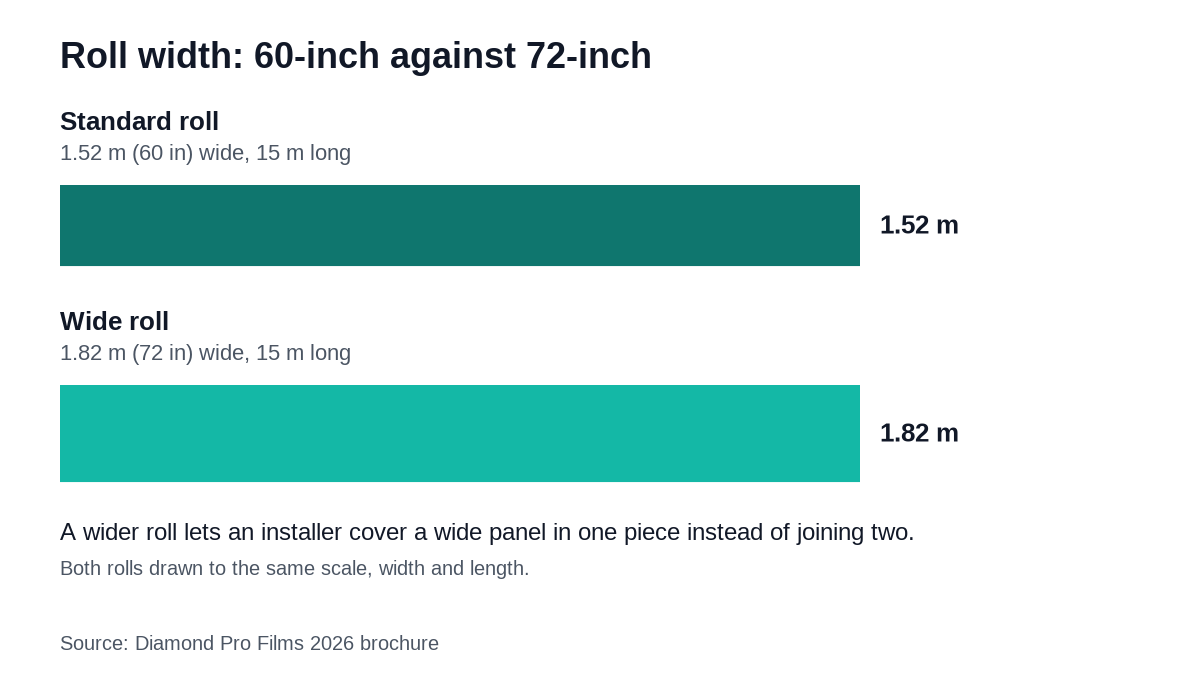
Diamond Pro 72 inch is the core TPU film on a wider roll: 1.82 m (72 in) wide instead of the usual 1.52 m (60 in), still 15 m long. It carries the standard film's 10-year warranty and 8 mil (203 µm) thickness. It is the one film in the range defined by its size rather than by its chemistry.
Width matters because paint protection film looks best in one piece. When a panel is wider than the roll in the direction the installer needs to lay the film, there are three options: a seam where two pieces meet, a relief cut that lets the film fit around a shape, or a pattern that stops short of the edge. Each of those leaves a visible line that can collect dirt and is a place where lifting starts. An extra 30 cm of width lets a full bonnet, roof or tailgate on a large vehicle be covered in a single sheet more often.
That is a practical advantage in the UAE, where large SUVs and pickups are a big share of the cars that get film. Whether your car needs it depends on the panel's size and shape and on how the installer orients the pattern on the roll; a skilled installer can often run film lengthwise to avoid a seam. Ask before booking whether your bonnet and roof will be one piece on a 60-inch roll, and if not, whether the shop stocks the 72-inch film.
Be clear about what the wide roll is not. It is not unique to Diamond Pro: 3M lists Scotchgard Pro Series 200 on rolls up to 1.83 m wide, according to the figures this site holds for 3M. And it is the 10-year standard film on a wider roll, not the 15-year Diamond Pro X. If you want both the widest coverage and the longest term from Diamond Pro, you have to choose one, or accept a seam on the widest panel in X.
The wide roll is also an installer decision as much as a buyer's. Shops that mostly fit saloons may not stock it. Asking for it by name is the simplest way to find out whether a shop is set up for large vehicles.
Diamond Pro Nano Ceramic Window Tint: the five shades
Diamond Pro's window tint is a nano ceramic film sold in five shades, DP00, DP30, DP50, DP70 and DP90, all with a 10-year warranty. Diamond Pro publishes visible light transmission, infrared rejection at two wavelengths, UV rejection and total solar energy rejected for each shade. That is more than many tint brands give per shade, and it makes the range easy to check.
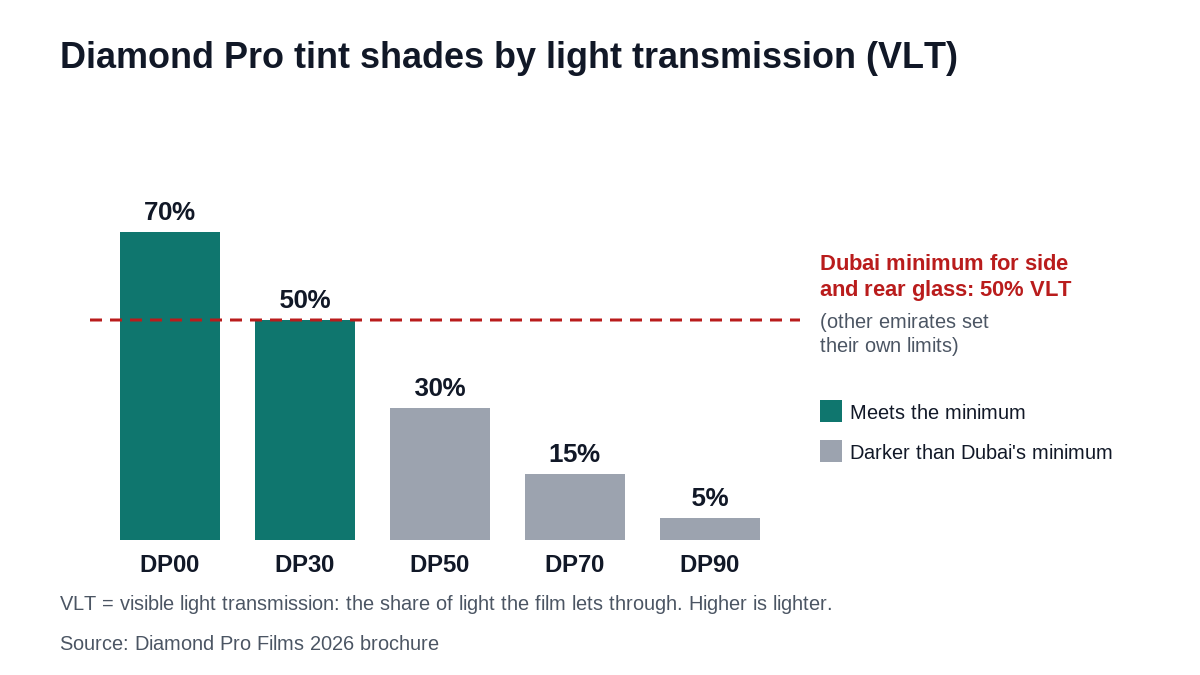
Read the shade names carefully, because they run the opposite way to the light figure. The DP number rises as the film gets darker; it is not the percentage of light let through. DP00 lets through 70% of visible light. DP30 lets through 50%. DP50 lets through 30%. DP70 lets through 15%. DP90 lets through 5%. A buyer who asks for 30 expecting 30% VLT and receives DP30 gets a much lighter film than intended, and a buyer who asks for DP50 believing it is 50% VLT gets a film that is illegal on side glass in Dubai.
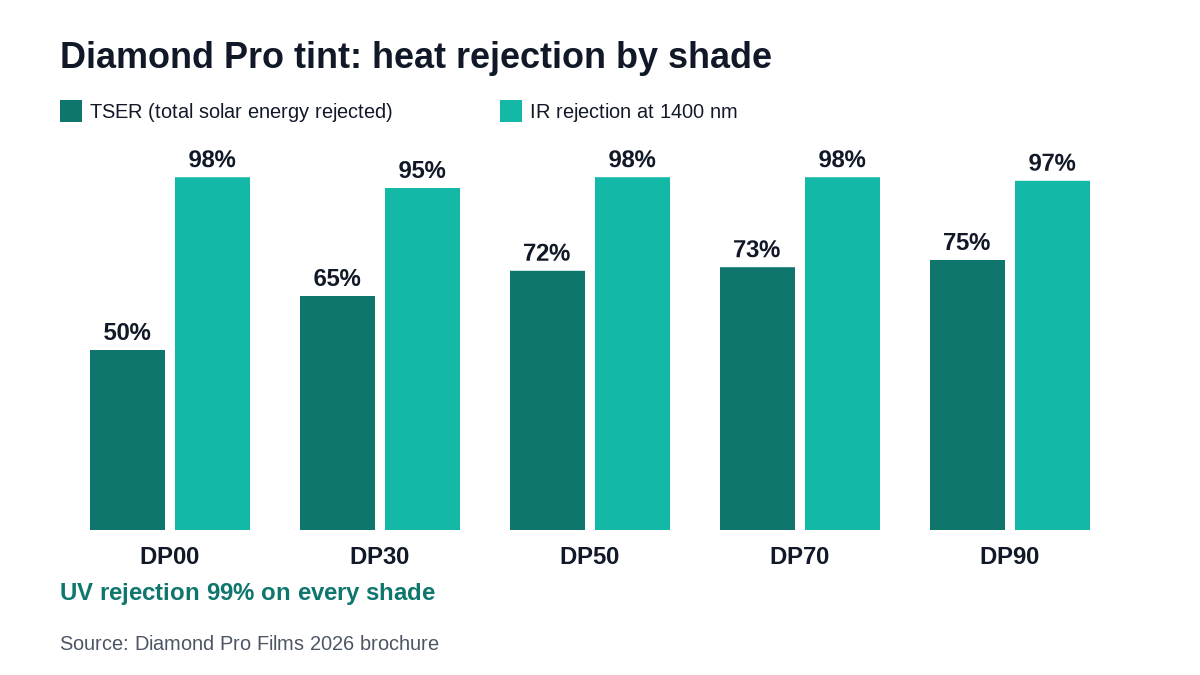
All five shades are rated at 99% UV rejection, the figure that protects skin and stops dashboards and leather fading. Total solar energy rejected (TSER) runs from 50% on DP00 to 75% on DP90. Infrared rejection at 950 nm runs from 85% to 95%, and at 1,400 nm from 95% to 98%. The next section explains what those numbers mean in practice.
The warranty is 10 years and has two conditions: the tint must be professionally installed by an authorised Diamond Pro dealer, and proof of installation must be submitted to Diamond Pro's digital warranty programme. It covers significant fading or discolouration beyond what Diamond Pro calls the industry standard, adhesive failure such as bubbling, peeling or blistering, delamination, and cracking not caused by external factors. It excludes accidents, misuse, improper cleaning or maintenance, damage from harsh chemicals, abrasives or sharp objects, and alterations by unauthorised people. Diamond Pro reserves the right to repair or replace with a similar product of equal value.
Ten years is a respectable term but shorter than several competitors. XPEL's automotive tint carries a transferable lifetime warranty, STEK NEX a limited lifetime warranty that ends when the car is sold, SunTek's ceramic and carbon lines a lifetime limited warranty, and 3M Ceramic IR a limited lifetime warranty, according to the figures this site holds for those brands. On tint, Diamond Pro's warranty is not its selling point.
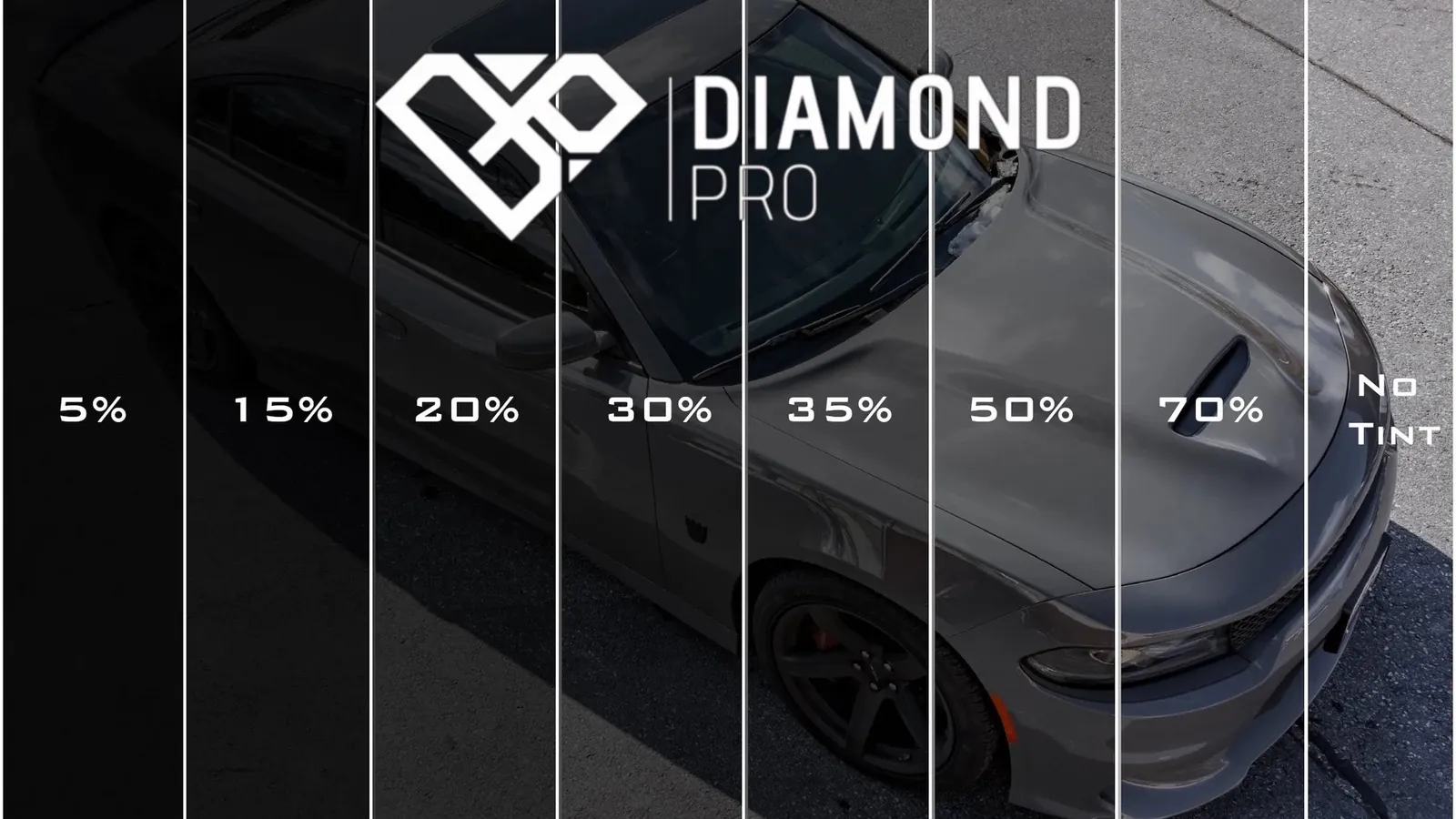
The brochure's tint swatch page shows strips at 5%, 15%, 20%, 30%, 35%, 50% and 70% visible light. Only five shades appear in the specification table. If an installer offers a Diamond Pro shade that is not in the table, ask for its published figures before agreeing to it.
| Shade | VLT | IR rejection 950 nm | IR rejection 1,400 nm | UV rejection | TSER | Dubai side and rear glass |
|---|---|---|---|---|---|---|
| DP00 | 70% | 92% | 98% | 99% | 50% | Meets the 50% minimum |
| DP30 | 50% | 85% | 95% | 99% | 65% | Meets the 50% minimum |
| DP50 | 30% | 88% | 98% | 99% | 72% | Darker than the minimum |
| DP70 | 15% | 95% | 98% | 99% | 73% | Darker than the minimum |
| DP90 | 5% | 95% | 97% | 99% | 75% | Darker than the minimum |
Tint heat numbers in plain words: VLT, IR, UV and TSER
Tint brochures use four measurements, and each one answers a different question. Knowing which is which is the simplest way not to be sold a number that sounds better than it feels.
VLT, visible light transmission, is how much visible light gets through the glass and film. Higher VLT means lighter. It is the figure the law uses, and it says nothing about heat on its own.
UV rejection is how much ultraviolet light the film blocks. UV is what burns skin through a side window and fades dashboards. Diamond Pro rates every shade at 99%. UV rejection is close to universal on modern films, so it is a box to tick rather than a reason to choose between brands.
IR rejection is how much infrared, the part of sunlight felt as heat on the skin, is blocked. Diamond Pro gives IR at two single wavelengths, 950 nm and 1,400 nm. A single wavelength is a spot check, not the whole infrared band. Notice that on Diamond Pro's own figures the lightest shade, DP00, rejects more infrared at 950 nm (92%) than DP30 (85%) or DP50 (88%). That is because infrared rejection in a ceramic film comes from the ceramic particles, not from darkness. It is the reason a light ceramic film can feel cooler than a dark dyed one.
TSER, total solar energy rejected, is the best single number for how much cooler the cabin will be. It counts visible light, infrared and UV together. Diamond Pro's TSER runs from 50% on DP00 to 75% on DP90. TSER rises with darkness because a dark film also blocks visible light, which carries heat too. The two shades that meet Dubai's side-glass minimum, DP00 and DP30, reject 50% and 65% of total solar energy respectively.
For context, other brands publish TSER for their legal shades too. STEK gives NEX 45 (45% VLT) at 52% TSER and NEX 70 (66% VLT) at 46%. SunTek's Evolve series runs from 50% to 65% TSER across its shades, and 3M quotes Crystalline at up to 71%, according to the figures this site holds for those brands. Those numbers are not measured the same way: 3M states its data assumes 6 mm green automotive glass, SunTek measures to NFRC guidelines on clear glass, and Diamond Pro does not state its method. Cross-brand TSER comparisons are approximate at best. On Diamond Pro's own figure, DP30 at 50% VLT is a strong result; ask the installer for the method behind it.
The practical rule is the same for every brand. Choose the darkest shade the law allows on your glass, then compare TSER for that exact shade, not the brochure headline for the darkest film.
Which Diamond Pro tint shades are legal in Dubai
Dubai's minimum is 50% VLT on side and rear glass for private cars, the fine is AED 1,500 and the film must come off; the windscreen must stay clear apart from a narrow sun strip along the top; other emirates set their own limits.
Applied to Diamond Pro's range, that is simple. DP00 (70% VLT) and DP30 (50% VLT) meet Dubai's minimum on side and rear glass. DP50 (30% VLT), DP70 (15%) and DP90 (5%) are darker than the minimum and should not go on the side or rear glass of a private car registered in Dubai. The shade name is the trap here: DP50 sounds like 50% and is 30%.
The check happens at RTA vehicle testing, not at the tint shop. A shop that fits a dark shade does not carry the fine or the removal; the owner does. The film also stays on the car through registration renewals, so a shade that slips through once is still a problem the next time the car is tested. Choosing DP30 rather than DP50 does not cost much in comfort, either: on Diamond Pro's own figures DP30 rejects 65% of total solar energy against DP50's 72%.
The windscreen is a separate rule. In Dubai it must stay clear apart from a narrow sun strip along the top, so none of the five tint shades is a windscreen film. Diamond Pro's TPU windscreen protection film is a different, optically clear product, covered in the next section.
Outside Dubai, check the current limit for the emirate where the car is registered before choosing a shade. The rules differ, and a shade that is fine in one emirate can fail testing in another. This site's UAE window tint law guide carries the current Dubai figures.
For most Dubai drivers the decision is therefore between DP00 and DP30. DP30 gives the most heat rejection a legal Diamond Pro shade offers. DP00 gives a near-clear look with 50% TSER and 92% infrared rejection at 950 nm, which suits owners who want the glass to look untinted.
| Shade | VLT | Side and rear glass, private car, Dubai | Windscreen |
|---|---|---|---|
| DP00 | 70% | Meets the 50% minimum | Not a windscreen film; clear apart from a top sun strip |
| DP30 | 50% | Meets the 50% minimum | Not a windscreen film; clear apart from a top sun strip |
| DP50 | 30% | Darker than the minimum | Not a windscreen film |
| DP70 | 15% | Darker than the minimum | Not a windscreen film |
| DP90 | 5% | Darker than the minimum | Not a windscreen film |
TPU windscreen protection film
Diamond Pro's TPU windscreen protection film is not a tint. It is an optically clear, multi-layer thermoplastic polyurethane film that is thermally fitted to the windscreen to absorb the impact of road debris. Diamond Pro describes it as patented and says it forms an invisible bond with the glass.
Diamond Pro publishes the following figures: 87% visible light transmission, 99% UV rejection, 15% IR rejection and 18% TSER, at 2 mil thick. It names the test methods as ASTM E-1175 for the optical figures and ASTM D-638 and D-903-98 for the mechanical ones. This is the only Diamond Pro product for which test methods are named.
Read those heat figures correctly. At 15% infrared rejection and 18% TSER, the windscreen film is not a heat film and will not make a noticeable difference to cabin temperature. Its job is impact protection and UV blocking. Diamond Pro says impacts that would shatter unprotected glass leave only minimal pin-points on the film, and that it is scratch resistant against everyday abrasion such as wipers. Those are the brand's claims; no independent test is published.
No warranty term is published for the windscreen film, in the brochure or on the website. Ask for the term in writing before fitting. For comparison, STEK publishes a thirty-day warranty for its DYNOtop windscreen film covering manufacturing failures only, and excludes rock chips and wiper wear, according to the figures this site holds for STEK. Windscreen films take a harder life than paint films, and short or unpublished terms are common across brands.
On the legal side, Dubai requires the windscreen to stay clear apart from a narrow sun strip along the top. Diamond Pro describes this film as optically clear at 87% VLT, but any film on a windscreen is something the testing centre will see. Ask the installer to confirm the car will pass RTA testing with it fitted, and keep the product documentation in the car.
Who suits it. Drivers who cover long highway distances behind trucks, where windscreen chips are frequent, and owners of cars whose windscreens are expensive or slow to replace because of cameras and sensors behind the glass. It is a protection product for the glass, not a comfort product.
| TPU windscreen film | Published figure | Test method named |
|---|---|---|
| Visible light transmission | 87% | ASTM E-1175 |
| UV rejection | 99% | ASTM E-1175 |
| IR rejection | 15% | ASTM E-1175 |
| TSER | 18% | ASTM E-1175 |
| Thickness | 2 mil | Not stated |
| Mechanical tests | Methods named: ASTM D-638, D-903-98 | As listed |
| Warranty | Not published | Ask in writing |
Door edge PPF and the installer support kit
Diamond Pro sells a precision-cut door edge film: narrow pieces of paint protection film cut to fit the edges of the doors, which take chips every time a door is opened into a wall, a pillar or the car alongside in a tight car park. The brochure describes it as a seamless, invisible barrier against daily wear. Thickness and warranty term are not published separately for it.
Door edges are a sensible small job on their own, and they are also one of the areas Diamond Pro's FAQ lists as most commonly protected, alongside the front bumper, bonnet and wing mirrors. If a car is getting a front-end package, adding door edges is usually a small extra; ask whether the edge pieces are pre-cut for your model or cut by hand.
The rest of the catalogue is aimed at installers rather than owners. Diamond Pro sells application squeegees in medium and firm flexibilities, microfibre towels, wheel splash protection that keeps slip solution and polish debris off the wheels during fitting, and marketing materials including flyers, demo hoods and sample pieces. None of this changes what goes on the car, but it tells you something about the brand's model: it sells to and supports a network of shops rather than to the public.
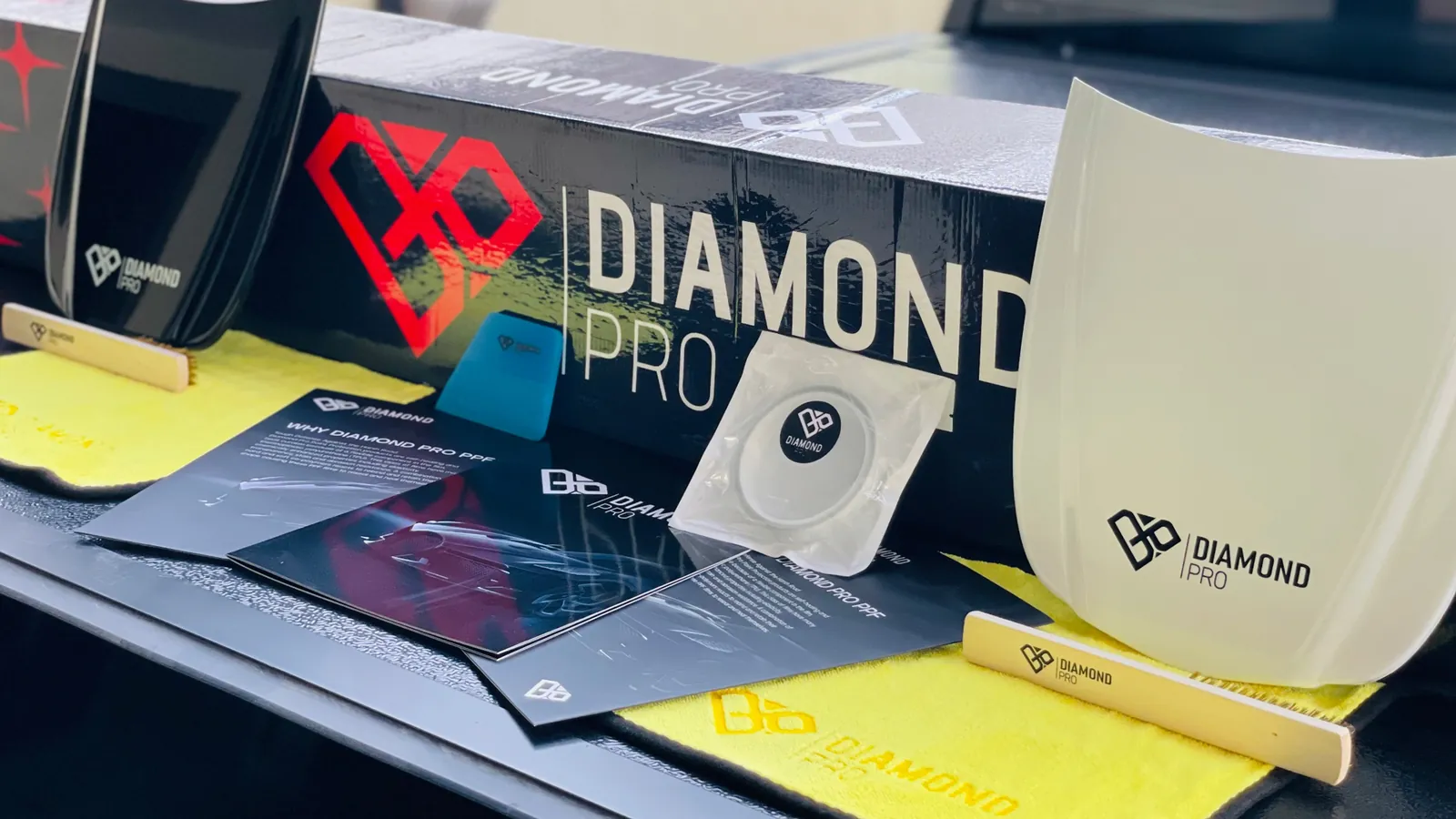
The demo hood is the part worth using as a buyer. A demo hood is a painted panel with film fitted, kept in the shop so customers can see and touch the film. Ask to see one with the exact film you are being quoted, in daylight. It is a better guide to clarity, gloss and texture than any number on a spec sheet, and a shop that has one on hand is at least set up as a Diamond Pro dealer.
What Diamond Pro's published test numbers mean, and their limits
Diamond Pro publishes more test numbers for its paint films than most brands this site covers. That is a genuine point in its favour: the figures exist, and a buyer can hold the brand to them. It is also the place where a careful reader needs to slow down, because every figure is the brand's own. No laboratory is named, no test method is given for the paint film tests, and no independent third party has published a test of Diamond Pro film that this site could find as of November 2026.
Comparison sheets circulated by the brand describe themselves as independent comparisons. They are Diamond Pro's own material, and this page uses them only for Diamond Pro's figures about itself. Claims they make about other brands are not repeated here.
The table below explains each test in plain words and what it cannot tell you. The short version: these numbers show the film was tested and how it performed on the brand's bench. They do not show how it compares with a competitor tested the same way, and they do not show how it ages on a car parked outdoors in the Gulf for a decade.
Gloss, ΔE and elongation are the three most quoted. Gloss units (GU) are read by a glossmeter at a fixed angle; Diamond Pro gives 145.7 GU for X but not the angle, so the number cannot be compared with another brand's. ΔE is a measure of colour difference between a sample before and after ageing; a ΔE below about 1 is generally treated as too small for most people to see. Elongation at break is how far the film stretches before it tears, a measure of how well it conforms around curves and absorbs an impact without splitting.
Two figures are hard to interpret at all. The hydrophobic rating of R9 to R10 is Diamond Pro's own scale, and the brand does not explain it, so it is not translated into a water-contact angle here. Stain resistance described as removable by tissue is a description, not a measurement.
The fair conclusion is that Diamond Pro's spec sheets are more transparent than many brands' marketing, and less proven than independent data would be. Use them to hold the brand to account if a film yellows or cracks under warranty, not as proof that it outperforms another brand.
| Test | Diamond Pro's published figure | What it means | What it does not tell you |
|---|---|---|---|
| Gloss level | 145.7 GU (X) | How shiny the film surface reads on a glossmeter | Angle not stated, so not comparable with other brands |
| Elongation at break | Over 390% (X), 350% (standard), 300% (Lite) | How far it stretches before tearing | How it behaves after years of heat cycling |
| Tensile strength | 33 MPa (X, standard), 28 MPa (Lite) | Force needed to pull it apart | Stone-chip resistance on a moving car |
| Yellowing test | ΔE below 1 after 1,000 hours | Almost no visible colour change in accelerated ageing | Real Gulf exposure over 5 to 15 years |
| Hydrophobic property | R9 to R10 | Diamond Pro's own water-repellency rating | The scale is not published |
| Stain resistance | Can be removed by tissue | Marks wipe off in the test | Which stains, after how long |
| Acid resistance, rain spot | No abnormalities | No visible damage in the test | Test conditions or duration |
| Removal test | No damage to paint or glue residue | Clean removal in the test | Removal after years on a sun-baked panel |
The Diamond Pro warranty decoded
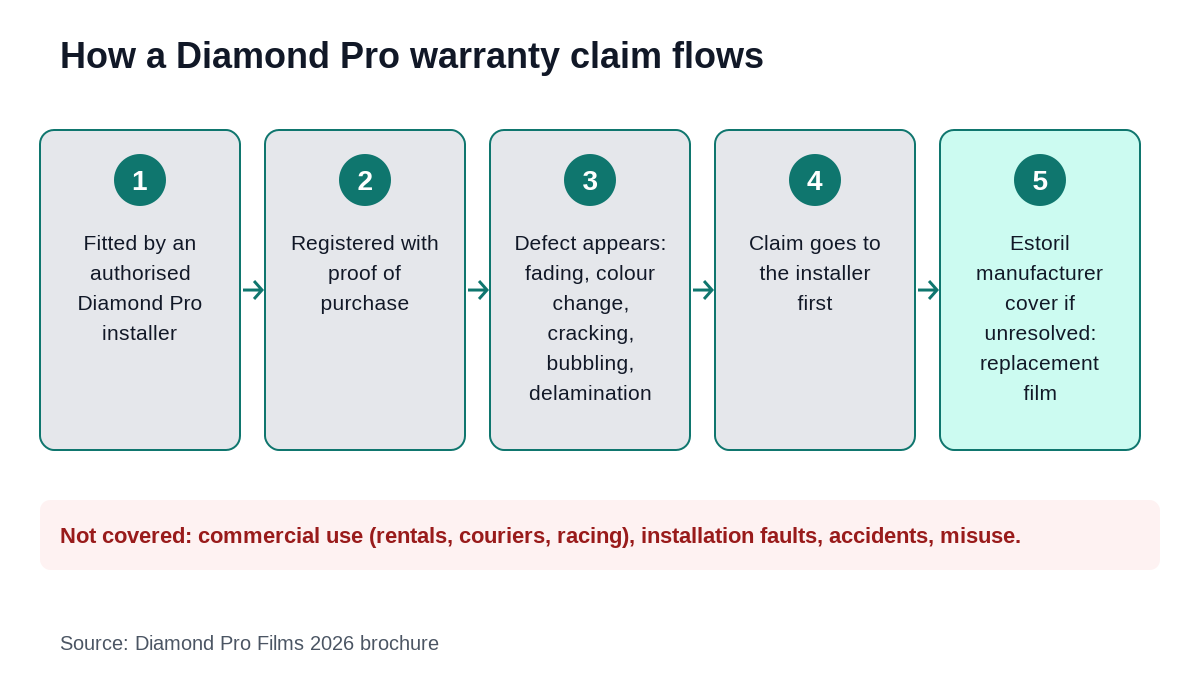
Diamond Pro's paint film warranty is certified under the name Estoril. The brochure and the product pages say Estoril's warranty certifies all Diamond Pro product lines to be free of manufacturing and workmanship defects for the stated term from the date of installation on painted automotive surfaces. The next sentence narrows that: the warranty covers only defects that can be attributed to the manufacturing process of the film, such as fading, colour change, cracking, bubbling or delamination. The website FAQ adds that warranties of 5 to 15 years cover yellowing, cracking, peeling and staining.
What it pays. Replacement of the defective film is the only form of compensation, provided only on a valid proof of purchase issued by an authorised dealership. The published terms do not promise labour for removing the failed film and fitting the new one. On a full-body job, labour is a large part of the original work, so ask the installer in writing who pays for labour on a warranty claim.
Who you claim from. All claims go first to the original dealership or installer. Only if that claim proves unsatisfactory will Estoril provide manufacturer coverage. Diamond Pro does not publish who Estoril is, how to contact it, or how a claim reaches it if the installer has closed. That is the single biggest gap in the warranty as published, and it is a question worth putting to Diamond Pro directly before choosing a long-term film.
What it excludes. Diamond Pro products on vehicles used for commercial or professional activities are not covered, including racing cars, courier fleets and rentals. The Lite terms spell out further exclusions that read as general: defects or accidents caused by inappropriate installation processes or facilities, intentional misuse, and exceptional damage from large debris, collision or vandalism. A stone that punches through the film is the film doing its job, not a warranty claim, and that is true of every brand.
Registration. The brochure asks owners to register the product using a form at the time of installation to make any claim quicker. For tint, proof of installation goes into Diamond Pro's digital warranty programme and is a condition of cover. Make sure registration happens at handover, in your name, and that you receive confirmation.
What the terms do not say. They do not say whether the warranty transfers to a new owner when the car is sold. XPEL Ultimate Plus transfers with proof of the original installation date; STEK DYNO transfers only if the new owner submits that proof within thirty days of the sale; SunTek Reaction does not transfer, according to the figures this site holds for those brands. Ask Diamond Pro or the installer to state the transfer position in writing.
What to keep. The invoice from the authorised dealer naming the exact film (Diamond Pro X, Diamond Pro, Matte and so on), the panels covered, the installation date and the car's plate or VIN; the registration confirmation; the installer's name and branch; and dated photos of the car at handover. Without proof of purchase from an authorised dealership there is no claim at all.
| Question | What Diamond Pro publishes | What to do |
|---|---|---|
| Who certifies it? | Estoril; not explained anywhere public | Ask Diamond Pro who Estoril is and how to reach it |
| How long? | X 15, standard and 72-inch 10, Matte 7, Lite and Colour 5 years; tint 10 | Confirm the term for your exact film on the invoice |
| What is covered? | Manufacturing defects: fading, colour change, cracking, bubbling, delamination | Photograph the film at handover |
| What does it pay? | Replacement film only | Ask who pays labour on a claim |
| Where do claims go? | Original dealer or installer first; Estoril only if that fails | Keep the installer's details |
| What is excluded? | Commercial use, rentals, courier fleets, racing; installation faults, misuse, large debris, collision, vandalism | Do not fit warranted film to a fleet car |
| Registration? | Register at installation; tint needs digital registration | Get confirmation in your name |
| Transfer on sale? | Not stated | Ask for the position in writing |
How Diamond Pro film performs in UAE conditions
Diamond Pro's central claim is that its films were developed in Kuwait for the Middle East. Its FAQ answers the question of whether extreme heat will damage the film with a plain no, on the basis that Kuwait is one of the hottest places in the world. That is the brand's position. There is no independent long-term data on Diamond Pro film in UAE conditions that this site could find, so what follows sets out the conditions and what the published figures do and do not say about each.
Heat. Summer air temperatures in the UAE pass 50°C, and a dark panel in direct sun gets hotter still. Heat is not all bad for paint film: Diamond Pro's self-healing topcoat is heat-activated, so a car standing in the sun supplies the heat that closes light wash marks without a heat gun. The risk heat poses is to adhesives and edges, through daily expansion and contraction. Diamond Pro's answer is its proprietary Edge Seal Technology, which it says keeps film from lifting. That is a claim; good edge work by the installer, with edges wrapped where the panel allows, matters at least as much.
UV. The sun is strong all year, not just in summer, and UV is what yellows clear film. Diamond Pro publishes a yellowing result of ΔE below 1 after 1,000 hours of testing and warrants against fading and colour change for 5 to 15 years depending on the film. The test is accelerated ageing on a bench; the warranty is what protects you if the film does yellow on the car.
Sand and dust. Fine sand acts as an abrasive when a dusty car is wiped dry, which is the main cause of swirl marks on any film or paint. Self-healing closes light marks; it does not undo deep scratches. Rinse before wiping, use clean microfibre, and avoid dry-wiping a dusty car.
Sprinklers and water spots. Treated water from garden and roadside sprinklers, and frequent washing, leave mineral spots that can etch a surface if left to dry in the sun. Diamond Pro's rain-spot test reports no abnormalities and its hydrophobic rating is R9 to R10 on its own scale. A water-shedding surface helps; drying the car promptly helps more.
Washing and parking. Diamond Pro's FAQ says not to wash the car for three days after fitting and to avoid automatic car washes, which can damage the film. Outdoor parking is where film earns its keep, and also where every one of the stresses above is strongest. For a car that lives outdoors, the longer warranty films (X and the standard film) are the better match, and registration and paperwork matter more.
How Diamond Pro compares with XPEL, STEK, SunTek and 3M
The table compares Diamond Pro X with the flagship clear films of the four brands most often quoted in the UAE. Competitor figures are taken only from the manufacturer-sourced research this site already holds for those brands; where a figure is not in that research, the cell says so rather than guessing. Diamond Pro's figures are its own.
Where Diamond Pro leads. The warranty: 15 years on X against 10 on XPEL Ultimate Plus, 10 on STEK DYNOshield as standard on STEK's US site (12 with Final Coat, and 12 on STEK's global document depending on region), 12 on SunTek Reaction and 10 on 3M Scotchgard Pro Series 200. The breadth of published test numbers. A 1.82 m wide roll option; of the other four brands, only 3M's roll width is in this site's data, at up to 1.83 m. And film, tint and windscreen film from one Gulf brand. On thickness, XPEL's own listing gives about 8 mil; this site's spec table records 193 µm (7.6 mil), so X's published 203 µm is marginally thicker, a difference too small to matter in practice.
Where it trails. XPEL has certified installers listed across Dubai, Abu Dhabi, Sharjah and Fujairah and a pattern library of more than 80,000 patterns; STEK has a Dubai distributor established in 2015 and a public installer locator; SunTek is distributed through Al Ghurair Motors; 3M runs an authorised car care network. Diamond Pro's UAE list is a short list of shops in Dubai and Abu Dhabi. XPEL's warranty transfers with proof of installation; Diamond Pro's terms are silent on transfer. And the global brands have years of public reviews, press and installer experience in the UAE, while Diamond Pro has very little.
What the table cannot settle is real-world durability. None of the five brands is compared here on an independent, like-for-like test, because no such test of Diamond Pro exists. A longer warranty is a stronger written promise, and only as good as the claims process behind it. In practice the installer's skill decides more about how a film looks after three years than the brand on the box.
Separate head-to-head guides on this site compare Diamond Pro with XPEL and with STEK in more depth, and the best PPF brands guide ranks every brand by use case.
| Diamond Pro X | XPEL Ultimate Plus | STEK DYNOshield | SunTek Reaction | 3M Scotchgard Pro Series 200 | |
|---|---|---|---|---|---|
| Maker and origin | Diamond Pro Films, founded Kuwait 2018 | XPEL, Inc., San Antonio, Texas, founded 1997 | STEK, Korean-engineered, marketed via STEK USA | Eastman Performance Films, USA | 3M Company, USA |
| Thickness | 8.0 mil (203 µm) | About 8 mil per XPEL's listing; 193 µm (7.6 mil) in this site's spec table | 8 mil | 8.0 mil (Ultra/Reaction, per this site's data) | 0.2 mm |
| Warranty | 15 years | 10 years | 10 years (12 with Final Coat) | 12 years | 10 years |
| Transfers on sale | Not stated | Yes, with proof of install date | Only if the new owner submits proof within thirty days | No | Not in this site's data |
| Topcoat | Heat-activated self-healing; nano-ceramic infused, with a hydrophobic topcoat on every paint film, per Diamond Pro | Self-healing elastomeric polymer; hydrophobic topcoat on Ultimate Fusion | Self-healing, hydrophobic, nano-ceramic infused | Tetrashield resin, super-hydrophobic | Self-healing, hydrophobic top surface |
| Widest roll | 1.52 m (1.82 m on the 72-inch film) | Not in this site's data | Not in this site's data | Not in this site's data | Up to 1.83 m |
| Pattern library | Not published | More than 80,000 patterns | Not in this site's data | Not in this site's data | Approved for 3M's own pattern software |
| UAE network | Approved applicators in Dubai and Abu Dhabi | Certified installers in Dubai, Abu Dhabi, Sharjah, Fujairah | STEK UAE-Oman, Dubai, est. 2015, plus locator | Al Ghurair Motors | 3M UAE Authorized Car Care network |
| Independent test data | None found | Not compared here | Not compared here | Not compared here | Not compared here |
How to verify a genuine Diamond Pro install
Counterfeit and mislabelled film is a known problem in the UAE paint protection market, and a smaller brand with fewer installers makes the checks more important, not less. Every check below can be done before or at handover, and none relies on taking a shop's word for it.
First, check the shop is on Diamond Pro's own approved-applicator list on diamondprofilms.com before booking. The list is Diamond Pro's, not this site's, and it changes; a shop that was on it last year may not be on it now. If the shop is not listed, ask Diamond Pro directly whether it is an authorised dealer, because the paint film warranty needs proof of purchase from an authorised dealership and the tint warranty needs installation by one.
Second, get the exact product name on the quote and the invoice. Diamond Pro X, Diamond Pro, Matte, Lite, Colour and 72 inch carry terms from 5 to 15 years, so an invoice that just says PPF or Diamond Pro film does not tell you which warranty you bought. For tint, the shade code and its VLT should both be written down.
Third, ask to see the roll and its box before the film goes on. Diamond Pro has not published what its genuine labels or liners look like, so this is not a forensic check, but a shop fitting genuine film has no reason to hide the roll, and the label should name the product you are paying for.
Fourth, make sure the warranty is registered at fitting, in your name, and that you receive confirmation. For tint, registration in the digital Diamond Pro warranty programme is a condition of cover. If confirmation has not arrived within a few days, chase the installer while the job is fresh.
Fifth, if anything is unclear, contact Diamond Pro directly. Its Dubai office and WhatsApp number are on its website, and asking the brand to confirm that a named shop is authorised and that a particular invoice will be honoured takes a few minutes. That is a reasonable request for any long-warranty product.
| Check | Why it matters |
|---|---|
| Shop is on Diamond Pro's current approved-applicator list | Warranty depends on an authorised dealer |
| Invoice names the exact film or shade | Terms run from 5 to 15 years depending on product |
| You see the roll and its label | Confirms the product before it is on the car |
| Warranty registered in your name at fitting | Speeds claims; required for tint cover |
| Proof of purchase kept with dated photos | Replacement film is given only on valid proof of purchase |
| Brand confirms the shop if in doubt | Diamond Pro's own contact details are published |
Diamond Pro's approved installers in the UAE
Diamond Pro's own approved-applicator list includes Auto Magic, Autoplus (Abu Dhabi), Autowerks, Hallmark Detailing, Performance Plus, Quick Pro Auto, The Detail Bay, The Lab Auto, Wrapsters and Oryx Detailing (checked 26 November 2026). Apart from Autoplus in Abu Dhabi, the list places these in Dubai.
Check the installer is on the current list before booking; the list is Diamond Pro's, not this site's. Inclusion on it is Diamond Pro's statement that a shop is approved. It is not a review of the shop's work by this site, and installers can join or leave a brand's network at any time.
The list is short compared with the networks of the larger brands. That has practical consequences. Outside Dubai and Abu Dhabi there may be no listed applicator nearby, which matters for warranty claims because claims go to the original installer first. If you move emirates or the shop closes, ask Diamond Pro how a claim would be handled before relying on a long term.
A good installer matters more than the film. When comparing listed shops, ask to see finished cars, ask whether patterns are pre-cut for your model or trimmed by hand on the paint, ask whether edges will be wrapped where the panel allows, and ask whether the shop stocks the film you want, especially Diamond Pro X and the 72-inch roll, which not every shop will hold.
Strengths and weaknesses, honestly
Diamond Pro is a credible regional brand with a strong written offer and a thin public record. Both halves of that sentence matter, and the table sets them side by side.
The strengths are real and checkable. The 15-year term on Diamond Pro X is the longest fixed-term manufacturer PPF warranty among the brands this site covers; Hexis and KAVACA publish conditional lifetime terms. The brand publishes layer-by-layer construction and test figures for its paint films, and per-shade figures for its tint. It is developed in the Gulf for Gulf conditions, by its own account. It offers a 72-inch roll. And it covers paint film, tint and windscreen film under one brand, which simplifies a combined job.
The weaknesses are equally real. The installer network is a fraction of XPEL's and much smaller than STEK's or 3M's in the UAE. Every test figure is the brand's own, with no laboratory named and no independent test found. Estoril, the name behind the warranty, is not explained anywhere public, and the remedy is replacement film only. The terms do not state whether the warranty transfers on sale. Matte and Colour carry shorter terms than competing matte and coloured films. The tint warranty is 10 years against lifetime terms from several rivals. Ownership and legal entity are not published. And there is little press or review footprint to show how the film has aged on real cars.
Neither list is a verdict. For an owner who wants the longest fixed-term PPF warranty among the brands this site covers and has a listed applicator nearby, Diamond Pro X is a reasonable choice. For an owner who values a large network, transferability on sale, or a long public track record, the global brands are the safer pick.
| Strength | Weakness |
|---|---|
| 15-year warranty on Diamond Pro X, the longest fixed-term PPF warranty among the brands this site covers | Small UAE installer network, far smaller than XPEL's |
| Layer-by-layer specs and test figures published | All test data is the brand's own; no independent tests found |
| Developed in Kuwait for Gulf conditions (brand's statement) | Estoril, the warranty certifier, is not explained publicly |
| 72-inch (1.82 m) roll for wide panels | Replacement film only; labour not promised; transfer not stated |
| Per-shade tint figures, including two Dubai-legal shades | 10-year tint warranty against lifetime terms from rivals |
| Paint film, tint and windscreen film under one brand | Matte (7 years) and Colour (5 years) shorter than rival matte and colour films |
| Dubai office and published contact details | Ownership, legal entity and finished-film origin not published; little press |
How to choose a Diamond Pro film
Start with how long you will keep the car and where it lives, then pick the finish, then check the panel widths. The table maps common situations to the film that fits and the thing to watch.
For most daily drivers kept for several years, the standard Diamond Pro is the default and Diamond Pro X is the upgrade for owners who want the longest term in the range. Lite suits short ownership and front-end coverage. Matte and Colour are finish choices, with shorter terms to weigh. The 72-inch film is a width choice for large vehicles. For tint in Dubai the choice is between DP00 and DP30.
Whatever the choice, three steps apply: book through a shop on Diamond Pro's current approved-applicator list, get the exact product on the invoice, and register the warranty at fitting.

| Situation | Diamond Pro film | Why | Watch out for |
|---|---|---|---|
| Daily driver, kept 5 to 10 years | Diamond Pro (standard) | 8 mil, 10-year term, the core of the range | Get the product named on the invoice |
| Keeping the car 10 years or more, parked outdoors | Diamond Pro X | Longest term in the range: 15 years | Transfer on sale not stated; replacement film only |
| Factory matte paint or a satin look | Diamond Pro Matte | Keeps or creates a satin finish | 7-year term, shorter than rival matte films |
| Lease, short ownership or front end only | Diamond Pro Lite | Entry 5-year film for the stone-chip zone | Thinner at 6.3 mil (160 µm) |
| Large SUV or pickup with wide panels | Diamond Pro 72 inch | 1.82 m roll avoids seams on wide panels | 10-year standard film, not X |
| Colour change with paint protection | Diamond Pro Colour | New colour and protection in one film | 5-year term; Dubai colour-change paperwork |
| Cooler cabin, legal in Dubai | Nano ceramic tint DP30 or DP00 | Both meet Dubai's 50% minimum on side and rear glass | DP50 is 30% VLT and darker than the minimum |
| Frequent windscreen chips | TPU windscreen film | Clear impact layer, 99% UV rejection | No published warranty term; low heat rejection |
| Door chips in tight car parks | Door Edge PPF | Pre-cut edge protection | Thickness and term not published |
Diamond Pro Films — common questions
- Is Diamond Pro Films a good PPF brand?
- On paper it is a credible premium option. Diamond Pro Films is a Gulf paint-protection-film and window-tint brand, founded in Kuwait in 2018, with an office in Dubai. Its flagship Diamond Pro X carries a 15-year warranty, the longest fixed-term manufacturer PPF warranty among the brands this site covers (Hexis and KAVACA publish conditional lifetime terms), and it publishes detailed specs. Against that, its test figures are its own, its UAE installer network is small and its public review record is thin.
- Where is Diamond Pro Films from, and who owns it?
- Diamond Pro Films was founded in Kuwait in 2018 and says it was developed especially for the Middle East market. Its Dubai office is listed as OneSpace Business Center, Green Community. Diamond Pro does not publish its owner or legal entity, and the brochure names raw-material sources (Germany, Japan, Spain) but not where the finished film is made.
- Is Diamond Pro Films the same as Diamond ProTech, Ceramic Pro or Desert Diamond?
- No. Diamond Pro Films is a separate company from Diamond ProTech, Ceramic Pro and Desert Diamond. Ceramic Pro's film brand is KAVACA. When a shop quotes Diamond Pro, ask for the full product name, such as Diamond Pro X or Diamond Pro Matte, on the quote and invoice.
- How long is the Diamond Pro warranty?
- It depends on the film. Diamond Pro X carries 15 years, the standard Diamond Pro and the 72-inch film 10 years, Diamond Pro Matte 7 years, and Diamond Pro Lite and Diamond Pro Colour 5 years. The nano ceramic window tint carries 10 years. No term is published for the TPU windscreen film or the door edge film.
- Who is Estoril, the company named on the Diamond Pro warranty?
- Diamond Pro's warranty is certified under the name Estoril, but Diamond Pro does not explain anywhere public who or what Estoril is, as of November 2026. The terms say claims go first to the original installer and that Estoril provides manufacturer coverage only if that claim proves unsatisfactory. Ask Diamond Pro how to reach Estoril before relying on a long term.
- What does the Diamond Pro paint film warranty actually pay for?
- Replacement of the defective film is the only compensation, and only on valid proof of purchase from an authorised dealership. It covers manufacturing defects such as fading, colour change, cracking, bubbling and delamination. It excludes commercial vehicles including rentals, courier fleets and racing cars, plus installation faults, misuse, large debris, collision and vandalism. Labour is not promised in the published terms.
- Is Diamond Pro X better than XPEL Ultimate Plus?
- It has a longer warranty, 15 years against 10, and Diamond Pro publishes more test figures for it. XPEL Ultimate Plus has a much larger UAE installer network, a pattern library of more than 80,000 patterns and a warranty that transfers on sale with proof of installation. Neither has been compared on an independent like-for-like test, so the choice is between a longer written term and a bigger, better-proven network.
- How does Diamond Pro compare with STEK?
- Diamond Pro X and STEK DYNOshield are both 8 mil films with self-healing topcoats, and both are sold as hydrophobic: STEK's is its HYDROphobe topcoat, and Diamond Pro X has a hydrophobic topcoat, as every Diamond Pro paint film does per Diamond Pro, rated R9 to R10 on the brand's own scale. Diamond Pro X carries 15 years; STEK publishes 10 years as standard on its US site, 12 with Final Coat, and 12 on its global document depending on region. STEK has a Dubai distributor established in 2015 and a public installer locator, a larger UAE presence than Diamond Pro.
- What is PCU, and why does Diamond Pro X use it?
- PCU is polycarbonate urethane, a polyurethane built from polycarbonate-based ingredients. Most premium paint films, including the standard Diamond Pro, use TPU, thermoplastic polyurethane. Diamond Pro lists the 160 µm film layer of Diamond Pro X as PCU from a German source and says PCU resists heat-induced deformation better. That is the brand's claim; no independent test of it is published.
- How thick is Diamond Pro paint protection film?
- Diamond Pro X, the standard Diamond Pro, Matte, Colour and the 72-inch film are 8 mil (203 µm) thick. Diamond Pro Lite is 6.3 mil (160 µm). Diamond Pro X is built from a 160 µm PCU layer, a 25 µm self-healing coating and an 18 µm adhesive. The TPU windscreen film is 2 mil.
- Does Diamond Pro PPF go yellow in the UAE sun?
- Diamond Pro publishes a yellowing result of ΔE below 1 after 1,000 hours of testing, a colour change generally too small to see, and its warranty covers fading and colour change for 5 to 15 years depending on the film. The test is the brand's own accelerated ageing result, not independent long-term Gulf data, so keep the proof of purchase that any claim depends on.
- Does Diamond Pro film self-heal?
- Yes. Every Diamond Pro paint film has a heat-activated self-healing topcoat that Diamond Pro says closes light scratches and swirl marks when warmed, which a car parked in UAE sun does without a heat gun. Self-healing works on light surface marks, not on deep scratches, cuts or stone impacts that go through the film.
- Which Diamond Pro tint shades are legal in Dubai?
- Two shades: DP00 and DP30. DP00 lets through 70% of visible light and DP30 lets through 50%. Dubai's minimum is 50% VLT on side and rear glass for private cars, the fine is AED 1,500 and the film must come off; the windscreen must stay clear apart from a narrow sun strip along the top; other emirates set their own limits. DP50 (30% VLT), DP70 (15%) and DP90 (5%) are darker than Dubai's minimum.
- Does DP30 tint mean 30% VLT?
- No. Diamond Pro's shade numbers rise as the film gets darker and are not the visible light percentage. DP00 is 70% VLT, DP30 is 50%, DP50 is 30%, DP70 is 15% and DP90 is 5%. Always ask for the VLT figure, not just the shade code, and have both written on the invoice.
- How much heat does Diamond Pro tint block?
- Diamond Pro publishes total solar energy rejected (TSER) of 50% for DP00, 65% for DP30, 72% for DP50, 73% for DP70 and 75% for DP90, with 99% UV rejection on every shade. Infrared rejection at 950 nm runs from 85% to 95%. The test method is not stated, so cross-brand comparisons are approximate.
- What is the Diamond Pro 72-inch film for?
- It is the standard 10-year Diamond Pro TPU film on a 1.82 m (72 in) wide roll instead of the usual 1.52 m (60 in). The extra 30 cm lets wide bonnets, roofs and tailgates on large SUVs and pickups be covered in one sheet more often, avoiding a visible seam. It is not the 15-year Diamond Pro X.
- Does Diamond Pro make a matte paint protection film?
- Yes. Diamond Pro Matte is an 8 mil (203 µm) TPU film with a satin, self-healing topcoat that keeps factory matte paint matte or turns gloss paint satin. It carries a 7-year warranty, shorter than the 10 years published for XPEL Stealth, SunTek Ultra Matte and 3M Scotchgard Pro Series 200.
- Where can I get Diamond Pro fitted in the UAE?
- Diamond Pro's own approved-applicator list includes Auto Magic, Autoplus (Abu Dhabi), Autowerks, Hallmark Detailing, Performance Plus, Quick Pro Auto, The Detail Bay, The Lab Auto, Wrapsters and Oryx Detailing (checked 26 November 2026). Check the installer is on the current list before booking; the list is Diamond Pro's, not this site's.
- How do I know my Diamond Pro film is genuine?
- Book through a shop on Diamond Pro's current approved-applicator list, get the exact product or tint shade named on the invoice, ask to see the roll and its label before fitting, and register the warranty in your name at handover. If in doubt, contact Diamond Pro through the details on its website to confirm the shop is authorised.
- How should I wash my car after Diamond Pro film is fitted?
- Diamond Pro's FAQ says not to wash the car for three days after installation and to avoid automatic car washes, which can damage the film. Hand wash, rinse dust off before wiping, and dry water spots promptly in the sun. The tint warranty excludes damage from improper cleaning, harsh chemicals and abrasives.
Opens WhatsApp with Diamond Pro Films directly.
Sources and last checked
- Diamond Pro Films home page — https://diamondprofilms.com/ (checked 26 November 2026)
- Diamond Pro X product page — https://diamondprofilms.com/diamond-pro-x (checked 26 November 2026)
- Diamond Pro Nano Ceramic Window Tint — https://diamondprofilms.com/diamond-pro-nano-ceramic-window-tint (checked 26 November 2026)
- Diamond Pro FAQs — https://diamondprofilms.com/faq (checked 26 November 2026)
- Diamond Pro film specifications — https://diamondprofilms.com/film-specifications (checked 26 November 2026)
- Diamond Pro approved applicators, UAE — https://diamondprofilms.com/approved-applicators (checked 26 November 2026)
- Diamond Pro contact page — https://diamondprofilms.com/contact-us (checked 26 November 2026)
- Diamond Pro Films 2026 brochure (PDF, supplied by the brand)
- XPEL Ultimate Plus — https://www.xpel.com/products/ultimate-plus (competitor figures from this site's XPEL brand research)
- XPEL warranty information — https://www.xpel.com/warranty-information (competitor figures from this site's XPEL brand research)
- XPEL UAE installer directory — https://www.xpel.com/installers/United_Arab_Emirates/All/All (competitor figures from this site's XPEL brand research)
- STEK DYNOshield — https://www.stek-usa.com/paint-protection-film/dynoshield/ (competitor figures from this site's STEK brand research)
- STEK DYNO series warranty — https://www.stekautomotive.com/support/warranty/paint-protection-film-dyno-series (competitor figures from this site's STEK brand research)
- STEK NEX window film — https://www.stekautomotive.com/brands/stek/window-film/nex (competitor figures from this site's STEK NEX brand research)
- SunTek Reaction — https://suntekfilms.com/emea/en/paint-protection-film/reaction/ (competitor figures from this site's SunTek brand research)
- SunTek automotive window film specifications — https://suntekfilms.com/content/dam/eastman/performance-films/suntek-films/documents/film-specifications/automotive-window-film-specifications.pdf (competitor figures from this site's SunTek brand research)
- 3M UAE automotive surface protection films — https://www.3mae.ae/3M/en_AE/p/c/films-sheeting/surface-protection-materials/films/i/automotive/ (competitor figures from this site's 3M brand research)
- 3M UAE automotive window film — https://www.3mae.ae/3M/en_AE/p/c/films-sheeting/window/i/automotive/ (competitor figures from this site's 3M brand research)