555 steering and suspension parts in the UAE
Steering and suspension linkage parts: tie rod ends, ball joints, arms and links
555 is a trademark of its owner. We are not an authorised 555 dealer or distributor, and nothing here is endorsed by them. The name and mark are shown to say which parts we quote and source.
The quick answer
555, spoken as triple five, is the brand of Sankei Industry Co., Ltd. of Ritto in Shiga Prefecture, Japan, founded in September 1960. It makes steering and suspension linkage: tie rod ends, rack ends, ball joints, control arms, idler and pitman arms, stabilizer links and cross rods, more than two thousand items in all, and the 555 brand accounts for ninety-eight per cent of what the company supplies. The one thing worth knowing before you buy is that Sankei describes itself as an aftermarket manufacturer, which is not what the listings selling 555 tend to say about it.
Ask a human · free · no account
Looking for genuine 555?
We'll only send you shops that actually stock it.
Free · usually a reply in minutes · no obligation
Key facts
- 555 is the brand of Sankei Industry Co., Ltd., founded in September 1960 and headquartered at Ritto in Shiga Prefecture, Japan.
- Sankei describes itself as an aftermarket automotive parts manufacturer specialising in suspension and steering related parts. It does not describe itself as an original-equipment supplier.
- The 555 brand accounts for ninety-eight per cent of Sankei's product supply, and its parts are used in more than 120 countries.
- The catalogue runs to over two thousand items across tie rod ends, rack ends, arm shafts, idler arms, side rods, control arms, pitman arms, ball joints, stabilizer links and cross rods.
- Sankei was certified to ISO 9001 in August 1999, and held a 55th anniversary event at its 555 factory site in Japan in September 2015 with more than seven hundred attendees.
- Sankei names an authorised distributor in Saudi Arabia in its own news. It names no distributor in the United Arab Emirates, and this page names none for it.
- 555 is a single-tier brand. It publishes part families rather than a good, better and best ladder, so there is no upgrade within the range to be sold.
Rather fill in a form? Send the same request here and matched UAE suppliers reply on WhatsApp either way.
Open the request form555 — the range
| Range | How it is built | What it is for |
|---|---|---|
| Tie rod ends and rack ends | Ball-and-socket joints at each end of the steering linkage | The connection between the steering rack and the steering arm on the hub |
| Ball joints | Loaded ball-and-socket joints locating a control arm to the hub carrier | The pivot the wheel steers and moves around on most independent front ends |
| Control arms | Pressed or forged arms carrying their own joints and bushings | Locating the hub to the body and setting the geometry it moves through |
| Idler arms and pitman arms | Pivoting and driven arms in a recirculating-ball steering linkage | Older and heavier steering systems that do not use a rack |
| Stabilizer links | Short links with a joint at each end, connecting the anti-roll bar to the suspension | Transferring anti-roll bar load to the moving suspension on both sides |
Source: Sankei Industry — product information, the 555 part families and item count, read 2026-09-03
Which one fits your car
| If this is your car | Use | Why |
|---|---|---|
| Vague steering, wander on a straight road, uneven inner tyre wear | Tie rod ends and rack ends | Wear here changes toe, and toe change eats tyres faster than almost anything else on the car. |
| Knocking over bumps at low speed, movement felt through the floor | Ball joints | A loaded joint carrying the corner of the car. Free play in one is a failure in progress, not a noise. |
| Alignment that will not hold after adjustment | Control arms | If the arm or its bushings have moved, the geometry the alignment was set to no longer exists. |
| Older four-wheel drive or pickup with a steering box rather than a rack | Idler arms and pitman arms | A different linkage entirely. Rack-based parts do not translate to it. |
| Rattle over small bumps that disappears on smooth road | Stabilizer links | The cheapest part on this table and the one most often blamed on something expensive. |
The range descriptions are the manufacturer’s. Matching them to a car is our guidance, and it is a starting point rather than a fitment check — the part number is what actually decides. Send us the make, model and year and we will confirm it.
Original equipment
This is the field the whole page turns on, so read the reasoning rather than just the verdict. Listings for 555 parts across large retail sites, marketplaces and wholesalers state that its tie rod ends, ball joints, control arms and idler arms are regularly supplied to the assembly lines of Japanese carmakers, and product titles frequently carry the words Sankei and OEM together. We could find no statement from Sankei naming any vehicle manufacturer as a customer. What we did find is Sankei's own corporate profile describing the company as an aftermarket automotive parts manufacturer specialising in suspension and steering related parts. That is not a gap in the record where a contract might be. It is the manufacturer describing itself as the opposite of what its resellers describe it as, and where those two disagree we go with the manufacturer. If original-equipment fitment matters for your repair, ask the counter to show the part number against the vehicle maker's own catalogue, and treat the word OEM in a listing title as the seller's marketing rather than the brand's claim.
Where it is made
Japan
Sankei is headquartered at Ritto in Shiga Prefecture and refers to a 555 factory site in Japan, which it used for its 55th anniversary event in 2015. What it does not publish is whether every 555 part number is built there.
Source: Sankei Industry — news, the 555 55th anniversary event at the factory site in Japan, read 2026-09-03
One thing follows from the entry above and one thing does not. Sankei is a Japanese manufacturer with a Japanese factory site, and that is sourced. Whether every part carrying a 555 box was built in Japan is not stated anywhere we could read, and Sankei's own news covers Korean applications as well as Japanese ones, so the catalogue is plainly not confined to one market. There is a widely repeated piece of folklore that Japanese-built 555 parts outlast Taiwanese-built ones and that a buyer should insist on the Japanese version. We are not repeating it. It implies a two-origin structure that Sankei does not publish, it comes from forums rather than from the company, and telling a reader to reject a part on the strength of it would be handing out a purchasing rule nobody has checked.
555 in the UAE
Sankei names one distributor in this region and it is not in this country. Its own news records exhibiting at a trade show in Jeddah alongside its authorised distributor in Saudi Arabia, and that is the only Gulf appointment the manufacturer names anywhere we could reach. There is no named United Arab Emirates distributor, importer or agent. A Saudi appointment does not extend across the Gulf and it would be careless to present it as though it did, so this page names nobody here. That is a statement about what the manufacturer publishes rather than about which shops sell the brand, and there are certainly shops in this market that do.
Triple five, and the company behind the three digits
555 is a brand rather than a company, and the company is Sankei Industry Co., Ltd., founded in September 1960 and headquartered at Ritto in Shiga Prefecture, Japan. If you have wondered why a Japanese parts brand is named after a number, the answer is simply that it is: the brand is spoken as triple five and it is what almost the whole business trades under. Sankei says 555 accounts for ninety-eight per cent of its product supply.
What Sankei makes is narrow and deep. It is a steering and suspension linkage specialist: tie rod ends, rack ends, arm shafts, idler arms, side rods, control arms, pitman arms, ball joints, stabilizer links and cross rods, running to more than two thousand items. It does not make dampers, springs, brakes or bearings. That focus is unusual enough to be worth noticing, because it explains why the catalogue looks the way it does and why there is nothing to upgrade to within it.
The company was certified to ISO 9001 in August 1999, says its parts are used in more than 120 countries, and marked its 55th anniversary in September 2015 with an event at its 555 factory site attended by more than seven hundred people including employees, families and local suppliers. That last detail is a small thing but it is the kind of small thing that tells you what sort of manufacturer this is: a single-site Japanese engineering business of long standing rather than a badge applied to somebody else's output.
The original-equipment claim that Sankei itself does not make
If you search this brand you will read, over and over, that 555 parts are supplied to the assembly lines of Toyota, Nissan, Honda and Mazda. It appears on large retail parts sites, in marketplace listing titles that pair the words Sankei and OEM, and in wholesalers' product descriptions. It is stated with complete confidence and it is not attributed to anyone.
Sankei's own corporate profile describes the company as an aftermarket automotive parts manufacturer specialising in suspension and steering related parts. We could find no Sankei statement naming any vehicle manufacturer as a customer, in any language, anywhere.
Those two things do not sit side by side as a strong claim and a weak one. They point in opposite directions. The reseller version says the parts go to factories; the manufacturer says it makes aftermarket parts. When a company declines to claim something as flattering as original-equipment supply, that silence is not modesty and it is not an oversight, and it is certainly not an invitation to fill the gap on its behalf.
It is worth understanding how a claim like this becomes common knowledge, because the mechanism is not fraud and it explains why so much of what you read about parts brands is wrong in the same direction. A seller writes a plausible line of copy. A second seller copies the first. A comparison article summarises the sellers. A forum post cites the article. Within a few years the claim has more citations than most true facts about the brand, and every one of them traces back to somebody who was selling something. Nobody lied on purpose. The claim simply never had a source and never needed one.
The practical version for a buyer standing at a counter: if the shop tells you 555 is the OEM part for your car, that may be their honest belief, and it is still not a thing the manufacturer says. Ask them to show you the part number against the vehicle maker's own catalogue. If the answer is a listing title rather than a catalogue, you have your answer about how much the word OEM was worth in that sentence.
A catalogue with no tiers, and how to shop one
Most parts brands sell you a decision: an entry line, a mid line, a premium line, and a shop assistant to steer you between them. 555 does not. Sankei publishes part families rather than a quality ladder, so there is no better 555 tie rod end to be upsold to. There is the tie rod end for your car and there is the wrong one.
That is genuinely simplifying, and it changes what a good buying conversation looks like. With a tiered brand the questions are about how the car is used and how long you intend to keep it. With a single-tier brand the only questions are whether the part is right for the vehicle and whether the part in the box is what the box says it is.
It also removes a common sales lever, which is worth knowing in a market with a lot of independent counters. If you are offered a premium 555 or a higher-grade 555, that grading is not coming from Sankei. It may be the seller distinguishing between stock of different ages or origins, it may be a genuine attempt to describe something, or it may be nothing at all. Whichever it is, it is not a manufacturer's range and it should not be paid for as though it were.
The corresponding weakness of a single-tier catalogue is that it gives you no signal about intended service life. A tiered brand at least tells you where it thinks a part sits. Here you get one part and the manufacturer's word for it, which puts more weight on getting the fitment right and on buying somewhere that will still be there if it is not.
What linkage parts do, and why wear in one is not just a noise
Everything 555 makes belongs to a category most people never think about until it fails, so it is worth a paragraph on what these parts actually are.
Springs and dampers carry and control the car's weight. Linkage parts do something different: they decide where the wheels point and where they are allowed to go. A tie rod end sets the angle of the wheel as you steer. A ball joint is the pivot the wheel turns and moves around while carrying the corner of the car. A control arm holds the hub in a particular relationship to the body so that the geometry stays what the manufacturer designed. A stabilizer link passes anti-roll bar load across to the moving suspension.
Because they are geometry parts, wear in them shows up first as something other than a broken part. Steering that wanders. An alignment that will not stay. Tyres wearing on one edge for no obvious reason. A knock over speed bumps that a shop attributes to a bush. It is easy to live with all of that, and a great many people do, because the car still drives.
The reason not to is the failure mode rather than the annoyance. A worn damper degrades gradually and predictably. A ball joint or a tie rod end that separates does not degrade at all; it holds, and then it does not, and the wheel is no longer attached to anything that decides where it points. That is why the trade treats free play in a loaded joint as a failure in progress rather than as a service item, and it is why the fitment table above is written around symptoms rather than around mileage.
The distributor Sankei names, and where it is
Sankei's own news records the company exhibiting at a trade show in Jeddah alongside its authorised distributor in Saudi Arabia, named in that item. It is the only Gulf appointment the manufacturer makes anywhere we could reach.
There is no equivalent for the United Arab Emirates. Sankei names no distributor, importer or agent in this country, and this page therefore names none. That is worth stating precisely, because two wrong conclusions are available from it and both are easy to reach. It does not mean 555 is unavailable here, which would be an odd thing to conclude about a brand present in more than 120 countries. And it does not mean any particular UAE seller lacks a relationship with the manufacturer, which we have no way of knowing either way.
It does mean that a shop presenting itself as the authorised 555 distributor for this market is making a claim we cannot check against Sankei, and we do not repeat claims of that shape. A Saudi appointment does not cover the Emirates, and stretching it to cover them would be exactly the sort of small, plausible, sourced-looking overstatement that this segment exists to avoid.
Things said about 555 that are not on this page, and one caveat about our own sources
Two pieces of buying advice circulate about this brand and neither one is here.
The first is that Japanese-built 555 parts last longer than Taiwanese-built ones, and that a buyer should insist on the Japanese version. Sankei publishes no two-origin structure. The advice comes from forums, and following it would mean rejecting parts on a distinction the manufacturer does not draw.
The second is a supposed authenticity test: that genuine 555 joints are sealed rather than greaseable, so a greaseable one is either fake or old stock. We could not source that to Sankei either. An unverified authentication test is a worse thing to publish than no test at all, because a reader who applies it confidently will reject genuine parts and accept counterfeit ones with equal conviction. Sankei publishes no counterfeit-identification guide that we could find, so this page offers none.
And a caveat about our own footing, which belongs on the page rather than in a footnote. Sankei's website presents a security certificate belonging to a different domain, so its pages could not be fetched and verified directly. Everything attributed to Sankei above was read through a search index of Sankei's own pages. That is the company's own material, and it is one step weaker than reading the page ourselves. It is the reason nothing on this page is finer-grained than the company's own summary statements, and it is why the corrections above are stated as what Sankei says about itself rather than as quotations we can hold up.
Shops for suspension in the UAE
These shops are here because their recorded stock covers at least one of tie rods, ball joints, control arms and stabilizer link — not because we have confirmed that each one carries 555. We hold no reliable shop-by-shop record of which brands are on which shelf, so ring or message before you travel.
Where to actually buy this
Shops whose own website lists these parts, or whose stock we have recorded ourselves. Last checked July 2026. Not paid placement.
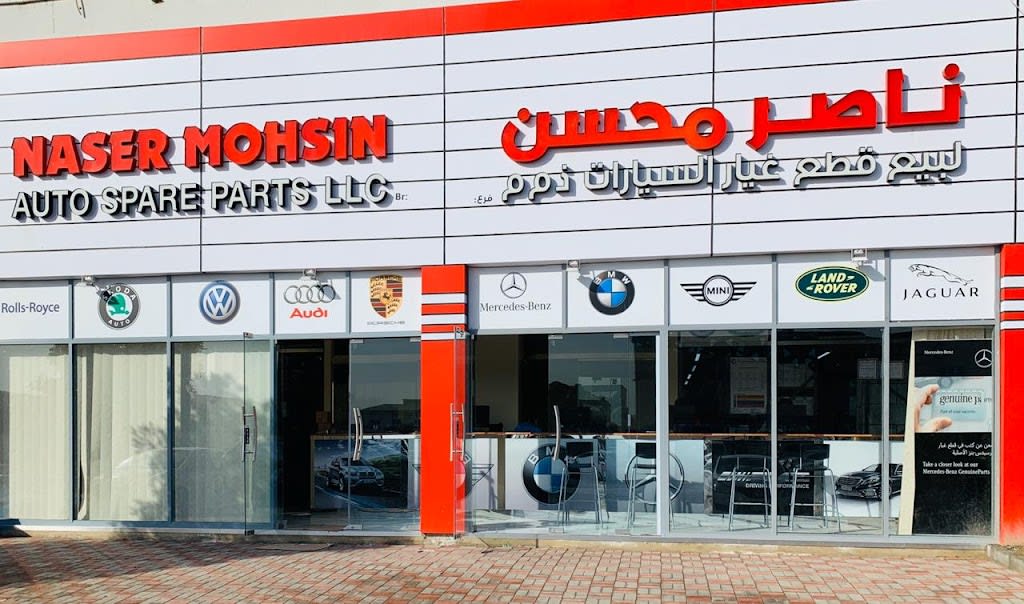
- Naser Mohsin Auto Spare PartsAbu Dhabi
Stocks tie rods, ball joints and control arms — genuine OEM, new parts. It carries Bosch, Febi Bilstein, Lemforder and Textar, matches parts to your VIN and delivers to Dubai, Abu Dhabi and Sharjah.
4.3 on Google from 151 reviews
Stocks tie rods, ball joints and control arms — genuine OEM, new parts. It carries Acdelco, Mopar and Amaron, matches parts to your VIN and delivers to Dubai, Abu Dhabi and Sharjah.
3.8 on Google from 4 reviews
Stocks tie rods, ball joints and control arms — genuine and aftermarket, new parts. It carries Firestone, Neoterra, Kunlun and Sailun and 4 more and delivers to Dubai, Abu Dhabi and Sharjah.
4.8 on Google from 19 reviews
Stocks tie rods, ball joints and control arms — genuine OEM, new parts. It carries KIA, Hyundai, GMC and Chevrolet and 4 more, matches parts to your VIN and delivers to Dubai, Sharjah and Abu Dhabi.
4.7 on Google from 7 reviews
Stocks tie rods, ball joints and control arms — aftermarket. It carries TAB and sells trade as well as retail.
4.9 on Google from 117 reviews
Stocks tie rods and ball joints — genuine OEM, new parts. It carries Energizer, matches parts to your VIN and delivers to Dubai, Abu Dhabi and Sharjah.
4.5 on Google from 10 reviews


Listings are compiled from each business’s own public information. If you run one of these shops and want the entry corrected or removed, email easycarpartsteam@gmail.com.
Still easier on a form? The request goes to the same matched UAE suppliers, free, with only the number of shops you choose able to contact you.
Open the request formKeep reading
555 — common questions
- Who makes 555 suspension parts?
- Sankei Industry Co., Ltd., a Japanese manufacturer founded in September 1960 and headquartered at Ritto in Shiga Prefecture. The 555 brand accounts for ninety-eight per cent of what the company supplies.
- Is 555 an OEM brand supplied to Toyota, Nissan and Honda?
- Not according to Sankei. Its own corporate profile describes the company as an aftermarket automotive parts manufacturer specialising in suspension and steering related parts, and we could find no Sankei statement naming any carmaker as a customer. The assembly-line claim appears widely in retail listings and wholesaler copy, none of which traces back to the manufacturer.
- Why do so many listings say Sankei OEM then?
- Because listing copy propagates. One seller writes a plausible line, others copy it, articles summarise the sellers and forums cite the articles, until a claim that never had a source has more citations than most true facts about the brand. It is not usually deliberate, and it is still not evidence.
- What does 555 actually make?
- Steering and suspension linkage, and nothing else. Tie rod ends, rack ends, arm shafts, idler arms, side rods, control arms, pitman arms, ball joints, stabilizer links and cross rods, running to more than two thousand items. It does not make dampers, springs, brakes or bearings.
- Does 555 have good, better and best ranges?
- No. It is a single-tier brand and Sankei publishes part families rather than a quality ladder. If a seller offers you a premium or higher-grade 555, that grading is theirs rather than the manufacturer's, and it should not be paid for as though it came from Japan.
- Are 555 parts made in Japan?
- Sankei is a Japanese company with a Japanese factory site, which it used for its 55th anniversary in 2015. Whether every part number is built there is not published, and the catalogue covers Korean applications as well as Japanese ones. We are not repeating the common advice about insisting on Japanese-built stock, because Sankei publishes no two-origin structure for anyone to insist on.
- How do I spot a counterfeit 555 part?
- Sankei publishes no counterfeit-identification guide that we could find, so this page gives you no test. The two tests that circulate, about greaseable joints and about country of origin, are forum material rather than the manufacturer's, and a confident but unverified test causes people to reject genuine parts as readily as fake ones.
- Does 555 have an authorised distributor in the UAE?
- Sankei names one authorised distributor in the Gulf and it is in Saudi Arabia, recorded in its own news around a Jeddah trade show. It names none in the United Arab Emirates. That does not mean the brand is unavailable here, and it does not mean any given seller lacks a relationship; it means the manufacturer does not publish one for this country.
- How do I know when a tie rod end or ball joint needs replacing?
- By symptoms rather than mileage. Wandering steering, an alignment that will not hold, tyre wear on one edge, or a knock over low-speed bumps are all worth having the linkage checked for. Free play in a loaded joint is treated in the trade as a failure in progress rather than a service item, because these parts hold and then stop holding rather than degrading gradually.
- Is 555 a good brand for Japanese cars in the UAE?
- It is a long-established Japanese specialist in exactly these parts, certified to ISO 9001 since 1999 and sold in more than 120 countries, and that is the honest extent of what the sources support. We are not going to rank it against other names, because no comparative test exists that we could cite and a league table we invented would be the least reliable thing on this page.
Ask a human · free · no account
Not sure the 555 part you found is the real one?
Send us the number on the box and the car — we'll tell you.
Free · usually a reply in minutes · no obligation
Where these facts came from
Checked against the manufacturer’s own published material on the dates below. Anything we could not source is named as unsourced on this page rather than left out.
- Sankei Industry — corporate profile and history, read through a search index because the site's certificate does not match its domain — read 2026-09-03
- Sankei Industry — product information, the 555 part families and item count — read 2026-09-03
- Sankei Industry — news, exhibiting at Jeddah with its authorised Saudi Arabian distributor — read 2026-09-03
- Sankei Industry — news, the 555 55th anniversary event at the factory site in Japan — read 2026-09-03
- Sankei Industry — news item covering 555 Korean products — read 2026-09-03